


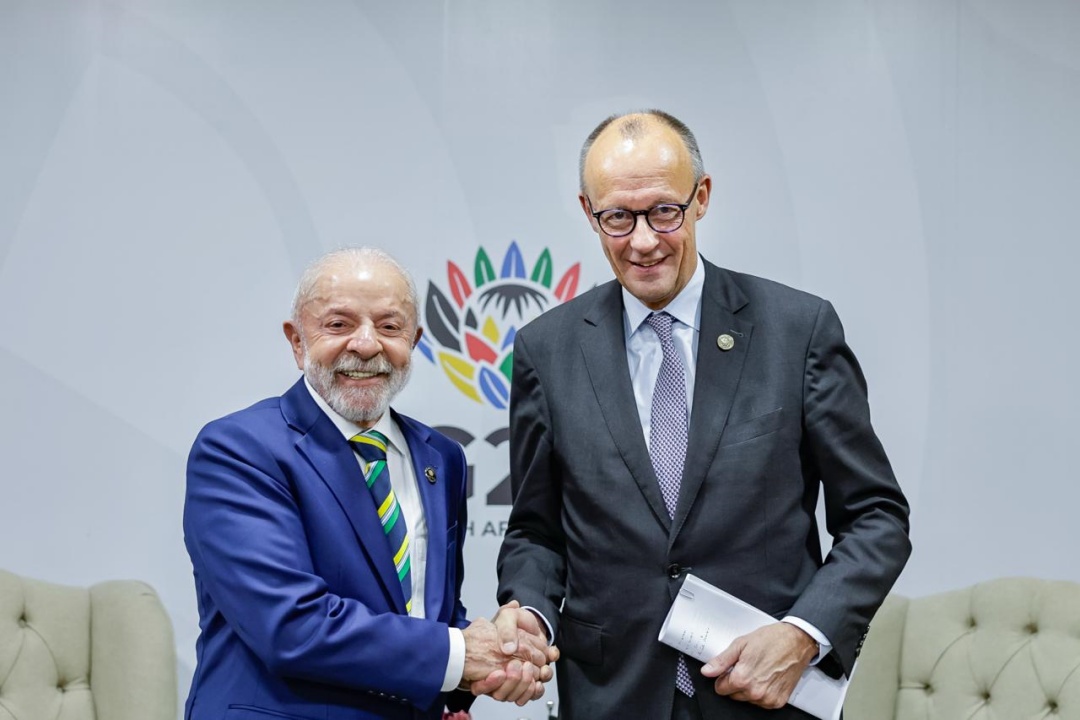
Germany and Brazil are expanding their cooperation and focusing on new joint projects, particularly in the raw materials and defense sectors. This is one outcome of talks held yesterday, Monday, in Hanover between German Chancellor Friedrich Merz and Brazilian President Luis Inácio Lula da Silva. Among other things, Brazil’s navy, which has already ordered four frigates from the German warship builder TKMS, will purchase four more. The negotiations took place during the Hanover Fair, where Brazil is this year’s guest of honor, and as part of the third German-Brazilian government consultations. A key reason for this intensified cooperation is the intense pressure being exerted on Brasilia by US President Donald Trump. He is demanding exclusive access to the country’s rare earth reserves and his administration is seeking to directly influence the Brazilian presidential election in October. Lula is seeking support against the US abuses, explicitly advocating for multilateralism and protesting: “Trump was not elected emperor of the world.”
Shield of the Americas
Lula’s visit to Berlin took place against a politically sensitive backdrop. The Trump administration has begun to split Latin America’s existing regional organizations—the Organization of American States (OAS) and the Community of Latin American and Caribbean States (CELAC)—and replace them with a new organization comprising only right-wing and far-right-leaning states: the Shield of the Americas. It currently has twelve member states, including the USA, Argentina under President Javier Milei, El Salvador under President Nayib Bukele, known for his inhumane prison policies, and Ecuador under President Daniel Noboa, the scion of a wealthy banana dynasty. Officially, the Shield of the Americas aims to combat drug cartels. This will primarily involve military action, similar to the Trump administration’s approach in the Caribbean, where US military forces have killed at least 180 people in 52 missile strikes against alleged or actual drug boats.[1] Observers suspect that, in the long term, the far-right alliance is also intended to contribute to Washington’s fight against China’s influence on the continent.[2] The three most populous countries – Brazil, Mexico, and Colombia – are currently governed by left-wing parties and are not members of the alliance.
Campaign support for Flávio Bolsonaro
This could, of course, change. Presidential elections will be held in Brazil in October. Whether Lula will run again is not yet officially certain. His opponent will be his eldest son, Flávio, since former President Jair Bolsonaro is imprisoned for his attempted coup in early 2023, and his son Eduardo, originally intended as his political successor, is charged with coercion of the judiciary and living in exile in the US.[3] Lula held a large lead over Flávio Bolsonaro in the polls for a long time, until the latter began to close the gap at the end of 2025. Now, Lula’s victory no longer seems certain. Trump is clearly backing Flávio Bolsonaro, who—like the entire Bolsonaro clan—is politically close to him. A few weeks ago, an influential US State Department official, Darren Beattie, attempted a PR-friendly visit to Jair Bolsonaro in prison and also to meet with Flávio—a thinly veiled attempt to boost his election campaign. The Lula government objected to the open interference in its country’s internal affairs and refused Beattie entry.[4] Trump had previously tried to blackmail the government into dropping the criminal proceedings against Jair Bolsonaro by imposing punitive tariffs – without success.
“Don’t constantly threaten war”
In light of the escalating conflict with Washington, Lula has repeatedly spoken out sharply against the policies of the Trump administration ahead of the start of the third German-Brazilian government consultations on Monday. Last week, in an interview with the magazine Der Spiegel, he stated: “Trump was not elected emperor of the world. He cannot constantly threaten other countries with war.”[5] The world is “turning into one giant war zone”; it therefore urgently needs to be “put right.” In an opinion piece for the daily newspaper Der Tagesspiegel, Lula declared: “I am convinced that multilateralism is the only option.” Unilateral action is unfortunately “gaining ground in international relations.”[6] Together with Germany, Brazil therefore wants to give multilateral policy renewed strength. At the opening of the Hannover Messe on Sunday, Lula judged the war waged by the US and Israel against Iran to be “madness.” It is unacceptable that around 2.7 trillion US dollars are now being spent worldwide on wars every year, while countless people continue to live in poverty or even suffer from hunger.[7] This must change urgently, demanded Brazil’s president.
Rare earth elements
To counterbalance the growing influence of the United States on Brazil’s important raw materials sector – in the spirit of a multilateral order – Lula proposed closer cooperation on mineral resources to German Chancellor Friedrich Merz on Monday. Brazil possesses large quantities of raw materials, including highly sought-after ones such as niobium, needed for the production of solar cells, and rare earth elements. A fierce competition has broken out, particularly for rare earth elements. Until now, these have been mined by the Brazilian company Serra Verde.[8] Until recently, Serra Verde had its rare earth elements processed in China. However, in exchange for a large loan from the US, it recently agreed to supply its rare earth elements only to the United States, or at most to its allies.[9] The consequences are not entirely clear, as the rights to allocate raw materials in Brazil lie with the government. The government is now pushing to relocate the processing of rare earth elements to Brazil in order to control larger parts of the value chains.[10] Against this background, Lula Merz has now offered that, in addition to US and Chinese companies, German companies could also participate.
Warships
Furthermore, Germany and Brazil are expanding their military and defense cooperation. As the German Ministry of Defense reports, Defense Minister Boris Pistorius and Brazilian Foreign Minister Mauro Vieira signed a memorandum of understanding in Hanover on Monday, which stipulates that Berlin and Brasília will “intensify their cooperation on various maritime, land-based, and air-based procurement projects.”[11] This is intended to encompass “the entire procurement process”: “from contract negotiations and training to the integration and operation of the systems.” In addition, both sides agreed on the delivery of four more frigates to the Brazilian Navy. Germany is not traditionally among the most important arms suppliers to the South American country, which has so far primarily procured its defense equipment from France, Italy, and the United States. However, in 2019, TKMS succeeded in securing a contract to deliver four MEKO A-100 frigates to Brazil. The ships are being built in Brazil – by the Águas Azuis consortium in Itajaí, a few hundred kilometers south of São Paulo, formed by TKMS and the Brazilian company Embraer. Águas Azuis is now slated to build four more frigates – a glimpse into the broader expansion of defense cooperation.
[1] Lazaro Gamio, Carol Rosenberg, Charlie Savage: Tracking US Military Killings in Boat Attacks. nytimes.com.
[2], [3] See The Subjugation of Latin America (II).
[4] Michael Pooler: Brazil blocks visit of Trump official to see jailed Jair Bolsonaro. ft.com March 14, 2026.
[5] Marian Blasberg, Jens Glüsing: “Trump was not elected emperor of the world.” spiegel.de 16.04.2026.
[6] Luis Inácio Lula da Silva: Brazil’s president focuses on cooperation. tagesspiegel.de 17.04.2026.
[7] Lula denounces the “madness” of the Iran war. tagesspiegel.de 20.04.2026.
[8] Ana Ionova, Ju Faddul: Brazil Hesitates as US Pushes Rare Earths Partnership. nytimes.com March 20, 2026.
[9] Camilla Hodgson, Michael Pooler: US secures rare earths supply as part of $565mn loan to Brazil mining group. ft.com April 1, 2026.
[10] Igor Patrick: Brazil demands rare earths be processed at home as US and China compete. scmp.com April 15, 2026.
[11] Germany and Brazil strengthen their defense policy partnership. bmvg.de 20.04.2026.
Previously published in German on German Foreign Policy here. Translation by UWI with AI support.