


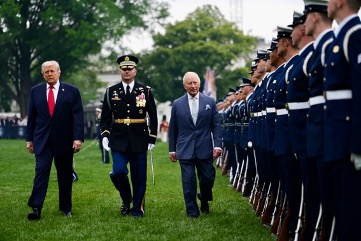
In this article, I aim to analyze the relationship between diplomatic conventions and symbolic politics in the interactions between Donald Trump, the 45th President of the United States, and Charles III, the head of the British monarchy.
In the discipline of international relations, the view that diplomatic gestures should be evaluated not merely as superficial practices of courtesy, but rather as critical instruments for the reconstruction of historical narratives and the indirect transmission of political messages, has become increasingly visible, especially with the rise of leader-centered diplomatic practices in the 21st century. In this context, statements attributed to Trump such as “you would be speaking German if it weren’t for America,” addressed to the King of England, constitute a striking example at the intersection of history and politics, regardless of their historical accuracy.
Indeed, the idea that the founding document of the United States— which declared its independence from the British Empire as a result of the American Revolutionary War—could, approximately two and a half centuries later, be presented as a diplomatic gift to the same monarchical tradition, produces a multilayered symbolic structure that embodies both historical irony and the transformation of modern diplomatic discourse. In this respect, when evaluated within an academic ethical framework, U.S.–U.K. relations during the Trump era can be interpreted as a period in which, on the one hand, the institutional continuity of the historically defined “special relationship” was preserved, while on the other hand, the hardening of diplomatic language, criticisms directed at multilateral norms, and the rise of leader-centered diplomatic practices contributed to a flexibilization of ethical standards in international relations. This demonstrates that relations between great powers should be assessed not only in terms of strategic interests, but also with regard to their level of adherence to normative principles.
Break from Empire: The American Revolution (1775–1783)
Tensions between the American colonies and Britain escalated in the mid-18th century, particularly over fiscal and administrative policies. Under the rule of King George III, Britain, seeking to offset the increasing debt burden following the Seven Years’ War, began to impose new taxes and regulations on the colonies. In this context, the issue of “taxation without representation” led to a serious crisis of legitimacy within the colonies.
The armed conflicts that began in 1775 quickly transformed into an open war of independence, and in 1776 the colonies declared their separation from Britain through the United States Declaration of Independence. This development represented not merely a colonial rebellion, but also an ideological rupture that signified a transformation in the understanding of sovereignty.
The most critical phase of the war emerged when the conflict assumed an international dimension. The support of European powers, particularly France, for the American side placed Britain in a difficult position on a global scale. This development transformed the crisis from a bilateral dispute into a component of great power rivalry.
With the Treaty of Paris in 1783, Britain was compelled to formally recognize the independence of the United States. This treaty marked not only the end of the war, but also the redefinition of British imperial dominance in the Atlantic world.
The Evolution of Anglo-American Relations
The United States Declaration of Independence, adopted in 1776, is not only a declaration of independence but also a theoretical manifesto of republican sovereignty against monarchical authority; through this document, the American colonies explicitly rejected the legitimacy of the British Crown, thereby creating one of the most significant turning points in the history of modern nation-states.
Nevertheless, from the late 19th century onward, particularly as a result of growing economic interdependence and the convergence of geopolitical interests, an increasingly deep cooperation emerged between the United States and the United Kingdom. This process evolved into a strategic alliance during World War II and ultimately gave rise to a lasting diplomatic paradigm known as the “special relationship.” Therefore, the contemporary re-circulation of the independence document within the context of a diplomatic gesture may be interpreted as a practice that simultaneously renders visible the tension between historical rupture and modern alliance.
Diplomatic Gift-Giving and Symbolic Politics
Diplomatic gift-giving, rather than belonging to the domain of hard power as envisaged by classical realism, constitutes a practice within the realm of soft power and symbolic communication, reflecting how states position themselves and the other. In this regard, it is observed that gifts selected by leaders often contain historical references, cultural codes, and ideological messages.
If the aforementioned claim were true—namely, that Donald Trump had indeed presented Charles III with the text of the United States Declaration of Independence bearing his own signature—this act could be interpreted as a personalized and theatrical gesture that transcends classical diplomatic norms; such behavior would signify the reflection of leaders’ individual political styles on diplomacy rather than interstate relations.
In modern political communication, the reinterpretation of historical texts and symbols is a frequently employed method, particularly in populist leadership styles; in this context, the selective reconstruction of the past is utilized to reinforce contemporary political messages.
From this perspective, the re-presentation of a foundational document such as the Declaration of Independence, detached from its original context and staged within a different diplomatic setting, should be understood not merely as a historical reference but also as a political performance; indeed, such gestures both reinforce national identity narratives and generate symbolic messages directed at the international public.
Conclusion
In conclusion, although the claim that Donald Trump presented Charles III with a framed and signed copy of the United States Declaration of Independence has not been historically verified, the analysis conducted through this claim provides an important theoretical contribution in demonstrating how historical symbols are reproduced and imbued with political meanings in modern diplomatic practice. In this context, it can be concluded that the relationship between the past and the present is not merely a matter of chronological continuity, but also a continuously reinterpreted field of narrative. Nevertheless, one undeniable reality is that Trump’s rude attitudes toward journalists who question him, his responses that verge on insult, and his arrogant behavior toward political figures remind us that the United States has a president who may commit yet another gaffe at any moment.
References
David Armitage, The Declaration of Independence: A Global History. Harvard University Press, 2007.
Joseph S. Nye Jr., Soft Power: The Means to Success in World Politics. PublicAffairs, 2004.
Eric Hobsbawm & Terence Ranger, The Invention of Tradition. Cambridge University Press, 1983.
Benedict Anderson, Imagined Communities. Verso, 1983.
John Lewis Gaddis, The Cold War: A New History. Penguin, 2005.