


By Dr. Ali Alsaç
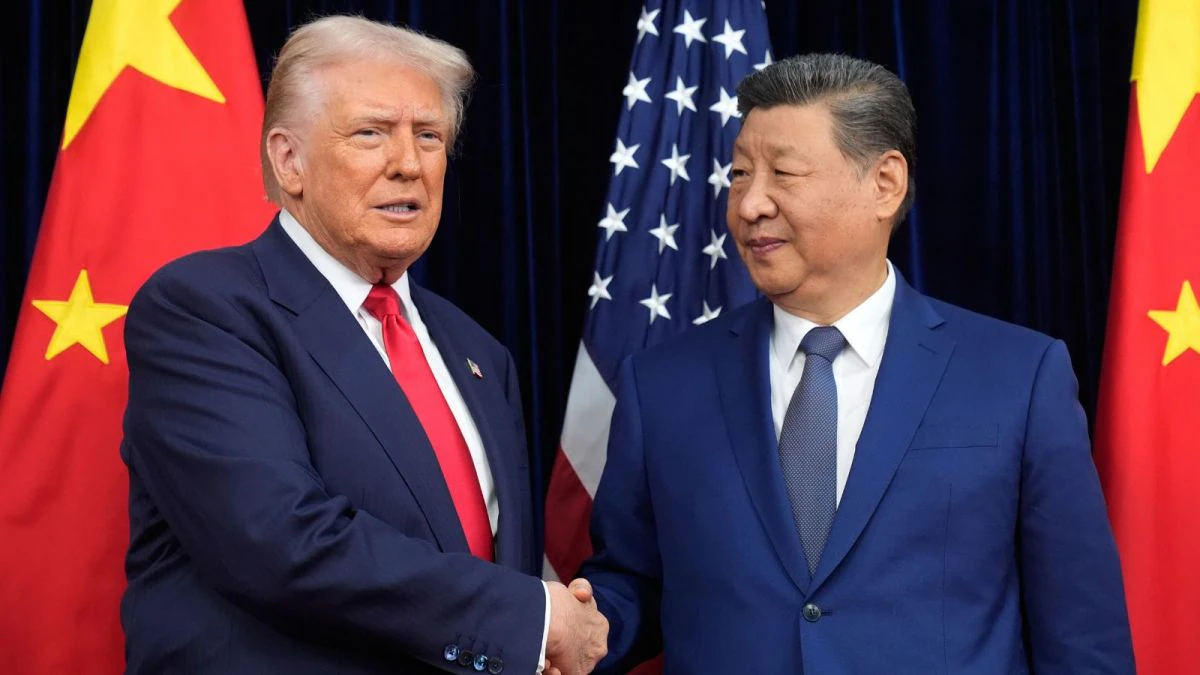
Donald Trump’s visit to Beijing on May 13–15, 2026, should be read not merely as a diplomatic contact, but as a stage showcasing the 21st century’s technological balance of power. It is no coincidence that Trump was accompanied by top-level representatives from the technology, finance, payment systems, aviation, and semiconductor sectors, including Elon Musk, Tim Cook, Jensen Huang, Larry Fink, David Solomon, Jane Fraser, Cristiano Amon, Sanjay Mehrotra, and Kelly Ortberg. The US delegation signified access to the Chinese market, protection of supply chains, easing of the chip export regime, and a renegotiation of American capital’s position vis-à-vis China.
However, the real significance of the visit lies in demonstrating that the competition between the US and China can no longer be explained solely through customs tariffs, trade deficits, or corporate profits. The new rivalry rests on three strategic pillars: AI computing power, advanced chips, and rare earth elements. These three areas are inseparable. AI requires chips to function; chip production needs rare earth elements, specialty metals, advanced lithography, and complex supply chains; and for all this infrastructure to operate, energy, data centers, engineering capacity, and state planning are necessary.
The US still possesses the world’s most powerful AI companies, an advanced GPU ecosystem, large pools of private capital, and cutting-edge model labs. By many metrics, American models still lead Chinese models; a Brookings assessment from April 2026 emphasizes that the US maintains overall performance superiority in frontier models, while China remains under pressure, particularly due to restrictions on accessing advanced chips. However, China’s superiority lies on a different plane. China treats AI not just as a digital service sold by companies, but as a matter of national infrastructure.
The future belongs to computing power; it is the key to successful resource planning!
Just as electricity was the fundamental input of the industrial age, computing power is becoming the fundamental input of the AI age.
This point is decisive for understanding today’s AI race. In China, computing power is no longer seen merely as a product of private cloud companies. Beijing plans computing capacity as a backbone of national development, alongside the electricity grid, railways, ports, logistics networks, 5G infrastructure, and data centers. The Chinese government’s computing infrastructure action plan, released in late 2023, aimed to establish an integrated computing power infrastructure by the end of 2025, increase the weight of national computing centers, and make this capacity more accessible and affordable.
By May 2026, discussions regarding China’s national computing power network have advanced even further. Beijing has begun to position computing power alongside basic infrastructure categories such as water, energy, transportation, and communications. The use of tokens is being framed as a measurable, priceable, distributable element that can be opened to the mass market, much like mobile data packages. This is an approach that takes AI out of the “chatbot” aesthetic and makes it a fundamental input for production, public services, research, and industry.
The US sells access to society; China builds capacity for society. In the West, AI is largely marketed as subscriptions, API access, private cloud packages, and company-scale efficiency applications. China, on the other hand, first establishes the infrastructure, then the scale, and then widespread application. Therefore, the real question is not which company makes the flashier demo. The real question is who can turn computing power into a public utility.
This difference also makes visible the civilization-scale distinction between the US and China. The American model relies on competition among capital markets, private tech giants, and global platform companies. The Chinese model progresses through state planning, infrastructure investment, regional development strategies, publicly supported data centers, and national industrial policy. A 2025 RAND assessment noted that China, with its National Integrated Computing Network, is trying to pool public and private data centers, and that state funds, local AI labs, and pilot zones support this ecosystem.
The US restricts, while China attacks with domestic production
The chip issue is the harshest front of this competition. The US aims to slow China’s model training capacity by restricting its access to advanced AI chips. The Trump administration repealed the Biden-era AI Diffusion Rule in May 2025; but simultaneously issued industry warnings regarding Chinese-made advanced processors and the use of American chips in training Chinese models. The permission granted at the end of 2025 for Nvidia H200 chips to be sold to China under certain conditions also shows Washington’s contradiction. The US wants to restrict China on one hand, while on the other, it wants to prevent Nvidia, AMD, Qualcomm, Apple, and other giants from completely disengaging from the Chinese market.
China, for its part, is using this pressure to strengthen its own semiconductor ecosystem. According to a November 2025 Reuters report, China issued a new directive encouraging the use of domestic AI chips in state-backed data centers, a move that opened space for domestic manufacturers like Huawei, Cambricon, MetaX, and Moore Threads. The new Zhenwu M890 AI chip introduced in May 2026 by Alibaba’s T-Head unit is another sign of China’s resolve to reduce its dependence on Nvidia. Alibaba has also announced a three-year, $53 billion investment plan for AI and cloud infrastructure.
Huawei’s recent announcements reinforce this trend. According to a Reuters report dated May 25, 2026, despite restrictions on access to advanced manufacturing equipment, Huawei announced a new chip design approach based on improving system-level efficiency and set a goal of a high-end chip equivalent to 1.4 nanometer density by 2031. This shows that China is not only trying to “catch up with the same technology,” but is also seeking alternative engineering paths to overcome restrictions.
Chinese dominance in rare earth mining
Rare earth elements are the decisive front of the struggle. On April 4, 2025, China added products related to samarium, gadolinium, terbium, dysprosium, lutetium, scandium, and yttrium to its export control list. This decision was seen as a response to Trump’s tariffs and created direct pressure on the defense industry, electronics, turbine blades, magnets, and semiconductor supply chains.
The International Energy Agency (IEA) also recorded this regulation as a significant development regarding critical mineral supply security. According to the IEA, the controls implemented by China in April 2025 subject the export of certain medium and heavy rare earth elements to a licensing mechanism.
This move is not merely a commercial decision. Rare earth elements are a fundamental input for a wide range of production areas, from defense and electric vehicles to wind turbines, semiconductors, magnets, and aviation engines. China has a decisive advantage in this field, not so much in mining but at a far more critical stage: processing and refining capacity. Therefore, the West’s dependence on China is not just about raw material supply, but at the level of high-value intermediate inputs.
The European Union’s preparation of joint stockpiling mechanisms for tungsten, rare earth elements, and gallium shows that the West sees this dependence as a strategic risk. China, for its part, is now openly turning this advantage into a technological bargaining chip.
The difference between corporate diplomacy and state diplomacy
In this context, the difference between Trump going to Beijing with CEOs and Putin going to Beijing with a delegation of state, energy, industry, finance, and regional development officials is striking. Putin’s visit to China on May 19–20, 2026, was accompanied by five deputy prime ministers, eight ministers, regional governors, and representatives of major state-owned companies. Approximately forty agreements in trade, investment, energy, Far East development, education, media, and technology were discussed during the meetings.
If this difference is to be expressed succinctly, the US delegation was in Beijing mostly to “protect corporate interests,” while the Russian delegation was there to “establish inter-state value chains.” On the US side of the table were Tesla’s Chinese market, Apple’s production chain, Nvidia’s export license, Wall Street’s capital flows, and Boeing’s aircraft sales. On Russia’s side were energy pipelines, nuclear technology, Asia-Far East development, cross-border logistics, the academic year, media cooperation, and state-owned companies. Of course, there is asymmetry in the Russia-China relationship, but the visit nonetheless demonstrates the difference between Atlantic-centered corporate diplomacy and Eurasia-centered state diplomacy.
The symbolic meaning of Jiuzhang 4.0
China’s progress in the quantum field should also be added to the same strategic framework. According to an announcement by the Chinese Academy of Sciences, the programmable photonic quantum computing prototype named Jiuzhang 4.0 set a new record in optical quantum information technology, with the study published in *Nature*. As reported by CGTN, the system generated the most complex data sample in 25 microseconds, while it was stated that the world’s most powerful classical supercomputer would need more than 10⁴² years to compute the same result.
It would be technically inaccurate to directly link such quantum achievements to today’s generative AI applications. Jiuzhang 4.0 is not a general-purpose AI machine. However, its symbolic and strategic meaning is immense. China treats AI, quantum, 5G/6G, supercomputing, energy infrastructure, and chip design not as separate fields, but as components of a long-term technological sovereignty architecture.
Platform capitalism vs. infrastructure civilization
At the heart of the US-China competition is not just the question “which country produces better models?” The US’s advantage lies in global software platforms supported by model quality, GPU ecosystem, capital markets, and research laboratories. China’s advantage lies in infrastructure scaling, state guidance, industrial policy, supply chain depth, superiority in rare earths, research universities, and the capacity to turn technological restrictions into national mobilization.
Today, US chip restrictions on China may slow China down in the short term. But in the long term, these restrictions are accelerating China’s orientation toward domestic chips, domestic software stacks, open-source model ecosystems, and national computing infrastructure. A 2026 study by the US.-China Economic and Security Review Commission also emphasizes that China’s open-source AI strategy has become a tool for consolidating industrial superiority.
Trump’s China visit also exposed the limits of the US strategy to contain China. Washington wants to technologically restrict China, but American companies cannot give up the Chinese market, Chinese production networks, or China’s engineering capacity. Beijing, meanwhile, draws US companies to the bargaining table, uses critical minerals as strategic leverage, transforms the chip embargo into a domestic industrial drive, and elevates AI to the level of national infrastructure.
The defining divide of the new era emerges here. On one side, there is platform capitalism, subscription economy, and corporate-centered technology diplomacy. On the other side, there is infrastructure civilization, planned capacity building, and the pursuit of state-directed technological sovereignty. The US remains technologically strong; but China’s rise cannot be measured by model performance alone. China’s real claim is to make AI a part of society’s productive foundation, just like electricity, railways, ports, and 5G.
Whoever turns computing power into a public utility will win
When tokens become as widespread as mobile data, AI will cease to be a luxury developer service and will become the common infrastructure of industry, education, healthcare, public administration, logistics, and scientific research. When that day comes, the winner of the race will be determined not by the flashiest chatbot, but by the country that builds the deepest infrastructure.
Therefore, Trump’s China visit is not an end, but a sign of a new era. While the US tries to restrict China’s access, China is growing its own capacity. US companies seek markets; China builds infrastructure. The US debates whether to sell chips; China turns the chip embargo into domestic production mobilization. The US tries to secure its rare earth supply; China turns its superiority in this field into a strategic bargaining tool.
In the AI age, sovereignty will no longer be measured solely by borders, armies, and currencies. Sovereignty will be measured by possessing computing power, energy, chips, rare earth elements, data centers, engineering talent, and the statecraft to integrate them. China appears to have grasped this reality early. The US, meanwhile, is still trying to resolve the contradiction between the global superiority of its own companies and the geopolitical restrictions imposed by its state. This is precisely the essence of the new technological geopolitics.