


By Mehmet Enes Beşer
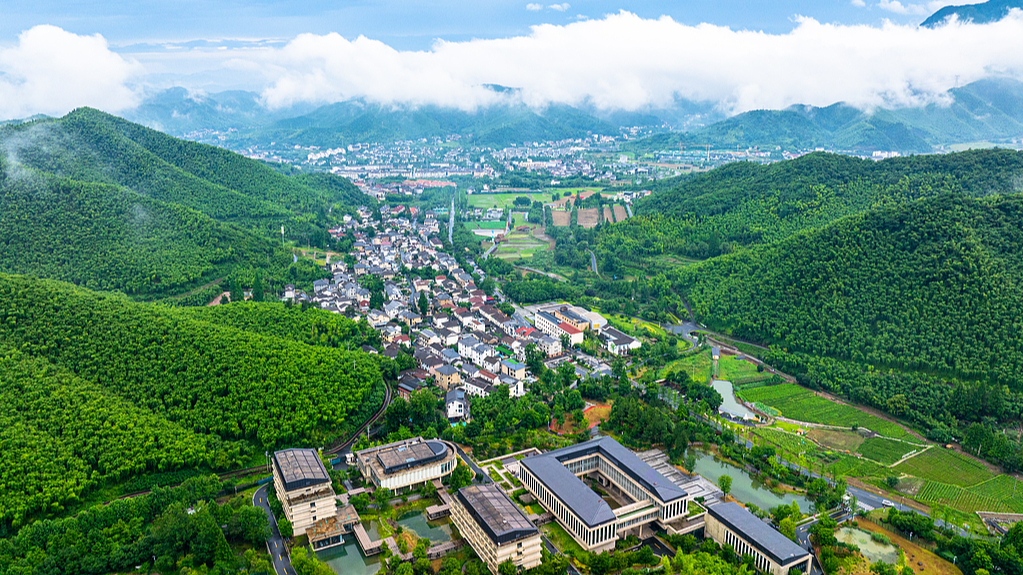
President Xi Jinping first came up with the theory of “Two Mountains,” where it believes that “lucid waters and lush mountains are invaluable assets,” in 2005. A declaration that would revolutionize economic thinking by stating that environmental protection is not the antithesis of development but an integral part of it. This philosophy has subsequently been turned into a pillar of China’s domestic green modernization strategy and a soft-power narrative in its foreign green diplomacy, particularly in the Global South. Southeast Asia, where climate danger is urgent and economic aspirations are urgent, has heard the Two Mountains policy ring out—but with significant reinterpretation and localization.
The reason why the Two Mountains doctrine has become so popular in Southeast Asia is that it is functionally and morally straightforward. It offers a sloganized integration of sustainability: economy and nature are not trade-offs but complementary. For countries facing the double challenge of environmental degradation and growth imperatives, this model appears to offer an escape from the dichotomy. Southeast Asian states, however, although receptive to its ethos, have not adopted it in its entirety. Instead, they have tailored it to their respective developmental trajectories, institutional arrangements, and domestic political economies.
In Vietnam, for example, the Two Mountains approach is reconcilable with the nation’s attempt to decouple economic growth from natural degradation. Instead of adopting China’s top-down control strategy, however, Vietnam has integrated green growth goals into market reform and international coordination mechanisms. The Vietnamese state, supported by international donors as well as the private sector, has centered on renewables, circular economy, and legal codification-based environmental management. The definition of “green assets” here is not just nature to be saved, but rather industries to be built—such as clean energy, ecotourism, and green farming.
Indonesia’s variation differs. Faced with deforestation, peatland loss, and carbon-extracting polluting industries, Jakarta answered with a “green economy” approach that resonates with the Two Mountains thinking but accounts for the national political spheres. President Joko Widodo’s government talks of weighing environmental conservation against employment and economic fairness, invoking local wisdom and Islamic environmental ethics in the process. The Nusantara new capital project, for example, is marketed as a “forest city,” a move to balance urbanization with ecological integrity. But many feel that such reframing merely covers the business continuation of extractive approaches under a new environmental vocabulary. Thus while Indonesia formally subscribes to the idea that nature is an economic good, the policies that accompany it are in dispute.
In Malaysia, the Two Mountains discourse resonates loudest at the subnational level, with Sabah and Sarawak introducing their own green economy master plans, often backed by international partners rather than Beijing. The lexicon of natural capital, biodiversity economy, and carbon credits emulates the initial Chinese framing but points towards resource federalism and indigenous rights—a reflection of Malaysia’s multi-faceted governance system and multi-racial society.
Cambodia and Laos, two recipients of huge Chinese investment, are more likely to invoke the Two Mountains theory more overtly in policy speeches and bilateral projects. But here, the concept risks being performatively invoked, being summoned more to woo Chinese investment and diplomatic backing than to drive actual environmental action. Where poor environmental regulation is coupled with restrictions on civil society, the rhetorical force of the theory can serve to hide environmental degradation from projects such as dam construction or forest clearing through Chinese-financed development.
Regionally, ASEAN has gone cautiously in mainstreaming elements of the Two Mountains approach into its narrative of sustainable development. The ASEAN Community Vision 2025 and the ASEAN State of Climate Change Report are both congruent in underscoring the economic worth of ecosystem services and the significance of environmental integrity for resilience and competitiveness. ASEAN’s nature as a consensus-oriented body, though, perceives such mainstreaming as general and non-binding—more a harmonization of principle than policy.
It is also worth noting that while the Two Mountains theory is framed as global, it also has a Chinese governance logic appended to it: a technocratic, centralized government managing development by policy planning and environment enforcement through surveillance. Southeast Asian governments, by contrast, which consist of numerous of them being democratic or hybrid regimes, must deal with public accountability, election cycles, and institutional fragmentation. The transfer of the Two Mountains concept then requires not merely cross-language translation but cross-paradigm governance.
Conclusion
China’s Two Mountains theory has been a useful conceptual anchor for reconsidering environmental sustainability as an economic imperative in Southeast Asia. But it has not been exported as a strict blueprint. Instead, Southeast Asian countries have selectively adopted, localized, and even reinterpreted the theory to fit their national goals and constraints.
This localized take-up is reflective of the area’s pragmatic regional governance—melding rhetorical sympathy with Beijing’s developmentalism along with seeking diversified and context-fitted strategies. The future for green transformation throughout Southeast Asia is likely to increasingly depend less upon adherence to purchased theories and increasingly upon how states can balance eco-concern with inclusive development. In this exercise, the Two Mountains doctrine will still inspire—local politics, and not foreign slogans, will determine what happens on the ground.