


By Adem Kılıç, Political Scientist
When discussing a U.S. ground operation in Hormuz, it would be misleading to view the issue solely through the lens of military capability.
For the true determining factors are the constraints imposed by geography, Iran’s war doctrine, and the tension created by the interplay of these two with the U.S.’s global and Israel’s regional positions.
Washington, which speaks of absolute military superiority on paper, enters a completely different equation the moment it hits the ground and will realize that not only can it not trigger the uprisings within Iran—its Plan A—but also that the Strait of Hormuz is not, in the classical sense, an area to be “conquered.”
Just 23 days ago, Trump was pleased that NATO was in control and that the Gulf countries in the region were under the U.S. security umbrella, and the Strait of Hormuz was functioning to meet the world’s energy needs.
However, at this point, all these issues have become problematic for the U.S., and for Trump, returning to the conditions of 23 days ago is now a victory.
So, will Trump attack the Strait of Hormuz to achieve this?
Given all the realities I’ve outlined, creating a narrative of victory for Trump now appears to hinge solely on reopening the Strait of Hormuz.
In such a scenario, the U.S.’s first reflex would be to “soften up” the area around the Strait of Hormuz using air and naval power.
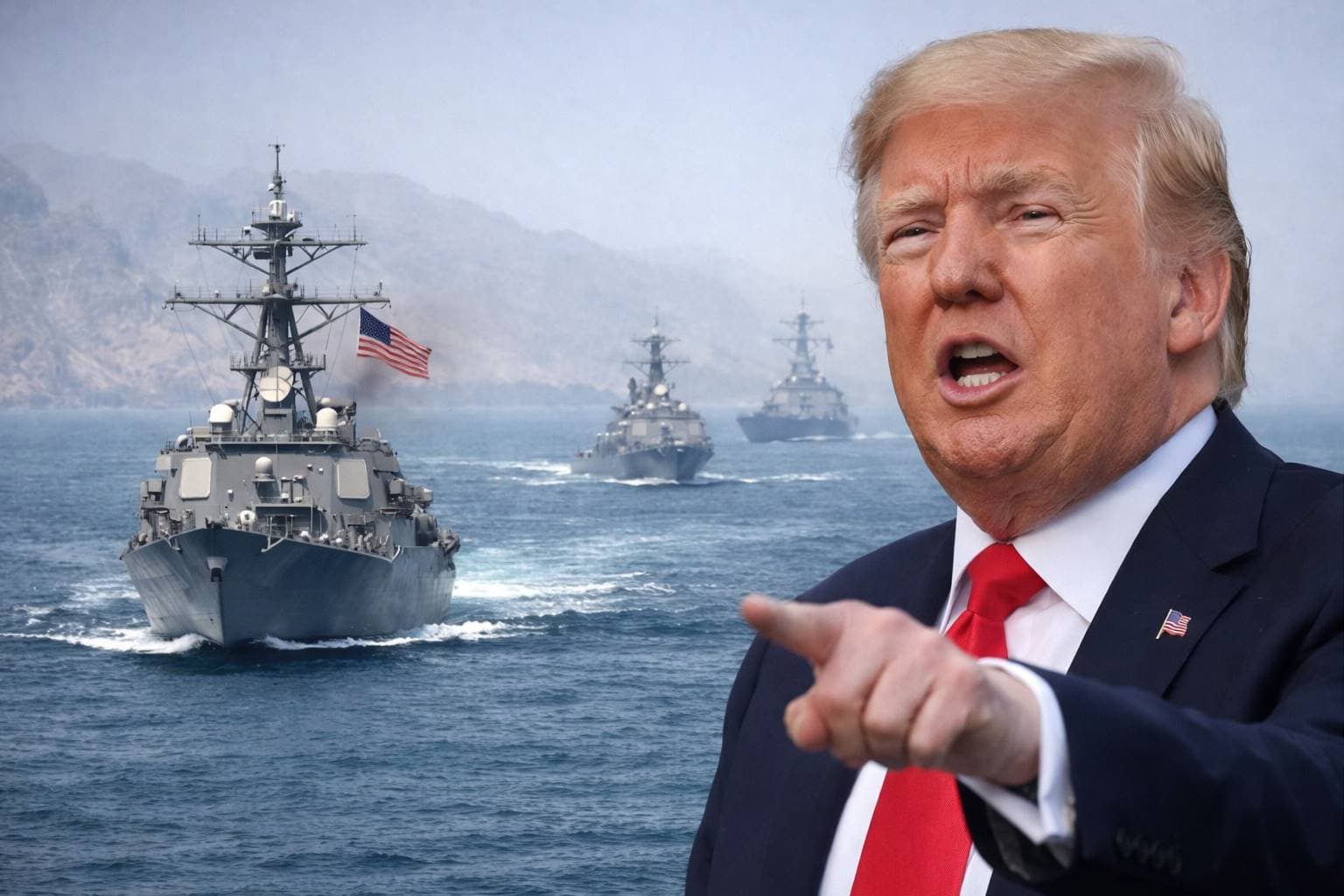
Aircraft carriers, long-range bombers, and cruise missiles will target Iran’s coastal radar networks, missile batteries, and command centers—such as those in Bandar Abbas—and then the amphibious force, which was reportedly dispatched from Japan last week, will be deployed.
At first glance, this phase might seem to favor Washington. Since the U.S. holds air superiority, Iran’s fixed infrastructure surrounding the strait would suffer a severe blow. However, this could turn out to be the most deceptive phase of the war.
Iran’s true capabilities lie not in fixed systems but in mobile and concealable assets—mobile missile platforms dispersed across mountainous terrain, underground tunnels, and many small-scale drones—which will turn the U.S.’s long-term deployment strategy in the region into utter chaos.
In other words, the U.S. can strike the battlefield but cannot control it.
In other words, the real breaking point emerges the moment ground contact begins, and even a limited U.S. amphibious landing—such as attempting to establish a foothold around Bandar Abbas or at energy choke points like Kharg Island—would completely change the rules of the game.
An amphibious landing supported by naval firepower may appear successful at first. However, this success begins to unravel as soon as it faces the test of sustainability.
Because every unit the U.S. deploys to the ground becomes a target within a narrow 33-kilometer area along a 150–160-kilometer strip. Iran’s doctrine, however, is precisely designed for this moment; rather than engaging in direct frontal combat, it transforms this narrow area into a Vietnam for U.S. forces through constant attrition.
Anti-ship missiles fired from the coast, swarms of kamikaze drones, low-speed boats with minimal radar signatures, and most importantly, sea mines, could inflict massive casualties on the U.S.
On the other hand, the impact of even a single mine in a narrow waterway like the Strait of Hormuz would have not only military but also global economic consequences. When a tanker is hit, the issue ceases to be merely a U.S.-Iran war and transforms into a global energy crisis.
This further narrows the U.S.’s room to maneuver, not only militarily but also politically.
This is precisely the area where the U.S. has historically struggled. While logistical support in Iraq and Afghanistan was provided via thousands of kilometers of land routes, in the Strait of Hormuz—where operations are entirely dependent on the sea—Trump could find himself in a far more untenable position.
It is precisely at this stage that the Gulf states could step in. But not in the way one might expect.
The U.S. wants to share the costs; it demands bases, logistical support, and financial contributions. However, just as has been the case for the past 23 days, the Gulf capitals continue to avoid direct involvement in the conflict, creating an asymmetrical situation.
Conclusion
This scenario is not merely a hypothetical scenario but rather a preview of what will unfold based on the realities on the ground.
In other words, this development will not be a sudden military collapse, but rather a slow, costly, and grinding process.
To interpret this scenario correctly, the following distinction must also be made. The U.S. may not lose a war, but it will lose its strategic superiority. A stalemate in the Strait of Hormuz would produce precisely such an outcome.
Ultimately, the Strait of Hormuz may become not just a stage for a show of force for the U.S., but a test of strategic patience, presenting the world with a new reality that calls into question America’s global supremacy.