


By Orçun Göktürk, from Beijing, China
The world’s attention was focused on U.S. President Trump’s visit to Beijing on May 13-15. While some commentators argued that a new phase of ceasefire had begun in US-China competition, others focused on Washington’s attempt to seek Beijing’s assistance in overcoming its difficulties stemming from the war against Iran and the crisis in the Strait of Hormuz.
So how did Trump’s visit to China, his meeting with Xi, trade issues, Iran, Taiwan, and related matters resonate within Chinese public opinion? Let us take a closer look.
Calmness and warnings simultaneously highlighted in state media
The Communist Party of China dominance over state and private media in China is well known. Nevertheless, outlets such as the Hong Kong-based South China Morning Post (SCMP), owned by Alibaba Group and operating somewhat outside the direct party line, also exist.
In the People’s Daily, the CPC’s official newspaper, and its English-language counterpart Global Times, two themes stood out both before and after Trump’s visit: “mutual respect” and “stability.” For a long time, China has argued that relations with the United States should not be a “zero-sum game,” but rather a form of “manageable competition.” The emphasis on “stability” reflects the idea that U.S.-China relations are broader and longer-term than Trump’s personality and unpredictability. From Beijing’s perspective, the fundamental issue is that China’s rise is perceived by the United States as a strategic threat, and this forms the core basis of the conflict.
For this reason, Chinese media often portrayed Trump as a product of the internal contradictions of the American system. While trade wars, technology embargoes, and pressure policies centered on Taiwan were criticized, Trump’s “America First” line was presented as one of the symptoms of declining U.S. hegemony. Chinese commentators frequently argued that behind Trump’s aggressive rhetoric lay Washington’s fear of losing its economic superiority.
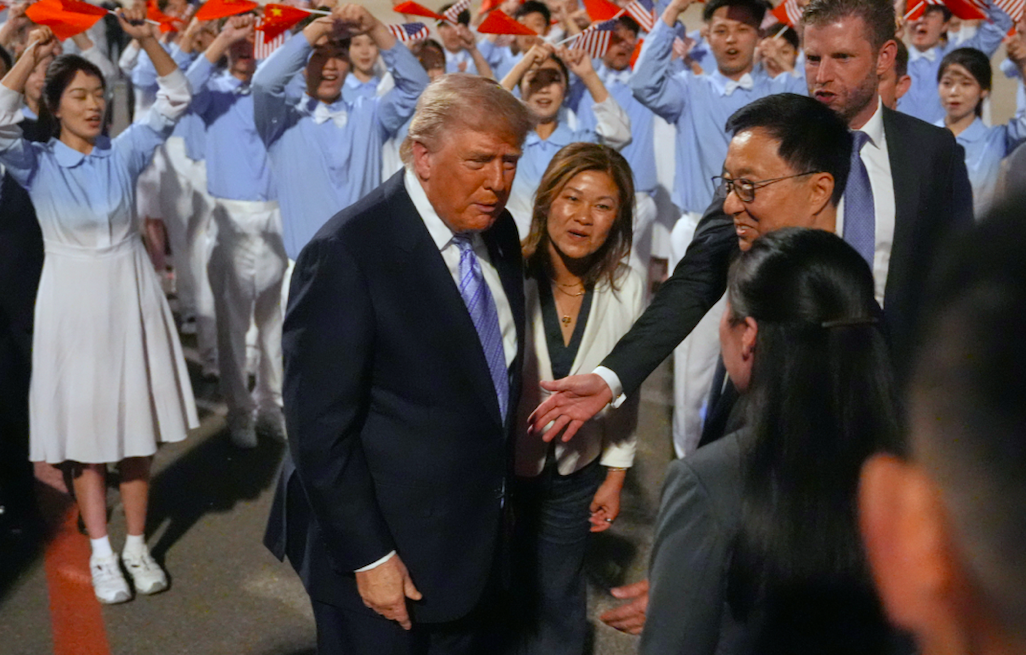
At the same time, it did not go unnoticed among Chinese observers that Trump behaved quite differently during this visit compared to his trips to other countries, displaying a more statesmanlike attitude. SCMP editor Chow Chung-yan summarized the situation as follows:
“The 79-year-old president held two meetings with Chinese President Xi Jinping in just 43 hours, attended a state banquet, walked through the Temple of Heaven in the scorching heat, and was hosted in Zhongnanhai (the heart of the Chinese state, where Xi’s private office and residence are located) in places that few world leaders ever have the chance to see. Trump showed no signs of fatigue from the long flight and appeared cheerful throughout, warmly shaking hands with everyone he encountered and looking genuinely happy. In Beijing, he temporarily set aside the trademark antics he often uses to surprise other world leaders, displaying his best behavior. He followed protocol, spoke like a true diplomat, and, despite being known for avoiding alcohol, even raised a glass of champagne with his Chinese hosts.”
Trump’s image on social media
Western social media and communication platforms are banned in China. Instead of Facebook, X, Instagram, WhatsApp, and YouTube, people use Chinese equivalents such as Weibo, Douyin (TikTok), WeChat, Youku, and Xiaohongshu (“Little Red Book”) to share articles, opinions, and videos. It should also be noted that since the 1990s, a growing fascination with the West has emerged among segments of the Chinese urban bourgeoisie and younger generations. Within this later-acquired liberal worldview, Trump naturally does not fit comfortably.
For this reason, Chinese social media both mocks Trump and, at the same time, includes many who describe him as a “chaotic but honest leader.” Trump’s refusal to hide behind the rhetoric of classical American liberalism and his direct embrace of power politics has, in a sense, divided Chinese public opinion as well. Yet for many nationalist-minded Chinese, the fact that “America’s attitude toward China has become visibly obvious” may serve as a wake-up call for those within China who sympathize with the United States either through trade ties or through cultural hegemony.
At the same time, a significant group — including many young people — believes that Trump’s trade wars, chip embargoes, and technological restrictions have actually accelerated China’s drive for technological and industrial self-sufficiency. The phrase frequently used in China, “turn crisis into opportunity,” was repeatedly voiced across social media throughout Trump’s visit.
The Thucydides Trap, the Warring States, and Mozi
Xi Jinping’s remark to Trump that “the Thucydides Trap is not inevitable in our relations” was widely discussed in China. Xi was clearly sending a message both to the United States and to the Chinese people. “China’s rise may be inevitable, but it does not necessarily have to lead to war.” In other words, China was calling on the United States to avoid historical determinism.
Xi’s reference to the Thucydides Trap also conveyed a message to the domestic audience: “We are engaged in a long-term struggle with the United States. Technology, energy, semiconductors, maritime trade routes, the Taiwan issue… In all these areas, the great rejuvenation of the Chinese nation is the key factor in this long-term competition.”
Xi’s emphasis during his meeting with Trump also prompted many Chinese academics to revisit the famous Chinese philosopher Mozi and his school of thought, Mohism. Living during the Warring States Period, Mozi was one of the strongest opponents of aggressive warfare in Chinese intellectual history. Unlike the Confucian hierarchical tradition, Mozi advocated “universal love” and “mutual benefit.” In his view, aggressive war was not only immoral but economically destructive as well. The oppression of weaker states by stronger ones would produce chaos rather than order.
Mozi’s ideas are once again attracting attention within international relations theory today because his approach offers an alternative to realist power politics. By invoking the Thucydides Trap — one of the foundational concepts associated with modern realism, which still dominates International Relations — Xi was also implicitly presenting an alternative framework. While realism assumes that security competition and conflict are inevitable, Mozi argued that states could develop cooperation based on shared interests. In this sense, Mozi’s ideas are regarded as one of the historical roots of the “win-win” and “cooperation” discourse that China promotes today.
Where are U.S.-China relations heading?
One Chinese commentator made a particularly striking remark: “If an alien had visited the world this week, they would probably have interpreted the meeting between Trump and his delegation and their Chinese counterparts not as a meeting between two rival superpowers, but between two allies.”
Of course, within the framework of U.S.-China rivalry, periods of compromise, breathing space, retreat, and renewed confrontation are all intertwined. In the coming period, Beijing-Washington relations still contain major uncertainties and potential traps, especially concerning how the United States will approach the Taiwan issue.
Following the visit, there is greater optimism within Chinese public opinion, along with comments suggesting that “Trump has come to better understand the limits of his empire.” Whether the Trump-Xi meeting and the search for a new phase of accommodation between the two countries will ultimately resemble Xi’s proposition that “we can avoid the Thucydides Trap” remains uncertain. Yet it is equally clear that the American state — which earlier this year brazenly abducted Maduro and launched war against Tehran through assassinations targeting senior political and military figures, including Iran’s supreme leader — has no genuine philosophy of “peaceful coexistence” in its vocabulary.
It is no coincidence that power and conflict lie at the very foundation of Western International Relations theory. Imperialism ultimately understands only power and resistance. China, however, is pursuing a different path and theorizing this practice. For years, Beijing has attempted to construct a distinct synthesis between classical Western realism and its own historical experience. On one side stands the logic of inevitable power conflict described by Thucydides; on the other stands the perspective of Chinese thinkers such as Mozi, who argued that “aggressive war corrupts the state.”
Naturally, nobody within the Chinese party-state leadership approaches the situation with romantic optimism. The increasing tendency of the United States to resort to greater coercion in order to preserve its declining hegemony weakens China’s dream of a “world without conflict.” Nevertheless, both the United States and Trump are aware that American hegemony is now confronting, for the first time, an alternative that is powerful economically, technologically, and civilizationally. Beijing believes that time is on its side. The struggle between Washington’s increasingly aggressive, power-oriented policies and Beijing’s strategic patience continues along a new axis.