


By Adem Kılıç, Political Scientist
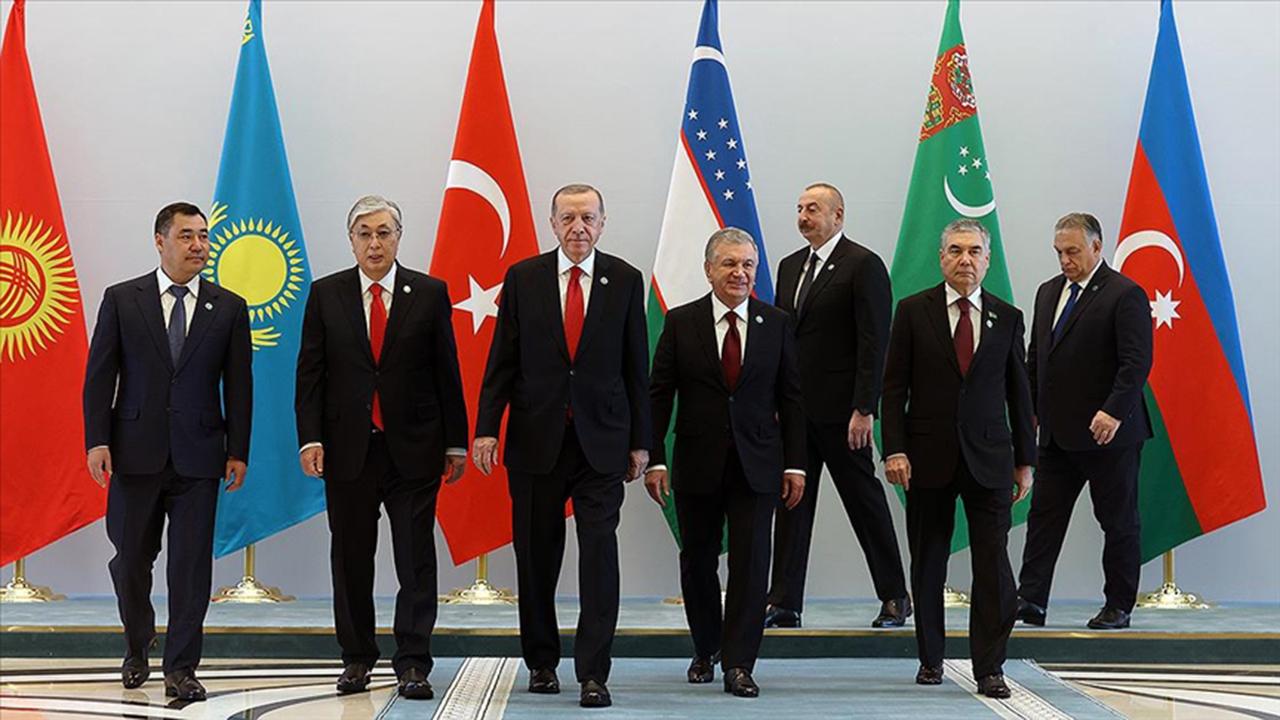
President Recep Tayyip Erdoğan’s recent visits to Central Asia and his diplomatic initiatives centered on the Organization of Turkic States have gone down in history as one of the most notable pillars of the multi-layered foreign policy strategy Türkiye has shaped in recent years.
In particular, the defense, energy, logistics, and technology-centered relationships developed with Kazakhstan, Uzbekistan, and other Turkic republics have moved beyond the general framework defined for decades—a process that could previously be interpreted solely within the context of cultural rapprochement. With these moves, Türkiye has now emerged as one of the new geopolitical powers rising at the center of global power competition.
At the current juncture, Türkiye’s Central Asian outreach is being analyzed in conjunction with shifting Central Asian balances following the Russia-Ukraine war, China’s Belt and Road Initiative, the West’s quest for energy security, and its growing dependence on the Middle Corridor.
For this reason, President Erdoğan’s recent visits should be evaluated not merely as diplomatic engagements but also as an initiative to shape the power architecture of the new era.
A New Axis in the Defense Industry
Throughout this entire process of advancement, one of Türkiye’s most notable areas of growth in Central Asia has undoubtedly been the defense industry.
In particular, the growing interest in systems like the Bayraktar TB2, Akıncı, ANKA, and the KAAN project—as well as other uniquely developed systems increasingly produced with full independence—in the Turkic republics has significantly enhanced Türkiye’s strategic influence in the region.
Kazakhstan’s move toward joint UAV production projects with Türkiye, Uzbekistan’s efforts to procure Turkish defense systems, and Kyrgyzstan’s growing alignment with Türkiye in the security sector have demonstrated that the Turkic States Organization has evolved beyond being merely a cultural platform and is increasingly emerging as a global balancing force.
These developments have shown that Türkiye is no longer pursuing an approach of merely serving as a “military base” in the traditional sense but is instead building a more sustainable model based on technology transfer, joint production, and fostering defense interdependence.
The successes achieved by Turkish defense industry products on the battlefield have undoubtedly enhanced Türkiye’s prestige in the region.
The Strategic Rise of the Middle Corridor
One of the key topics at the center of President Erdoğan’s recent visits to Central Asia was transportation and energy corridors. Indeed, Türkiye is moving toward the goal of becoming the main hub of the “Middle Corridor” along the trade route stretching from China to Europe.
The fact that the northern route passing through Russia has become risky due to the war in Ukraine has increased the importance of routes passing through the Caspian Sea. For this reason, the route through Kazakhstan, Azerbaijan, Georgia, and Türkiye is now viewed not only as an economic but also as a geopolitical corridor.
On the other hand, Türkiye’s efforts to integrate ports, railways, logistics, and customs with Turkic states are positioning Türkiye as a strategic hub between Europe and Asia.
In this process, Türkiye’s goal is defined not merely as being a transit country, but also as becoming an energy distribution hub, a logistics production base, and a control point for the regional trade network.
The Balance Between Russia and China
One of the most sensitive aspects of Türkiye’s Central Asia initiative is its policy of maintaining a balance with Russia and China.
Rather than pursuing a directly confrontational strategy, Türkiye is effectively leveraging diplomatic finesse and its leadership role within the Turkic world, carefully assessing how this balance can yield much broader strategic outcomes.
While Russia closely monitors Türkiye’s growing influence, Türkiye’s other moves—driven by its ongoing, multi-layered initiatives in energy, Syria, the Black Sea, and defense—are also being closely tracked by all Western actors, including the U.S. and NATO.
China, meanwhile, views Türkiye’s Middle Corridor vision as indispensable.
Organization of Turkic States
The Organization of Turkic States is now moving away from the purely symbolic structure it had when first established.
Indeed, through steps taken in recent years in the areas of economy, defense, digitalization, energy, and transportation, the organization has increasingly transformed into a more institutional and impactful structure.
In particular, defense industry partnerships, joint alphabet initiatives, educational projects, and trade integration clearly demonstrate that the organization has now entered a deeper phase of unity.
Conclusion:
President Erdoğan’s Central Asia initiative is taking its place in history as a key component of Türkiye’s “multipolar world” strategy developed in recent years, and Türkiye is now completely shedding the image of a country that operates solely within a Western-aligned security architecture.
Türkiye, operating within a broad sphere of influence stretching from the Black Sea to Africa, from the Gulf to the Caucasus, and now to Central Asia, is emerging as one of the most important actors in the reshaping global order.
At this juncture, the lasting impact Türkiye establishes here is producing decisive outcomes not only for the Turkic world but also regarding the balance of power along the Europe-China-Russia axis.
President Erdoğan’s recent visits to Central Asia and the diplomacy of the Organization of Turkic States also emerge as the on-the-ground reflection of this major geopolitical shift.