


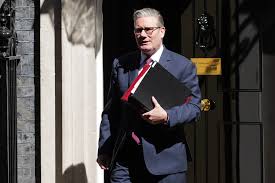
In the local and regional elections held across the UK on 7 May 2026, British Prime Minister Keir Starmer and his ruling Labour Party have suffered heavy losses. Reform UK has made big gains at the expense of Labour.
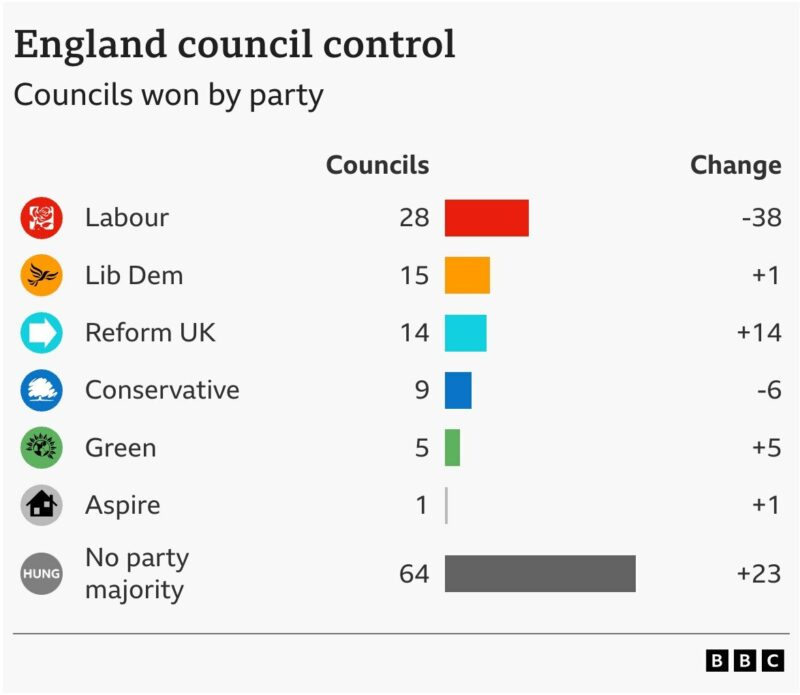
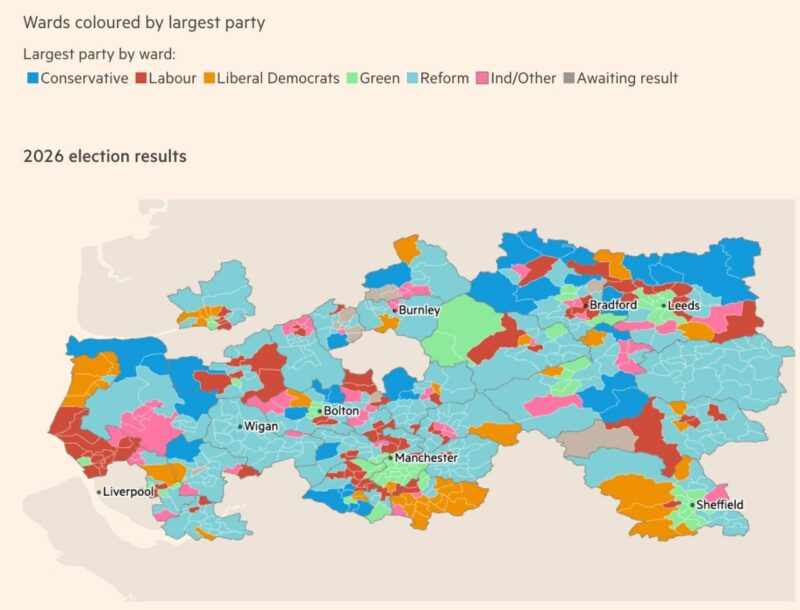
The Reform party has gained more than 1,450 council seats. What stood out was Reform UK’s big win in the constituencies known as “Labour heartlands” like Sunderland and Barnsley, where Nigel Farage’s party has taken control of the councils from the Labour Party after half a century.
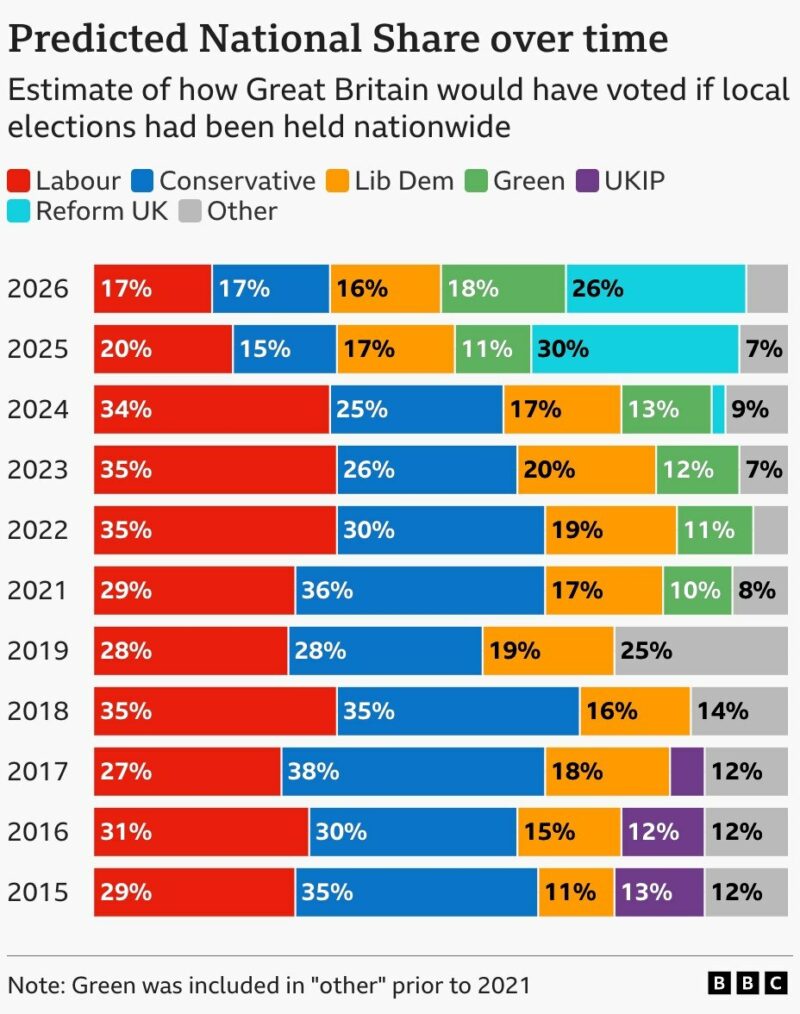
In total, Labour has lost more than 1,460 seats across the country. The party’s projected national vote share in the local elections has fallen to 17%.
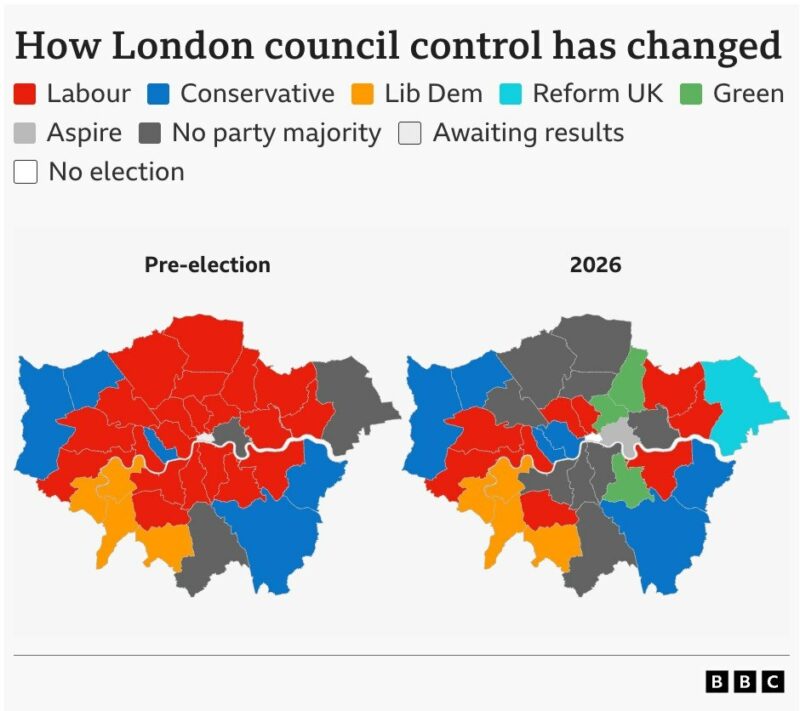
The graphics by the BBC visualise the overall results:
Following this massive electoral loss, the Labour Party has plunged into turmoil. More than eighty MPs alongside several ministers are openly calling on Prime Minister Keir Starmer to resign.
Labour officials are terrified that this local election disaster will trigger a government change and end Labour’s grip on power in the upcoming general election.
For many, Starmer’s resignation is seen as an opportunity for political new blood. In fact, chatter about who will replace him has already taken over party corridors and the media.
One of the strongest candidates for Prime Minister is former Health Secretary Wes Streeting. Streeting resigned from his post, telling Starmer directly, “It’s clear that you won’t be the one leading the Labour Party into the next general election.”
Even with all these calls to quit, Starmer announced that he’s going to stay on. But can he really hold on after such a bad election loss, all this criticism, and the pressure to resign?
Keith Bennett, an international politics and economics researcher based in London, shared his views on the UK election results with Aydınlık Avrupa—the European supplement of Türkiye’s Aydınlık newspaper. Bennett answers questions on many topics from internal fractures within Labour and Starmer’s future to potential new leaders, as well as the policies and voter bases of the Reform and Green parties.
—
A manifestation of the crisis that has long existed
Is the current internal crisis within the Labour Party exclusively a reaction to the local election results, or are these results merely a catalyst for long-standing systemic dissatisfaction?
The present crisis in the Labour Party has been brought to a head by the local election results in England and the elections to the Scottish and Welsh parliaments but they are not the cause. Rather they are if anything a manifestation of the crisis that has long existed.
There has always been contention between the left and the right, to one degree or another, throughout the Labour Party’s history. But there has never been a party leadership that suppressed the left more ruthlessly nor a Labour government that has offered so little to the working class at home. The elections on May 7 have brought this to a head. Moreover the discontent of party members now coincides with a realization on the part of many of the members of parliament that under Starmer, Labour is heading for electoral wipeout and disaster at the next general election and they will lose their jobs. Hence the growing clamor of parliamentarians from all wings of the party for Starmer to go.
Starmer will go “fairly soon”
What is the likelihood of Starmer’s resignation? In such an event, who are the primary contenders to succeed him, and how would the formal leadership transition be executed?
It’s not possible to predict exactly when and how Starmer will go but what is almost certain is that he will go fairly soon.
For now, he insists he will not resign. But his authority is crumbling and much stronger leaders than him (for example Mrs Thatcher) started by saying they would not resign only to do so not long afterwards when the reality of their situation sunk in.
Possible candidates
If Starmer refuses to resign a leadership contest can be triggered if 81 Labour MPs (this is based on a percentage of their total number) nominate another candidate who must be a Labour MP.
Some 80 have already called on him to go. But they are not united around an agreed candidate and would have different preferences. We will have to see in the coming days.
There are three main contenders to replace him at present:
– Wes Streeting
– Angela Rayner
– Andy Burnham
“Streeting is firmly on the right of the party”
Streeting has resigned from the Health Ministry but has not yet declared his candidacy. This probably means that so far, he doesn’t have the 81 nominations needed. But he is firmly on the right of the party at a time when party sentiment is shifting, if only slightly, to the left. Moreover, he is also tarnished by having been a good friend of the disgraced Epstein associate Peter Mandelson. However, for reasons explained below he is in the strongest position to actually stand at the moment.
Angela Rayner has announced that she has been exonerated by HMRC (the tax authorities) of deliberately misleading them and has paid all the tax she owes. This clears the way for her to stand. The fear was that she would have been found to have deliberately misled.
There is also increased speculation that Ed Miliband will stand. But Rayner, Burnham and Miliband will almost certainly coordinate their positions.
Rayner was the Deputy Leader of the party and a senior minister. Within the party she is deemed to have “working class” credentials. But she had to resign her posts recently due to a tax scandal related to a property purchase which is not yet resolved.
Burnham has the most ministerial experience of the three. He is probably the most popular among MPs, almost certainly among party members and also among the general public according to opinion polls. The problem is that he is not currently an MP but Mayor of Manchester and therefore not eligible to stand. For him to stand he has to get back into parliament which can be done if there’s a by-election and he is selected as the candidate and is elected (at the moment this would require a sitting MP to stand down). Precisely for this reason Starmer has been determined to stop this happening. He was prevented from standing at a recent by election which the Green Party won. Party rules say that as a serving Mayor he needs to get permission from the National Executive Committee (NEC) to stand, which Starmer presently controls. Whether Starmer’s authority has now been sufficiently weakened as to make it impossible for him to block Burnham a second time in this way remains to be seen.
For this reason, some Burnham supporters may actually try to slow down Starmer’s departure to hopefully give their man time to be able to stand. In general, it’s the problem in getting a suitable successor that may give Starmer a little more time in office. But it’s not enough to save him in the long term.
End of the two-party era in the UK?
In an article you shared with us, you emphasize that the two-party era in the UK has come to an end. Reform UK and the Greens are now significant forces. What do these rising actors represent in British politics? Where do their potentials lie?
Until recently the Green Party has been similar to green parties elsewhere in Europe. And has been on a similar rightward trajectory – regarding NATO and so on. However it had not gone so far as others like the German Greens, probably not least as it remained a small party with no realistic prospect of entering government in the near future.
Corbyn’s project and Zack Polanski
However, two things happened to change things. First Jeremy Corbyn and others decided to form a new left-wing party and initially this attracted a huge wave of enthusiasm. 800,000 people registered interest in a few weeks. However, they completely squandered this opportunity because of factional infighting.
Then there was a leadership contest in the Green Party, and this was won by Zack Polanski on a left populist platform. He was helped by a surge of new members essentially coming from the Corbyn project. Since he was elected there has been a further huge increase in members such that one can practically say that it has become a different party.
Polanski’s base of support
Polanski’s base of support, which would now be the majority of the membership, is mainly composed of fairly young left leaning professional people in the big cities along with members of the Muslim community who have abandoned their previous loyalty to Labour because of Starmer’s support for the genocide in Gaza and who are attracted to the party’s fairly strong support for Palestine. They remain weak in more traditional working-class areas.
Reform UK: Big support in the old traditional, “deindustrialized and abandoned” working class areas
Reform UK is a right-wing populist party led by Nigel Farage who was originally a supporter of Margaret Thatcher and who became well known as the main campaigner for Brexit. This party is getting big support in the old traditional working-class areas which have been largely deindustrialized and abandoned by successive governments. However, it offers no real solutions, just blaming immigrants and minority communities and promoting racism.
Farage: a very wealthy person cultivating image of an ordinary person
Moreover, although appealing to an important section of the working class, and engaging in populist rhetoric, it basically promotes neoliberalism and offers nothing to the working class. Unlike right wing populist parties in some European countries such as France. Farage however is a skilled orator and charismatic personality who cultivates the image of an ordinary person whilst being personally very wealthy and funded by the immensely wealthy. Besides this “left behind” section of the working class, another base of support for Reform is the older middle class in more prosperous areas who are attracted by its promotion of “British values”.
The potential for these parties at present is that the Greens could replace Labour as the main “left wing” party and Reform could replace the Conservatives as the main right-wing party.
Nationalism, right-wing parties and issue of sovereignty
How would you assess the differences between Reform UK and other nationalist parties across Europe? And do you think it is accurate to assume that nationalist parties necessarily strengthen the sovereignty of their countries? In that regard, would you consider Reform UK to be a counterexample in terms of sovereignty?
I’m not an expert on nationalist (I would prefer far right) parties in the rest of Europe.
And there is a basic and fundamental difference between the nationalism of an oppressed or Global South nation and the nationalism of an imperialist nation like Britain. Expressed bluntly, one is progressive, and one is reactionary.
Of course, that doesn’t preclude making use of inter imperialist contradictions or forgetting the distinction between greater and lesser imperialist powers.
To the extent that many far right nationalist parties in Europe are aligned with and related to US imperialism, Trump, Elon Musk, etc. (as advanced in the latest US National Security strategy and pushed by JD Vance for example), and Reform definitely comes into that category, then they are actually undermining, not defending their countries’ sovereignty, whatever their rhetoric.
One point I was making was that, in terms of actual policies, Reform offers nothing that can be presented as being in favor of working people. Unlike say Marine Le Pen in France. (Whether that’s genuine or realistic on her part is another question.) On foreign policy Reform is different to AfD in Germany, which so far at least, advocates good economic relations with Russia and sensible relations with China. All these parties are of course very pro-Israel.