


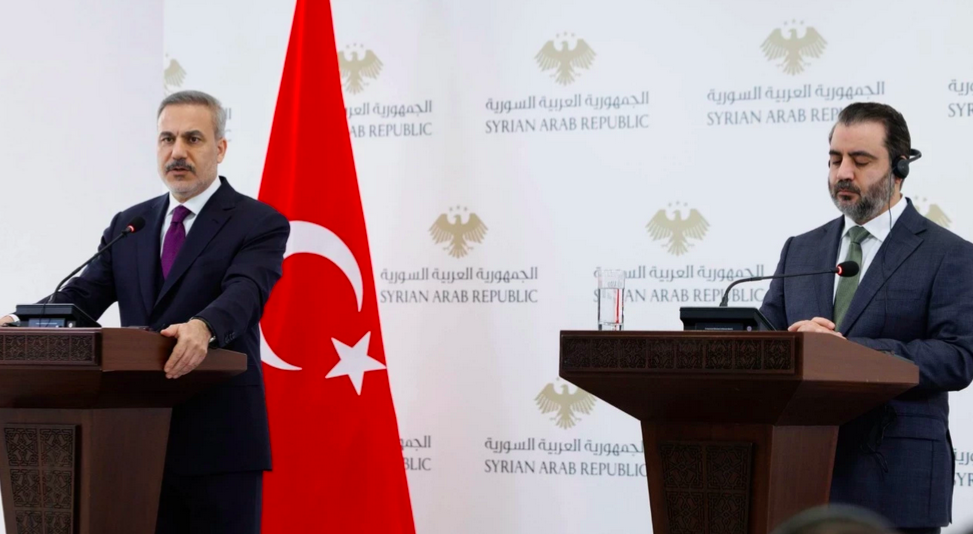
Last week in Türkiye, developments in Syria topped the political agenda.
Operations launched by the Syrian government against the Syrian Democratic Forces (SDF), which Ankara designates as a terrorist organization, were met with a positive response in the Turkish capital.
Foreign Minister Hakan Fidan’s remarks on the US, emphasizing alliance relations, was another major topic.
Developments in Iran also featured on the agenda.
Reactions from Türkiye to developments in northern Syria
The Syrian army’s large-scale operations against the PKK/SDF terrorist groups in northern Syria topped the agenda in Türkiye.
As a result of these operations, SDF forces were forced to withdraw from Aleppo and the strategically important city of Raqqa.
Following the clashes, a ceasefire was brokered between the Shara government and the SDF at the urging of the US, and an agreement was signed. Shara called on Arab tribes in the region that had been fighting the SDF to exercise restraint in order to ensure the implementation of the ceasefire.
The agreement reached between the Shara administration and the SDF includes provisions with far-reaching consequences for the group. These include the withdrawal of SDF forces to the east of the Euphrates, the handover of Deir ez-Zor and Raqqa to the Syrian government, the transfer of control over border crossings as well as oil and natural gas fields to Damascus, and the integration of SDF elements into the Syrian army.
During the course of the Syrian army’s operations, President Recep Tayyip Erdoğan held a phone call with his Syrian counterpart, Ahmed Shara. Presidency’s Communications Director Burhanettin Duran said the call addressed bilateral relations between Türkiye and Syria, and the latest developments on the ground.
According to Duran, President Erdoğan underlined Türkiye’s commitment to Syria’s territorial integrity, unity, stability, and security. “Our President stated that fully clearing Syrian territory of terrorism is essential both for Syria and for the region as a whole. Our President also emphasized that Türkiye’s support for Syria, particularly in the fight against terrorism, will continue to grow,” Duran said.
Following the signing of the ceasefire agreement, the Turkish Foreign Ministry also issued a statement:
“We hope that the Ceasefire and Full Integration Agreement announced today (18 January) by Syrian President Ahmed Shara will swiftly and effectively advance efforts to establish stability and security in Syria on the basis of the country’s territorial integrity and unity. We expect the agreement to contribute to the security and peace of the entire region, foremost the Syrian people and Syria’s neighboring countries.
The new period that began in Syria on 8 December 2024, which represents a unique opportunity for the country to achieve a prosperous future, is now passing through a critical stage. With a clear recognition of realities on the ground, we hope that all groups and individuals in Syria fully understand that the country’s future lies not in terrorism or division, but in unity, integration, and cohesion.
Türkiye will continue to support the Syrian government’s counterterrorism efforts, which are being carried out through an inclusive and integrative approach based on public consent, and its efforts aimed at the country’s reconstruction.”
Another statement on the issue came from Justice and Development Party (AKP) Spokesperson Ömer Çelik. Çelik said that the decree issued by Syrian President Ahmed Shara guarantees the cultural and linguistic rights of Syrian Kurds, adding: “This decree officially declares the end of the Baath regime’s long-standing policy of denial and rejection.”
Referring to the first article of the decree, Çelik stated: “The provision that ‘Syrian Kurdish citizens are an inseparable and indispensable part of the Syrian people, and that their cultural and linguistic identities are an integral element of the unified Syrian national identity’ is a clear declaration that all policies of denial and rejection from the Baath era have come to an end. This step is also a clear indication that the same inclusive approach will be extended to all ethnic and sectarian groups in Syria.”
He added that President Erdoğan had repeatedly raised the issue of the fundamental rights of our Kurdish brothers and sisters in Syria in earlier periods, and the decree shows how justified that stance has been.
Çelik also delivered harsh criticism of the SDF. He said that Syria is facing serious security and stability challenges in the period after the “revolution”, Assad’s fall:
By not complying with the March 10 Memorandum, the SDF had become an instrument of malicious project targeting both Syria’s Kurdish population and the country as a whole and had sought to undermine Türkiye’s goal of Terror-free Türkiye and a terror-free region. Attempts by the SDF/PKK to derail these goals were thwarted by the Syrian government’s counterterrorism operations, and the coup attempt targeting our principle of a ‘Terror-free Türkiye and region’ has been stopped. Terrorist organizations can no longer represent any ethnic or religious group.
“We continue to see that the strategy developed by our President over the years with patience, determination and hard work, based on respect for the sovereignty of brotherly countries, has produced the right results for everyone,” said Çelik, emphasizing that the essential thing is an inclusive social and constitutional model: “Together with our Arab, Turkmen and Kurdish brothers, all members of all religions and sects must be equal and honorable components of a united Syria.”
Foreign Minister Fidan’s remarks on the US-Türkiye relations
Foreign Minister Hakan Fidan recently appeared on a live broadcast on TRT Haber. He assessed the international developments and made notable remarks on Türkiye–US relations.
Fidan addressed claims that the US had made offers for Maduro to go into exile in Türkiye. He said:
“At the time, they came to us, asked for our views, and requested assistance. We did what we could in terms of facilitation and mediation about eight to ten months ago. But later we saw that these talks were going nowhere. But we have never received such a question or proposal. Maduro has never called us and said, ‘I want to come to Türkiye, will you accept me?’ Nor has anyone called us and asked, ‘Would you accept Maduro coming to you?’”
Continuing his remarks on developments in Venezuela, Fidan said:
“Talks between the US and the new administration of Venezuela have begun. Unlike other US operations, this one did not directly target the government or the system. Apparently, they did not want to bear the alternative wreckage and costs that could emerge as in Afghanistan or Iraq. Here, we see that the US is using military means in a different way to achieve its objective in its own Southern Hemisphere.”
Fidan said the US, escalating military pressure, conveyed a message to Maduro that “You can go wherever you want and hand over your position to whomever you choose, but we will not work with you.”
Fidan also addressed Türkiye–US relations, saying Ankara expects to begin seeing tangible outcomes in 2025 on a number of issues currently under discussion between the two countries. He said that these include the CAATSA sanctions and the Halkbank case.
Fidan also touched on ongoing regional cooperation with Washington, saying: “Regional solidarity is extremely important. It is important for the US to continue playing a constructive role in Gaza. It is also important that the policies pursued in Syria during the Trump era are maintained.”
Fidan said that Türkiye’s regional objectives “overlap” with US foreign policy goals during the Trump period:
“We see that a US that supports peace in the Caucasus, attaches importance to Azerbaijan, and also pushes Armenia toward peace aligns with our regional objectives. This holds true across a wide geography, from Russia to Azerbaijan, Armenia, from Syria to other regions.”
He added that “A potential shift in the Gaza situation could be troubled. Therefore, we need to engage in intensive diplomatic efforts.”
Reactions from Türkiye to developments in Iran
Internal unrest in neighboring Iran, and the possibility of US or Israeli attacks, was high on Türkiye’s agenda, as it was globally.
AK Party Spokesperson Ömer Çelik commented on developments in Iran:
“We would never wish for chaos to break out in our neighbor Iran. Of course, we do not deny that there are certain problems within Iranian society and state. But resolving these problems should take place through Iran’s own internal dynamics, as stated by Iranian President Mr. Pezeshkian, and through the national will of the Iranian state. We see that external interventions lead to worse outcomes, and that interventions sparked in particular by Israeli provocations would result in much deeper crises.”
Foreign Minister Hakan Fidan also shared his assessments on the situation in Iran:
“The protests in Iran are being manipulated from abroad by Iran’s rivals. Mossad has not hidden this and has openly called on the Iranian people to rise up through its own online accounts.”
Referring to remarks by Iranian President Masoud Pezeshkian, Fidan said he was certain that Israel would not achieve the outcome it expects.
On the possibility of renewed Israeli attacks on Iran, Fidan made the following assessment:
“Everyone knows that Israel, especially Prime Minister Benjamin Netanyahu, has a desire in this regard. This is no secret. We see that he is reluctant to enter a war that could carry serious consequences without first obtaining assurances from certain allies, primarily the US. We know that he is lobbying these countries to bring them on board and, so to speak, obtain a green light for an operation.”
Fidan said that Türkiye wants the Iranian people to suffer no harm, to avoid any military attack, and for Iran’s existing problems with the US and the West to be resolved through negotiations as soon as possible.
He also voiced his concern that even when Iran pursues negotiations, it is sometimes confronted with demands so far-reaching and unacceptable, which in effect pushes Iran away from reaching an agreement.
Foreign Minister Fidan said Türkiye supports the idea of an agreement with Iran—particularly involving key actors, foremost the United States—that could produce gains for both sides, stressing that “regional stability depends on this.”
Fidan added that Iran now needs to enter into what he described as a “genuinely sincere reconciliation and cooperation” with regional countries, continuing:
“Iran really needs to make a serious and sincere effort on this issue. It has to understand these realities. The whole world is not revolving around your perspective. Everyone has their own truths. We need to be able to move toward a point where these truths overlap. We have to be able to achieve that. In this regard, our President’s presence in the region and his resolute leadership are an opportunity for everyone. I tell them, ‘Make use of this.’ This opportunity will never come again, not even to us. We should appreciate it.”
Another assessment on Iran came from Devlet Bahçeli, leader of the Nationalist Movement Party (MHP), the government’s coalition partner.
Speaking at his party’s parliamentary group meeting, Bahçeli said: “Iran’s unrest and fragmentation pose a threat to Türkiye and to countries across the region in every respect.” Emphasizing the importance of Iran’s territorial integrity, he added: “This is a day for unity and solidarity.”
Bahçeli also pointed out to “organized, multi-actor intelligence operations and imperialist provocations, plots targeting Iran”, and Israel and the US’ involvement:
“The actors involved, the plans being implemented, and what kind of Iran some aim to create are so obvious that even children playing in a park could describe them to you. (…) We must look not only at the visible tip of the iceberg, but also at the part beneath the surface. (…) The threat is familiar and very close to us. The US and Israel positioning themselves for an attack on Iran, seeking to further destabilize the country in preparation for direct intervention, means moving one step closer to the global conventional war. We must oppose the developments in Iran on political, moral, faith-based, cultural, and neighborly grounds. Allowing our geography to be torn apart by Zionist and imperialist encirclement and interference, and by the breaking of ethnic and sectarian fault lines that deepen hostility, would work against us all.”
Bahçeli also mentioned “the calm and distant stance of Iranian Turks toward these events” as “valuable”, and “the Iranian people will not allow an imperialist proxy leader plan”.
Bahçeli then sharply criticized the US and Trump:
“US President Trump’s words at a recent meeting that ‘This is my morality and my reason. I don’t need international law’ is an expression of big myopia. Is the state the product of law, or is law the product of the state? It is now an undeniable reality that international law has become an accomplice to gang-like behavior and to the apocalyptic scenarios through which the US is setting the world on fire. Democracy has effectively vanished from the world. Unrestrained ambitions have overtaken human reason.
If a state that creates law does not abide by it, it becomes no different from a gang or an organized crime group. Trump is defending this on global scale.
Bahçeli went on describing the US as “rotted from within”:
“In the 19th century, the Ottoman Empire was labeled the ‘sick man.’ In today’s world, the real sick man is the US. A society that has rotted from within and largely lost its human quality will not be far from shattering into fifty pieces like a crystal vase.”