


By Orçun Göktürk, from Beijing / China
U.S. President Trump arrived in Beijing accompanied by political representatives and a massive group of CEOs (leaders of 17 companies). Welcomed at the airport with a large and warm ceremony, Trump met with Xi Jinping and his delegation this morning at the Great Hall of the People in Tiananmen.
Prior to the meeting, the American media mostly ran reports emphasizing that Trump was in the “most unusual role” among U.S. leaders who have visited China—meaning he arrived with a very weak hand. Politico raised the stakes by calling him a “supplicant begging for a favor,” while the New York Times reported on the meeting with comments stating, “Trump has nothing in his hand against China. Neither the Taiwan card nor a trade war. Xi and China don’t need to do anything because time is on their side.”
Glasses raised as a joint shield…
The meeting at the Great Hall of the People lasted a little over two hours. In the session open to the press, both leaders praised each other and spoke frequently of partnership. Xi Jinping stated, “China and the U.S. will gain from cooperation and suffer from conflict. We should be partners, not rivals,” and continued his speech as follows:
“The world is at a crossroads and undergoing a major transformation. The international situation is volatile and turbulent. Let us make 2026 a year that serves as a historic turning point, opening a new page in China-U.S. relations.”
Trump, as usual, distributed plenty of praise. Every other word was along the lines of “Great nation, great leader, you have a wonderful country.” Naturally, he followed up by mentioning the giant American companies and said, “They are here to develop our commercial relations on equal terms, and I hope we will make great deals with you.”
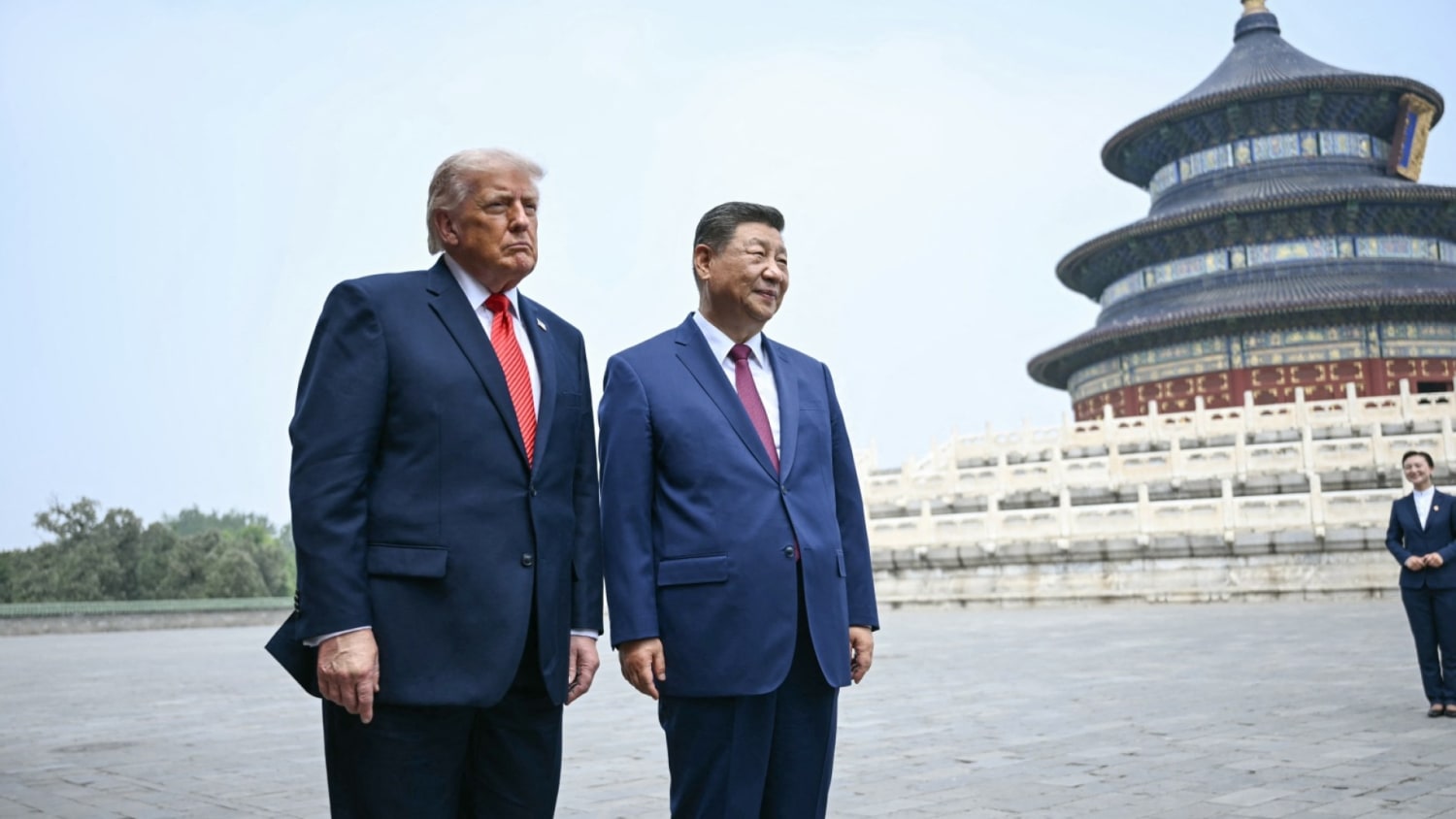
The two leaders later visited the famous Taoist “Temple of Heaven” in Beijing. This site, which is on the UNESCO World Heritage list, was the meeting point for China’s official religious rituals during the Ming and Qing dynasties in the Middle Ages.
The two leaders then had a joint dinner, and the words Xi spoke while raising his glass were unexpected: “We can help each other succeed. We can walk hand-in-hand toward the goals of the rejuvenation of the Chinese nation and making America great again.”
The realities lying behind
In fact, Donald Trump was supposed to come to Beijing at the beginning of April. He had announced this on his own social media platform in mid-February. However, the plan did not go as expected. Calculating that he would achieve regime change in Tehran with a lightning operation following the thuggish kidnapping of Maduro, Trump wanted to go to Beijing with a strong hand after the fall of Iran. Tehran’s resistance, in a sense, upended Trump’s plans and strengthened Beijing’s hand.
Trump thought that the Strait of Hormuz crisis would hit Beijing, which is the world’s largest oil importer with a daily requirement of 14.5 million barrels. What he expected did not happen. Not only did oil shipments from Hormuz to China continue, but Iran also set a condition: “Countries wishing to pass through the Strait must pay in the Chinese currency, RMB.”
Trump finally decided to make the Beijing visit, which he could no longer postpone, but he was left with no cards to play other than trade. The fact that separatists in Taiwan are increasingly losing power, and the recent visit of the Main Opposition leader to Beijing to meet with Xi, further narrowed Trump’s room for maneuver regarding China.
Trade and the approaching elections
U.S.-China trade volume had reached nearly $700 billion before Trump took office. In 2025, it fell dramatically to $450 billion. Trump’s tariffs were, of course, the primary factor in this. However, here too, Trump’s calculation backfired. Trump’s main expectation was to collect extra taxes from Chinese products and reduce China’s foreign trade volume. However, China turned to markets outside the U.S., and even in the first four months of this year, its foreign trade volume rose by a record 15%.
Yes, perhaps the U.S. current account deficit against China had decreased, but the cost of living in the U.S. increased, compounded by the Hormuz crisis. Beijing saw that the prolongation of the crisis was in its favor and against the Americans in the long run, and the Trump-Xi meeting took place in this environment.
A continuation of the Busan agreement
The resulting picture can be described as a continuation of the meeting held at the APEC Summit in South Korea last year. Before Busan, the conflict between the two countries had escalated significantly with mutually increasing tariffs, sanctions, and finally, China’s export restrictions on rare earth elements vital to America.
However, the compromise that emerged at Busan with both countries stepping back prepared the foundation for today. The U.S. hitting the “Tehran wall” and its hand becoming increasingly weak created a vital room for maneuver for Beijing.
War warning from Xi
So much so that Trump could not utter a single word regarding the Taiwan issue—at least as far as what was reflected in the media. Xi, however, issued a clear “red line” warning, according to news reported by the Chinese state agency Xinhua. Stating that the Taiwan issue is the most important area in U.S.-China relations, the Chinese leader called on the U.S. side to be extremely careful, saying: “If handled correctly, bilateral relations will generally stabilize. Otherwise, conflicts and even wars will occur between the two countries, putting the entire relationship in great danger.”
Regarding the Iran issue, we will see in the coming period to what extent Beijing will use its influence over Tehran, as Trump expects. Although White House staff reported to the media that “Xi agrees with Trump that Iran should not have nuclear weapons,” China has long advocated for military denuclearization while emphasizing that Iran has a right to nuclear energy. China states that for any bargaining with Iran regarding nuclear weapons, the first stage must be the end of unfair and unilateral sanctions against the country and the recent war involving the U.S.-Israeli partnership. Xi likely said this first, and White House officials likely decided not to release these parts to the media in their eagerness to show at least one political gain.
Trump will, of course, push for agreements for major commercial gains with China and will achieve most of them. Beijing has long been trying to move relations with the U.S. from an asymmetric level to an equal footing. Of course, China still needs time, but time is not an issue for China. Meanwhile, the bells are tolling for Trump, who enters the Senate midterm elections in November facing great stagnation both at home and abroad.