


By Héctor Bernardo* –
The Mexican Senate approved a constitutional reform that considers foreign interference grounds for annulling elections. The measure comes after Washington’s meddling in the electoral processes of Argentina and Honduras, the allegations surrounding the so-called “Hondurasgate” scandal, and threats against the democracies of Colombia, Brazil, and Mexico. “With this offensive we are witnessing from abroad, it is important to make it very clear that in Mexico, we Mexicans decide,” stated Mayor Claudia Sheinbaum.
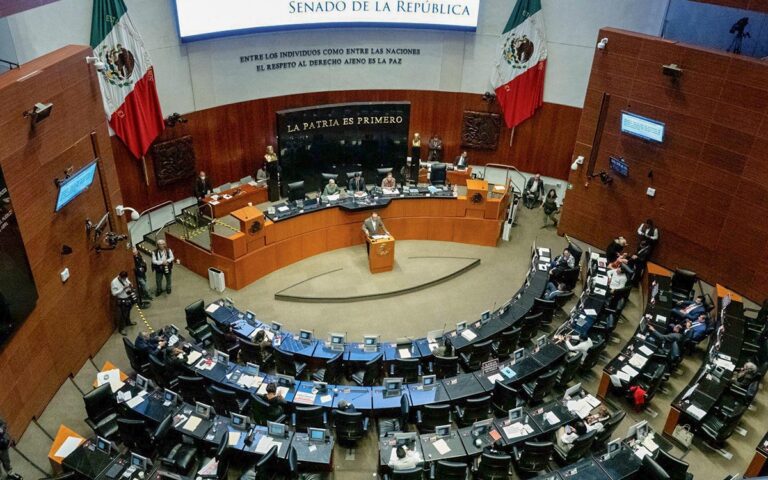
Last Friday, May 29, the Mexican Senate approved the reform of Article 41 of the National Constitution to establish that foreign interference is grounds for annulment of electoral processes.
With 85 votes in favor and 42 against, the addition of Section VI to Article 41 was approved to safeguard the country’s sovereignty against attempts at manipulation, interference, or foreign intervention in elections. The legislation had already been approved by the Chamber of Deputies.
The Congressional approval comes amid Washington’s interference in electoral processes in Argentina and Honduras, the allegations of the so-called “Hondurasgate”, and threats to the democracies of Colombia, Brazil, and Mexico itself.
Threatened democracies
The reform in Mexico comes after the President of the United States, Donald Trump, explicitly carried out acts of public interference in the electoral processes of Argentina and Honduras during 2025.
In Argentina’s October legislative elections, Trump promised $20 billion in aid to the country if President Javier Milei’s party won.
On December 9, at an event in Texas, which the Argentine president attended, Trump said that Milei “was losing the election until I supported him, and he won overwhelmingly.”
The Republican tycoon also intervened in the November presidential elections in Honduras to favor the right-wing candidate Nasry “Tito” Asfura of the National Party.
“If Tito Asfura wins (…) we will strongly support him. If he doesn’t win, the United States will not waste its money,” Trump said.
In that electoral process, interference took several forms; the one that sparked the most media reaction was the pardon granted to Juan Orlando Hernández, the leader of the National Party and former president of Honduras, who had been sentenced in the United States to 45 years in prison for drug trafficking.
Presidential elections will be held in Colombia and Brazil in 2026. There have already been reports of interference in the Colombian electoral process, the first round of which will take place on May 31. All indications are that similar actions will be carried out during the October elections in Brazil, in which the current president, Luiz Inácio Lula da Silva, is running for reelection. Inácio Lula da Silva will face a Trump ally, Flavio Bolsonaro (eldest son of former president Jair Bolsonaro).
In April, following an investigation by the media outlet Canal Red, a group of audio recordings were released that revealed a geopolitical network known as “ Hondurasgate ”.
According to the audio recordings, the pardon granted by Trump to former Honduran President Juan Orlando Hernández is part of a plot involving the governments of the United States, Israel, and Argentina to turn Honduras into a communications operations center to discredit the governments of Claudia Sheinbaum in Mexico and Gustavo Petro in Colombia.
The complaint alleges that a “digital journalism unit” was created to carry out disinformation and fake news operations that harm the governments of Colombia and Mexico.
The Mexican Senate. Photo: Cuartoscuro Archive
The path to consolidating the reform
After being approved by the Senate, the process called Permanent Constituent begins in order for the constitutional reform to materialize.
The Senate bill is sent to the 32 state legislatures for debate. It requires approval from at least half plus one of the state legislatures (that is, at least 17).
If approval is obtained, it is sent to the Executive Branch for promulgation, and once published in the Official Gazette of the Federation, the reform comes into effect.
During her daily press conference, known as Las Mañaneras, President Claudia Sheinbaum recalled that there has already been “funding from abroad. It was demonstrated in the case of ‘Mexicans Against Corruption’, which was financed by institutions in the United States through the Embassy that in one way or another supported a candidate.”
“In the current circumstances, with this offensive we are seeing from abroad, it is important to make it very clear that in Mexico, we Mexicans decide,” the president emphasized, adding: “All Mexicans should agree that there should be no foreign interference in the elections in Mexico.”
When asked if there is a risk of interference in Mexico, Sheinbaum stated: “Yes, there could be a risk of foreign intervention in Mexico’s elections.”
Mexico has taken a fundamental step in its quest to protect its democracy. The journey has only just begun; it will not be easy, but it is necessary.
Héctor Bernardo*- Journalist, writer and professor of Introduction to Contemporary Social and Political Thought – Faculty of Journalism and Social Communication – UNLP.
This article was previously published in Spanish on Noticias Pia here. Translation by UWI with AI support.