


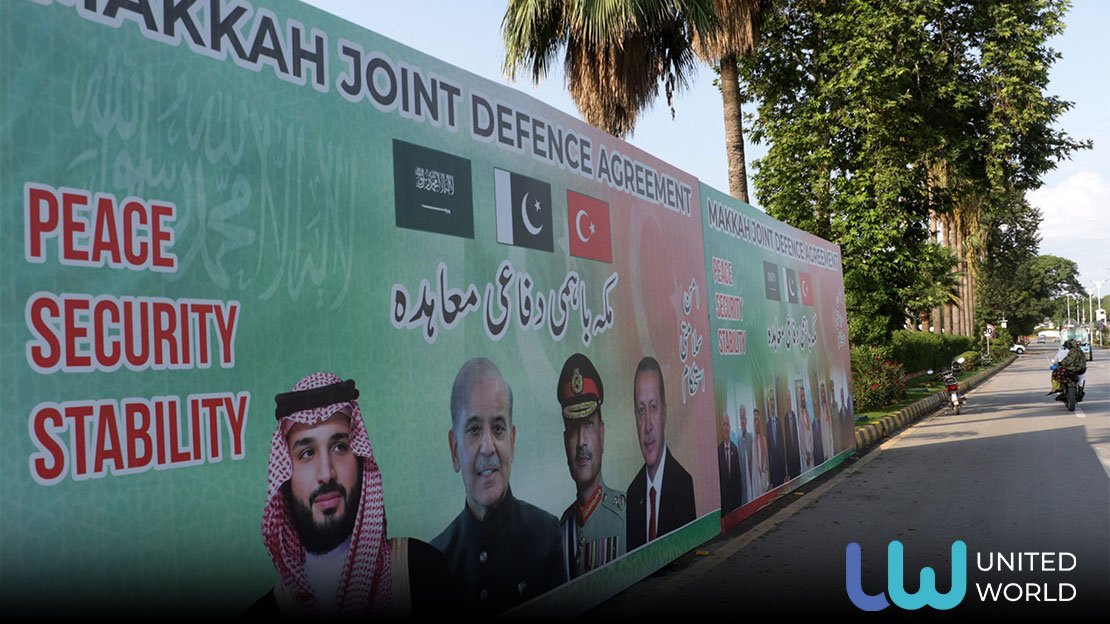
The recent Mecca Agreement between Türkiye, Saudi Arabia and Pakistan has been presented as the beginning of a new regional security architecture. Yet behind the language of cooperation and deterrence lies a fundamental ambiguity: the alliance does not clearly identify the threat against which its members are supposed to act.
For Alptekin Dursunoğlu, editor-in-chief of the Near East News agency, that ambiguity is not accidental.
“They deliberately leave the threat undefined,” he argues. “If you are really establishing an alliance, you have someone you perceive as a threat. And you say it openly.”
The central problem of the agreement, therefore, may be precisely what it does not say. Türkiye, Saudi Arabia and Pakistan have very different strategic environments, different enemies and different calculations. Whether these can be transformed into a common military doctrine remains an open question.
Retired Turkish Armed Forces General Dr. Fahri Erenel, now a professor at Istinye University in Istanbul, also sees major unresolved issues. The agreement may provide political deterrence, he says, but its practical implementation will require mechanisms that have not yet been defined.
Israel or Iran?
The most obvious candidate for the alliance’s target, at least in public debate in Türkiye, is Israel.
The argument is familiar: Israel’s military operations, its regional posture and the possibility of further confrontation have created growing security concerns. Erenel believes the three-country structure could be an important response to the regional alignment involving Israel, Greece and the Greekcypriot Administration. He argues that the presence of a nuclear-armed Pakistan could itself change the strategic equation.
Dursunoğlu, however, questions whether Israel can realistically be the alliance’s actual target.
“Three American allied countries are going to form a counter-force against Israel, which is the basis and axis of all American regional policies?” he asks. “Is that possible? Naturally, no.”
In his view, the political reality of Washington’s relationships with all three states makes the idea of an openly anti-Israeli alliance deeply problematic. If the alliance cannot act independently of the United States, its ability to deter Israel is necessarily limited.
That leaves Iran as the more plausible, although still officially unspoken, strategic concern.
Erenel argues that Iran is likely to be an important element in the alliance’s deterrent logic. He notes that Tehran itself has reacted cautiously and that the structure could encourage Iran to act more carefully. Yet he also points to the obvious contradiction: Türkiye, Saudi Arabia and Pakistan do not share a single, identical threat perception. Pakistan’s primary security concerns are linked to India, while Saudi Arabia faces threats different from those confronting Türkiye.
Dursunoğlu goes further, questioning whether Türkiye or Pakistan would actually fight Iran for Saudi Arabia.
“Saudi Arabia’s threat perception does not oblige Türkiye to throw its valuable neighborhood relations with Iran into the rubbish bin,” he says. Pakistan, too, has significant relations with Tehran. “Türkiye will not go to war with Iran at Saudi Arabia’s request. Pakistan will not either.”
His conclusion is that the alliance may have been designed precisely to avoid a clear answer to the question of its enemy. It cannot easily identify Israel because of the American factor, while identifying Iran openly would create political and strategic problems for Türkiye and Pakistan.
Washington’s shadow
The United States is therefore at the center of the debate, even if it is not formally part of the Mecca Agreement.
Erenel believes the agreement emerged with Washington’s knowledge and, potentially, its approval. He points to the close American relationships maintained by Saudi Arabia and Pakistan and argues that Türkiye’s participation in such a structure would be difficult to imagine without the United States being aware of it. He also interprets the alliance as potentially connected to a broader search for new regional security arrangements where NATO itself cannot simply expand eastward.
In Erenel’s reading, the three-country framework could eventually become a partner structure on NATO’s eastern and southeastern periphery. The countries already have substantial exposure to NATO standards, particularly through Türkiye’s military experience and the education of officers from partner countries.
“The standards and defense concepts applied by these three countries will in fact largely be NATO standards,” he says.
Dursunoğlu sees the American dimension from a different angle. He argues that the alliance is connected to a perceived weakening of direct American military influence in the region. “The United States is militarily in retreat, because it has suffered great losses in the war. For instance, the Iraqi parliament demanded the withdrawal of US forces for Iraq already back in 2020. They didn’t do that then, now, they are retreating. Secondly, they are retreating from their bases in Bahrein and Kuwait westwards, towards Jordan and Israel. Hence, they are placing distance between their forces and Iran.”
From this perspective, Saudi Arabia may be seeking to diversify its security dependence rather than simply replacing the United States.
Türkiye’s strong defence industry and Pakistan’s nuclear capability make them useful partners for Saudi Arabia, he says. But the arrangement also offers Ankara and Islamabad their own opportunities: defence exports, financial cooperation and a larger regional role.
Dursunoğlu argues that there is also an implicit message to Washington: Türkiye and Pakistan, as American partners, could assume a larger regional role as the United States reduces its direct presence.
“’My friend Trump, as you leave here, we can take on this role for you,’” he says, summarizing what he believes is the underlying political message.
This interpretation raises a critical question about the alliance’s autonomy. Is the Mecca Agreement an alternative to American security architecture, or an attempt to preserve parts of that architecture through regional allies?
The answer may determine its future.
An alliance without an operating system
Even if the political purpose becomes clearer, Erenel warns that the agreement currently lacks many of the mechanisms required for a functioning military alliance.
Who decides that one member has been attacked? What threats trigger collective action? Which forces are allocated? How quickly can they deploy? What are the rules of engagement?
These are not technical details. They are the difference between a political declaration and an operational alliance.
“If Saudi Arabia says the Houthis are the threat against me, Pakistan will say these are the threats against me, Türkiye will say these are the threats against me,” Erenel explains. “They have to sit down and determine how Pakistan and Saudi Arabia will support Türkiye against a threat, and how Türkiye will support Saudi Arabia.”
He says the alliance will need a joint mechanism involving officers from the three countries, plans for national forces that could be assigned to the structure, common exercises and political decision-making procedures.
The problem is particularly acute because Türkiye cannot simply assign all of its military capabilities to a new alliance; some forces already have NATO commitments. Any collective defence mechanism would therefore require detailed planning about what forces each member can actually provide.
There is also the nuclear question. Pakistan’s membership gives the agreement a unique dimension, but Erenel asks whether nuclear weapons would form part of the alliance’s deterrence concept and, if so, under what political and legal conditions. For now, he stresses, such issues remain undefined.
The agreement will also require legal and institutional foundations. Parliamentary approval and ratification procedures remain necessary in Türkiye and Pakistan, while practical implementation would require further arrangements, including agreements governing the presence and operation of foreign forces.
The Mecca Agreement may therefore be strategically significant, but its current strength is more political than operational. It signals a search for a new balance in a region where the old security guarantees are increasingly questioned.
Its weakness is equally clear: the alliance has not yet demonstrated that its members agree on whom they are defending against, when they would fight together or how such a decision would be implemented.
Until those questions are answered, the Mecca Agreement remains less a fully formed military alliance than a geopolitical experiment—one whose ambiguity may be its greatest short-term advantage, but also its greatest long-term vulnerability.