


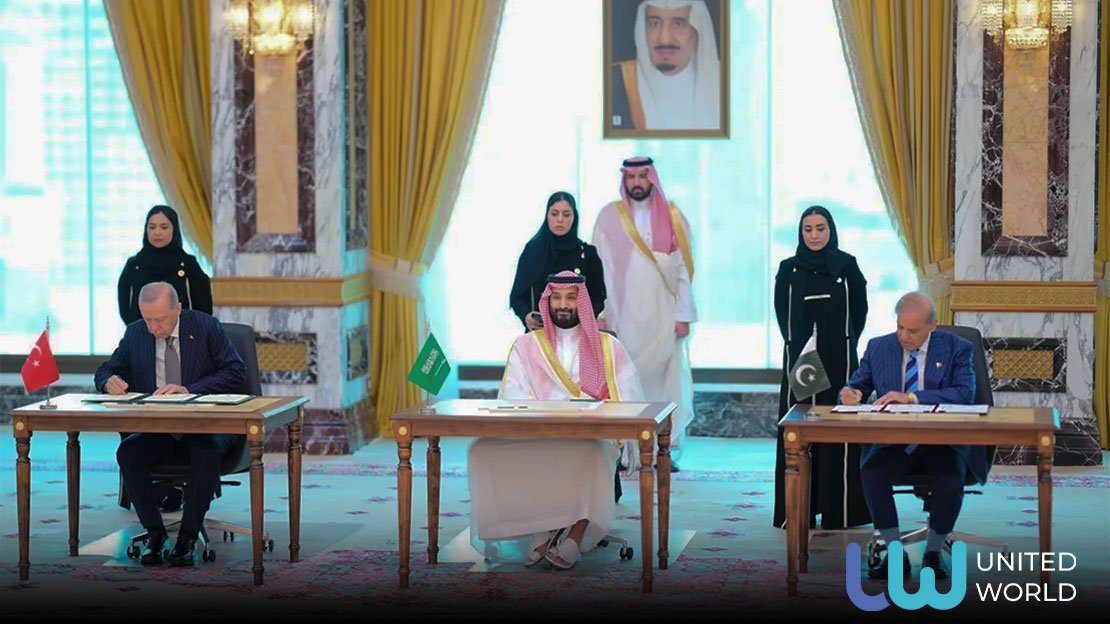
A few days ago, at Al-Safa Palace in Mecca, Saudi Crown Prince Mohammed bin Salman, Turkish President Recep Tayyip Erdoğan, and Pakistani Prime Minister Shehbaz Sharif signed a document titled the “Mecca Joint Defense Agreement.” Its core clause stipulates that an armed attack on any of the three signatory states is deemed an attack on them all—a formulation that, according to officials from the signatory nations, appears to invoke the spirit of Article 5 of the North Atlantic Treaty (NATO).
The choice of venue seems highly deliberate, laden with rich symbolism given Mecca’s sacred status and its universal reverence across both Sunni and Shiite Muslim traditions. The timing appears equally calculated, unfolding against the backdrop of a regional war in which the region had no say, yet bore the brunt of its fallout: the U.S. war on Iran. The conflict has triggered attacks on Gulf States and their strategic interests, forcing a fundamental redefinition of enemy and ally while raising serious questions about the viability of relying on the United States as a security partner and guarantor.
However, geography and timing alone are far from sufficient to definitively declare this agreement a structural shift in regional security dynamics. There are lingering concerns that current pressuring circumstances may have rushed it into existence without the rigorous analysis and preliminary groundwork required to forge a genuine deterrent power. In the view of some analysts, the pact might simply serve as a temporary political umbrella hastily erected in a moment of collective panic—one whose fragility could be laid bare at the very first real test.
Ultimately, any attempt to prematurely pass judgment on the efficacy and future of this agreement would be an oversimplification ill-befitting an event of such magnitude.
Erosion of Trust
Based on official statements issued by representatives of the three signatory capitals, there appears to be a shared conviction and an implicit agreement among them that the erosion of trust in U.S. security guarantees—following the joint U.S.-Israeli war on Iran that erupted on February 28—served as a primary catalyst bringing this agreement to fruition. That conflict saw Iranian strikes targeting Gulf infrastructure and disrupting the shipment of nearly a fifth of global oil and gas supplies. Indeed, this momentum is entirely understandable, particularly after the American guarantor appeared incapable of deterring the missiles and drones launched from Iran.
Even former U.S. Ambassador Christopher Hill described the agreement, in an interview with CNN, as one of the most significant developments of this war. He explicitly acknowledged that “there is a difference between being unpredictable and becoming unreliable,” adding that Washington has become the latter.
Yet, despite the plausibility of this premise, it cannot be asserted with certainty that the agreement’s timing was dictated solely by objective security imperatives. Rather, it may reflect an opportune political moment exploited by Riyadh to cement its position as a regional leader following the failure of the “Abraham Accords” framework to deliver the promised stability to the region. Those accords served as the spearhead through which Israel and the United Arab Emirates sought to project influence and claim regional leadership at Saudi Arabia’s expense. Washington had sponsored these agreements as a mechanism enabling both nations to fill any security and political vacuum created by a potential U.S. withdrawal from the region as it sought to its pivot toward East Asia, specifically China.
However, after the war exposed the fragility of a regional model—particularly in the Gulf—that relied on Israel as an alternative regional policeman to the United States, the Mecca Agreement cannot be passively viewed merely as a response to an Iranian threat. It can equally be interpreted as a preemptive rejection of an alternative security architecture being pressed upon the region by a third party.
Naturally, this does not diminish the legitimacy of the move, nor does it detract from its value. However, it necessitates approaching the agreement as a multi-faceted political maneuver rather than a purely defensive reaction devoid of the distinct political calculations of its participating parties.
Ambiguous Clauses
On the other hand, any rigorous assessment of the agreement appears virtually impossible in light of its publicly disclosed text, which is far less clear than its enthusiastic rhetoric suggests. Its provisions remain vague and ambiguous regarding effective implementation mechanisms, immediate triggers for activation, and how joint military assistance would be practically rendered during crises. Furthermore, there is no unified military command, no joint fighting doctrine, and no actual integration of air defense systems to date. In reality, all that currently exists is a ministerial committee and a general secretariat—likely to be headquartered in Riyadh—meaning the framework remains a political-coordinating structure closer to a high-level forum than an operational military alliance.
In my view, this ambiguity poses a genuine obstacle to determining the agreement’s true value. By way of comparison, Article 5 of the NATO Treaty derives its credibility from decades of joint exercises, shared maneuvers, and a unified command structure that make member commitments politically difficult to evade, even if their ultimate execution remains discretionary.
In the case of the Mecca Agreement, however, the most critical question—one demanding an unequivocal answer—remains: What actually happens if Saudi Arabia faces a direct, large-scale Iranian missile attack?
The answer remains entirely theoretical. According to multiple Arab sources, the hypothetical scenarios the agreement might face are what will ultimately define its worth. One such scenario considers whether, if the Saudis were to confront a grave military threat akin to the 1990 Iraqi invasion of Kuwait, they would rely solely on Türkiye and Pakistan, or if they would still require a U.S.-led international coalition, just as they did then. Conversely, could Türkiye and Pakistan—militarily robust yet geographically distant and anchored in geopolitically volatile regions—really call upon the Saudi military for assistance against their own adversaries?
Any candid answer to these two questions places the agreement in its logical context: while it may serve as an effective political deterrent in the short term, it cannot—at least for now—be a viable operational substitute for the American guarantee whose vulnerability it was ostensibly meant to offset.
Saudi Messages
Those who frame the agreement as a strategic endeavor to deter and contain Iran lack any logical grounding to support their position. They overlook the fact that Pakistan’s inclusion presents a stark contradiction to such an objective. Throughout the recent war, Islamabad never severed its channels of communication with Tehran; rather, it actively brokered dialogue between Iran and Washington for months. This mediation culminated in what became known as the “Islamabad Memorandum,” which provided Iran with a crucial political and economic lifeline during the conflict.
In my view, this underscores that the Mecca Agreement—despite its martial language—is not primarily directed against Iran in a direct, war-footing sense. Instead, it serves as a Saudi signal to multiple regional and international actors that Riyadh is capable of devising a new defense strategy that bypasses existing arrangements. Simply put, the most accurate lens through which to view the agreement is as a Saudi effort to reposition itself within the regional and global balance of power.
While the message directed at Washington and Israel—a firm rejection of all security blueprints that the Abraham Accords sought to impose—is easy to discern, another equally vital message was sent to Cairo. This comes against the backdrop of long-standing complexities in the security relationship between the two nations.
In 2017, Egypt declined a Saudi request for direct military engagement in the Yemen conflict, prompting economic retaliation in the form of a withheld Saudi oil shipment, despite Cairo’s critical need at the time. Furthermore, despite deteriorating security conditions in recent years that demanded regional military coordination, Gulf States last year rejected an Egyptian proposal at the Doha Summit to establish an Arab defense force—a mechanism the Gulf states acutely needed. According to multiple sources, the rejection was prompted by Saudi Arabia due to leadership disputes and misgivings over an inevitable Egyptian dominance of the force, given that the Egyptian military—the largest and most powerful in the region—would have formed its core foundation and operational backbone. Consequently, Cairo’s absence from the Mecca Agreement signatories cannot be overlooked.
Although Egypt’s non-participation was likely driven by its own long-standing constitutional doctrine against joining military alliances, Riyadh appeared eager to project the narrative that it had intentionally excluded Cairo. This intent was evidenced by leaks from Saudi sources published across international and Gulf media outlets.
Some of these sources framed Cairo as a beneficiary that takes without giving in return. However, the most provocative statement surfaced from an anonymous account on X (formerly Twitter) under the handle “Columbus”—widely believed to be tied to Saud al-Qahtani, the former adviser to the Crown Prince who remains close to him. The account posted that the doors of alliance are not open to those who merely seek to resolve their own crises and reap benefits without sharing the burden of the security mission, declaring that “the era of entitlement and one-sided generosity has come to an end.”
Strategic Repositioning
This rhetoric—regardless of the political validity behind it—reinforces the assertion that the agreement marks a personal repositioning for the Saudi Crown Prince on the international stage, following years in which the Yemen war exacted heavy political and humanitarian tolls. This, in turn, raises a key question: Does the Mecca Agreement truly serve Riyadh on a functional security level, or does it merely advance a political and symbolic narrative that Riyadh leads without waiting for anyone?
To be frank, the agreement serves both dimensions without inherent contradiction, regardless of the circumstances and catalysts that brought it about. Indeed, shaping political perception is an integral component of deterrence in international relations. However, conflating the two—or presenting one as a proxy for the other—is precisely the pitfall that risks reducing the agreement to a mere exercise in public relations.
Dismissing doubts regarding the operational mechanics of the pact and its efficacy in safeguarding the Kingdom’s security should never be construed as bad-faith skepticism aimed at undermining Saudi Arabia or its leadership.
Geopolitical realities dictate that Saudi Arabia is geographically distant from both Türkiye and Pakistan, separated by complex maritime and aerial corridors. Moreover, both partner nations operate under the pressure of their own internal and regional crises, making the prospect of their engagement in an all-out war to defend a geographically distant state objectively low. Consequently, Saudi Arabia’s actual security will remain fundamentally contingent on its indigenous air and missile defense capabilities and its ability to protect critical infrastructure, rather than on an alliance—no matter how potent its political symbolism may be.
Yet, this by no means renders the Mecca Agreement futile. Riyadh alone possesses the capacity to leverage the pact to enhance its military posture and safeguard its strategic assets. This agreement could serve as the gateway for the Kingdom to transition into defense manufacturing and absorb the extensive combat expertise of its two treaty partners. Incrementally building upon this framework—through defense-industrial cooperation, technology transfer, and joint intelligence and security integration—could ultimately endow Riyadh with a level of self-reliance that obviates the need for external rescue when crisis strikes.
Potential Pitfalls
Furthermore, while the signatory states acted prudently by declaring the agreement un-targeted at any specific adversary, the Kingdom must refrain from exploiting it politically as leverage against the United Arab Emirates—a key player in an unannounced alignment alongside India and Israel. Should Saudi Arabia pursue this course, it risks stoking a major rift within the Gulf Cooperation Council that would weaken rather than strengthen its position.
Likewise, one should avoid overstating the agreement’s scope by framing it as a economic catalyst—such as proposing trade corridors linking Pakistan, Saudi Arabia, Türkiye, and Europe through a revival of the Hejaz Railway or the Trans-Arabian Pipeline (Tapline). This theoretically ambitious vision overlooks an uninspiring historical track record, potentially casting a shadow over the credibility of the defense pact itself.
Ultimately, passing a final judgment on the Mecca Agreement is premature. Any attempt to portray it either as a fully realized strategic milestone or as a mere public relations exercise defies logic and leaps ahead of reality. In truth, the pact accords Riyadh genuine political maneuvering space, reflecting a legitimate desire to diversify its security architecture following a severe test that laid bare the limits of relying on a single guarantor. Yet, it remains an agreement fraught with operational ambiguities, laden with contradictions regarding shared threats, and subject to lingering doubts about the true alignment of its signatories’ core interests.
The ultimate test will come with the first actual crisis that forces Türkiye and Pakistan to choose between the text they signed and their own strategic calculations with Iran, India, or other powers. Until that moment arrives, the Mecca Agreement remains an open-ended political gamble rather than a definitive strategic triumph.