


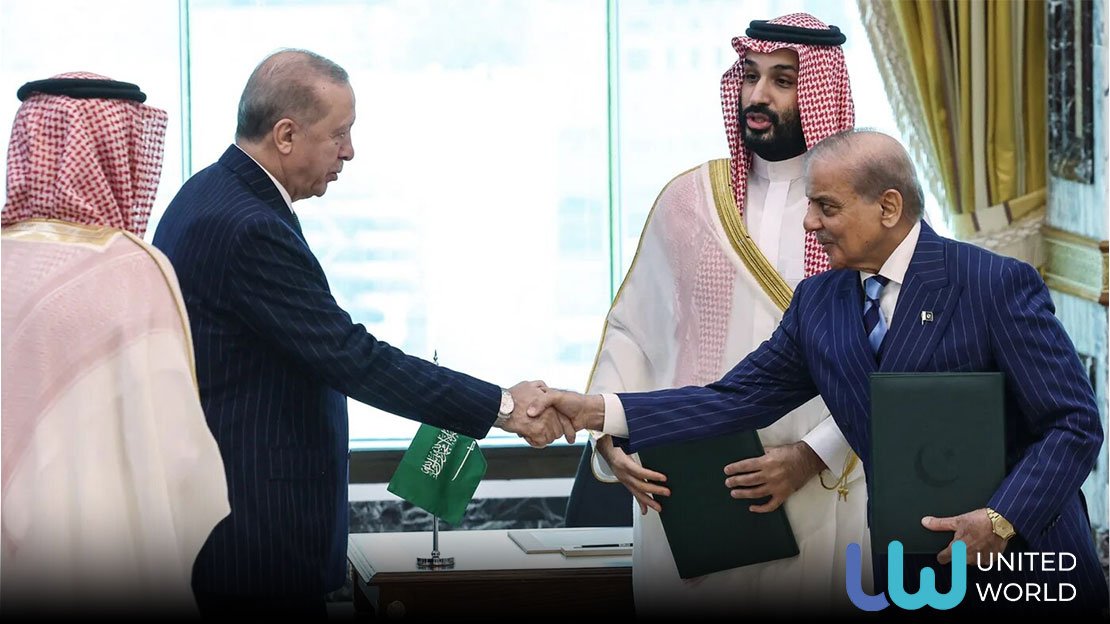
To answer the question posed in the title of this article, it is useful to outline certain contextual facts regarding the conjunctural background of the Mecca Agreement, signed between Türkiye, Pakistan, and Saudi Arabia, which is stated to be the result of approximately 2.5 years of preparation.
To summarize:
1. The global weakening of American hegemony has two fundamental consequences for West Asia:
1.1. In connection with rising multipolarity dynamics, centrifugal tendencies in relations with the U.S. are strengthening among West Asian states, as in the rest of the world.
1.2. The U.S., recognizing this reality, has changed its strategy towards the region. Washington has – at least temporarily, and particularly towards states it considers close – put aside its project of designing the region as a whole by foregrounding ethnic and religious organizations. Instead of its project of directly designing the region, Washington has shifted towards a strategy of controlling the region by opening up room for maneuver to states it considers close to itself. This strategy requires a flexible approach that opens space for new alliances. The U.S. administration has not refrained from announcing this new tendency on multiple occasions through the statements of U.S. Ambassador to Ankara, Tom Barrack.
2. Considering the general political tendencies and regional policies of the signatory administrations, the Mecca Agreement cannot be defined as an agreement against the U.S. and Israel.
3. In other words, the Mecca Agreement is not an agreement made despite the U.S., on the contrary, it is an agreement to fill up the geopolitical space opened – or forced to be opened – by the U.S., but still in a manner consistent with the U.S.
4. Liberating the “Middle East” from the U.S./Israeli grip and truly transforming it into “West Asia” is only possible by establishing a Türkiye-Iran-Egypt equation outside of U.S. plans.
5. Considering the current administrative structures and economic dynamics of Saudi Arabia and Pakistan, it is not possible to say that they can have tendencies independent of the U.S. While Saudi Arabia has taken a position alongside the U.S. in the war against Iran, Pakistan has functioned as an open channel between Washington and Tehran with U.S. approval.
6. When evaluating the Mecca Agreement, it is useful to consider the decisions taken against Iran at the NATO Summit held in Ankara.
7. In Türkiye, there are many signs that the government has recently moved considerably away from a controlled “policy of balance” between East and West and has entered a foreign policy approach that prioritizes relations with the U.S. The tendencies in the AKP administration’s stance on the Iran and Ukraine issues, as well as steps taken in bilateral relations with the U.S., are concrete facts in this regard.
8. There is no indication that the Mecca Agreement creates any pressure on Israel, the U.S.’s strategic ally in the region.
9. In its current form, the agreement resembles CENTO, which was established in 1955 under the direction of the U.S./U.K.
10. Agreements and alliances that ignore the decline of the U.S. and the parallel rising trend of multipolarity can’t be sustainable for long.
11. The full independence of West Asian countries and the end of the Israeli occupation in Palestine are only possible through politics and alliances that take a stance the projects of the U.S. and Israel in the region.
Within this framework, the Mecca Agreement can’t be considered an agreement that threatens the interests of the U.S. and Israel in the region and/or strengthens the trend towards multipolarity in the region.
The way to overcome the plan, announced through Tom Barrack by Washington, which targets nation-states, nations, and republics in the region, supports monarchies aligned with the U.S., and on the other hand aims to provoke the Sunni-Shia divide in the region, lies in the coming together of Türkiye, Egypt, and Iran – countries that possess a state tradition and have a genuine national identity in the region.