


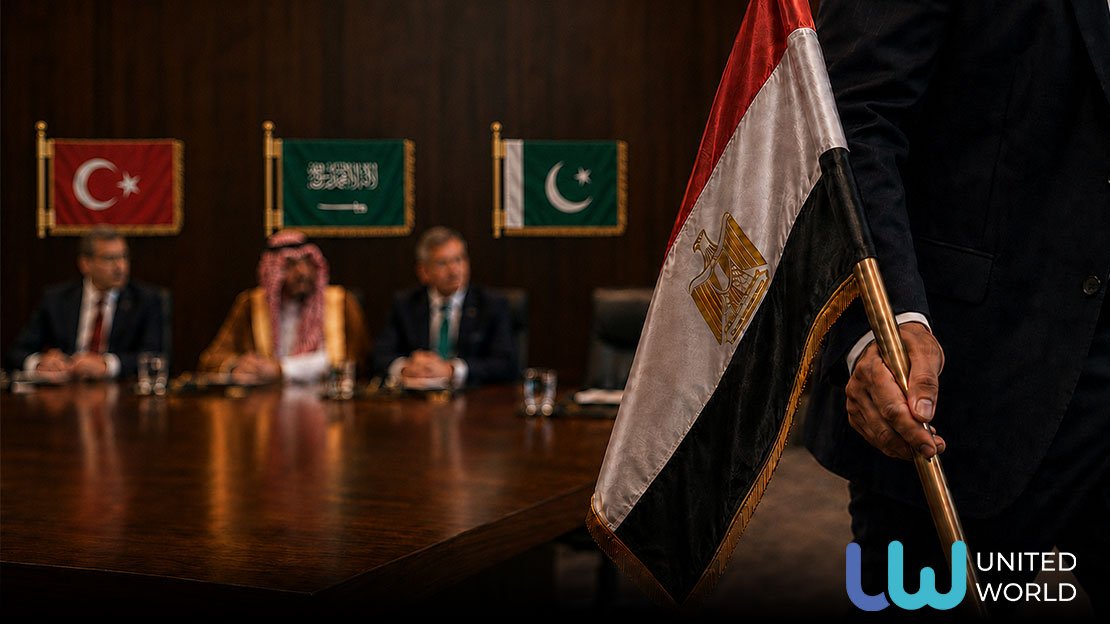
Egypt has not been absent from the regional coordination landscape, nor does it need to prove its presence by joining new military alliances or blocs. Cairo remains committed to coordination with its partners, foremost among them Saudi Arabia, Türkiye, and Pakistan, but on its own terms and in line with its national interests and established principles. At the heart of this approach is Egypt’s longstanding rejection of a politics of blocs and alliances, together with its commitment to strategic balance and openness to all.
Cairo starts from the conviction that the Arab Joint Defense Treaty already provides an established framework for Arab security cooperation, and that the security of the Gulf is an integral part of Egyptian national security. Egypt therefore sees no need for new treaties that would expand its military commitments beyond its immediate priorities. For Cairo, the real measure is not the number of alliances it joins, but its ability to protect its interests and strategic environment and to deter any threat to its security.
This explains why Egypt’s priorities remain closely tied to the issues most directly connected to its national security: the Palestinian cause, the Horn of Africa, the Red Sea, Sudan, Libya, border security, and strategic waterways. At the forefront of these priorities is Palestine, which remains a central Egyptian concern—not only because of history and geography, but because of its direct connection to Egypt’s national security and regional stability.
At the same time, Cairo regards development as a national-security imperative no less important than military preparedness and sees the building of Egypt’s comprehensive national power as the ultimate guarantee of an independent foreign policy and the ability to safeguard national interests.
From this perspective, Cairo sees little value in becoming absorbed in media-driven debates such as: “Why was Egypt excluded from the Big Three alliance?” only for the narrative to shift to another question: “Why was Cairo absent?” Egypt does not measure its role by its presence in every new regional arrangement. Rather, it measures its engagement by whether such arrangements serve its genuine interests and whether they enable Cairo to use its relationships and partnerships effectively in pursuit of its national and regional objectives.
Egyptian sources familiar with the matter point to several attempts to undermine Cairo’s relations with Saudi Arabia, Türkiye, and Pakistan. Yet the Egyptian assessment is that these relationships are deeper and more firmly rooted than to be easily disrupted by campaigns or attempts at polarization. Cairo, in this context, remains committed to a policy of “extended hands” toward all, maintaining channels of dialogue and coordination that enable it to play the role of a trusted mediator and interlocutor, particularly in addressing disputes within the Arab and Gulf arenas.
When Egypt coordinates with the four-country group, it does not do so to target any particular party, nor does it approach cooperation through a religious, ethnic, or sectarian lens. Cairo is far removed from building alliances on such foundations. It views partnerships instead as instruments for promoting stability, resolving disputes peacefully, and advancing common interests. Ultimately, Egypt’s priority is not to increase commitments or risks, but to improve the lives of its citizens, preserve stability, build a stronger economy and a more capable state, and protect national security.
But if this is indeed the Egyptian vision, Cairo will certainly choose the appropriate moment to explain its policy and the parameters of its position, based on its own calculations rather than in response to pressure or media-driven debates. Egypt coordinates strongly, but does not form alliances against anyone; it strengthens partnerships, but does not enter closed alignments; and it is a peace-loving power, but one strong enough to deter aggression.
This is precisely what distinguishes Egypt’s approach: its decision to remain outside military blocs and alliances is not a temporary position, but part of a longstanding strategic tradition based on balance, autonomy, and diversified partnerships. Cairo can therefore participate actively in the four-way coordination with Saudi Arabia, Türkiye, and Pakistan on issues that require it, while maintaining open relations with all sides and preserving its ability to engage different actors.
In Egypt’s broader strategic calculus, comprehensive national power cannot be built through alliances alone. It rests on a strong economy, sustainable development, a resilient society, capable armed forces, effective diplomacy, balanced international and regional relationships, and a stable strategic environment. The battle for development is therefore inseparable from the battle for security, just as protecting Egyptian interests in Palestine, the Horn of Africa, the Red Sea, Sudan, and Libya is inseparable from strengthening the state at home.
Egypt does not need a new alliance to be present, nor a bloc to be influential. It needs to know where its real interests lie, possess the comprehensive national power to protect them, and have the diplomacy necessary to defend them—while retaining the flexibility to extend its hand to all without compromising its principles.
Egypt’s Strategic Space: Absence, Autonomy and the Future of Regional Security
Egypt’s absence from the Saudi-Turkish-Pakistani defense agreement should not be read simply as a gap in the emerging regional security map. More importantly, it raises a broader question about the kind of regional order Cairo wants to see—and the role it intends to play in shaping it.
For decades, Egypt has been one of the principal pillars of the Arab regional system. Its geographical position, military capabilities, control of the Suez Canal, proximity to Gaza and the Red Sea, and diplomatic relationships with virtually all major regional actors have given Cairo a strategic weight that cannot easily be replaced.
Yet Egypt has also learned that strategic weight does not necessarily require permanent military commitments.
This distinction may explain much of Cairo’s current position.
The Difference Between Influence and Alliance
The emerging regional landscape is increasingly characterized by a paradox. On the one hand, countries are seeking greater strategic autonomy and are less willing to depend entirely on external security guarantees. On the other, they are simultaneously building new partnerships that could, under certain circumstances, create competing military blocs.
For Egypt, the challenge is to strengthen regional security without becoming trapped inside a rigid alliance structure.
This is particularly important because Cairo’s security interests extend across several interconnected theatres. Gaza and Sinai are directly linked to Egyptian national security. The instability in Sudan affects Egypt’s southern strategic depth. Libya remains critical to its western security. The Red Sea and Bab el-Mandeb are essential to both Egyptian maritime interests and the revenues of the Suez Canal. The Nile and the dispute over the Grand Ethiopian Renaissance Dam constitute a separate and highly sensitive dimension of national security.
None of these files can be managed through a single military alliance.
Indeed, Egypt’s strategic geography requires something broader: the ability to communicate with opposing camps, mediate between adversaries, and preserve the freedom to act when its vital interests are directly threatened.
This is why the distinction between strategic partnership and collective defense matters so much.
Egypt can conduct joint military exercises with a country without becoming committed to fighting alongside it in every future conflict. It can deepen defense-industrial cooperation without accepting automatic military obligations. It can coordinate politically with several states while retaining the ability to adopt an independent position when national interests require it.
That flexibility has increasingly become an asset rather than a weakness.
Cairo’s Strategic Equation Is Wider Than the Gulf
The Saudi-Turkish-Pakistani agreement is largely understandable through the security concerns of its three signatories. But Egypt’s strategic equation is wider.
For Riyadh, Gulf security and the threat posed by missiles, drones and regional instability are central considerations. For Ankara, the security environment stretches from Syria and Iraq to the Eastern Mediterranean and the Caucasus. For Islamabad, the relationship with India remains the dominant strategic reference point.
Egypt cannot simply adopt any one of these threat perceptions as its own.
Its security doctrine is shaped by a different geography.
This does not mean that Egypt is detached from Gulf security. Quite the opposite. The stability of Saudi Arabia and the Gulf is deeply connected to Egyptian interests. Egyptian security itself has historically been linked to the security of the Red Sea, the Arab Gulf and the broader Arab system.
But Cairo may prefer a regional security architecture in which Gulf security is protected without automatically turning every regional confrontation into a wider military conflict.
This could become increasingly important as the Middle East moves away from the old assumption that security must ultimately be guaranteed by an external power.
The Palestinian Question Changes Everything
There is another factor that makes Egypt’s position particularly distinctive: Palestine.
For Cairo, the war in Gaza is not simply another regional crisis. It directly affects Egyptian national security, the stability of Sinai, the future of the Palestinian cause and the architecture of the Arab regional order.
Egypt has consistently rejected any attempt to resolve the Palestinian question through the displacement of Palestinians or the permanent alteration of Gaza’s demographic and political reality.
This position has strategic consequences
A regional security arrangement that does not place the Palestinian issue at the center of its calculations risks addressing symptoms while leaving one of the principal sources of instability untouched.
From Cairo’s perspective, sustainable regional security cannot be constructed solely through military deterrence. It also requires political solutions to the conflicts that continue to generate instability.
This is one reason why Egypt may resist being absorbed into an emerging military bloc before the contours of the regional order become clearer.
The India-Pakistan Factor
The India-Pakistan equation presents another complication. Egypt has invested heavily in developing its relationship with India, which has become an increasingly important economic, political and defense partner. India is also emerging as one of the most influential powers in the broader transformation of the international system, particularly through its role in BRICS and its expanding relations with the Middle East.
At the same time, Pakistan remains an important Egyptian partner. This creates a delicate balancing equation. Cairo has no interest in allowing its relationship with Islamabad to come at the expense of its growing partnership with New Delhi. Nor does it want its relations with India to weaken its traditional ties with Pakistan.
A binding defense arrangement could complicate precisely this type of multi-directional diplomacy.
Egypt’s approach therefore appears consistent with a broader principle: partnerships should reinforce national strategic autonomy, not reduce it.
Iran Is an Even More Sensitive Test
The Iranian equation is perhaps even more revealing. Egypt has legitimate concerns about regional instability and has supported the security of the Gulf states. At the same time, Cairo has maintained channels of communication with Tehran and has generally avoided transforming political disagreements into a permanent military confrontation.
This is not neutrality for its own sake.
It reflects an Egyptian understanding that regional security cannot be built by permanently dividing the Middle East into opposing camps.
Egypt has repeatedly sought to preserve channels that could become useful during crises. Its diplomatic value often lies precisely in its ability to speak to actors who do not speak easily to one another.
Joining a formal collective-defense arrangement could narrow that diplomatic space.
The question, therefore, is not whether Egypt supports the security of Saudi Arabia, Türkiye or Pakistan. It clearly has important interests in maintaining strong relations with all three.
The question is whether Egypt wants these relationships transformed into automatic military obligations.
At present, the answer appears to be more cautious.
A Regional Architecture Still Under Construction
The most important point is that the new trilateral agreement may represent only the beginning of a larger process.
The Middle East is moving through a period in which traditional alliances are being reconsidered, new partnerships are emerging, and middle powers are seeking greater autonomy.
Saudi Arabia is diversifying its strategic partnerships. Türkiye is expanding its defense-industrial and geopolitical reach. Pakistan is seeking to strengthen its position amid a changing Asian and Middle Eastern environment. Egypt is pursuing its own network of relationships across the Arab world, Africa, Asia and Europe.
These developments do not necessarily point toward the emergence of a single regional alliance. They could instead produce a more complex system of overlapping partnerships.
In such a system, countries cooperate on defense, energy, trade, intelligence, infrastructure and crisis management without necessarily becoming members of a single rigid bloc.
That model may ultimately be closer to Egypt’s strategic preference.
The Question Is Not Whether Egypt Will Join—But What It Will Seek
For this reason, the current Egyptian position should not be interpreted as a final rejection.
If the trilateral framework evolves, its future shape could change substantially. Its institutional structure, rules of engagement, decision-making procedures and relationship with other regional powers will all matter.
If the agreement becomes a flexible mechanism for consultation, deterrence and defense cooperation, Egypt could find ways to participate without abandoning its strategic autonomy.
If, however, it develops into a rigid military alliance with clearly defined enemies or automatic obligations, Cairo’s calculations would become considerably more complicated. Egypt would then have to assess not only the benefits of membership but also the strategic costs.
The country may ultimately demand three conditions before considering any deeper commitment: clarity of obligations, respect for national decision-making, and a broader regional framework that does not reduce security to military confrontation.
This would be entirely consistent with Egypt’s traditional approach.
Cairo does not need to be present in every institutional arrangement to remain central to regional security.
Its influence comes from something more fundamental: geography, military weight, diplomatic reach and its ability to communicate across regional divides.
The coming period may therefore reveal that Egypt’s temporary absence is not necessarily a sign of weakness or exclusion.
It may be a strategic pause.
And in a Middle East undergoing profound transformation, the ability to wait, observe, maintain multiple channels and choose the right moment to commit can itself become a form of power.
The real test for Cairo will be whether it can convert this strategic space into influence—helping shape the emerging regional security architecture rather than merely responding to it.
Egypt may be outside the agreement today. But the more important question is whether any future regional security architecture can remain viable without Egypt.