


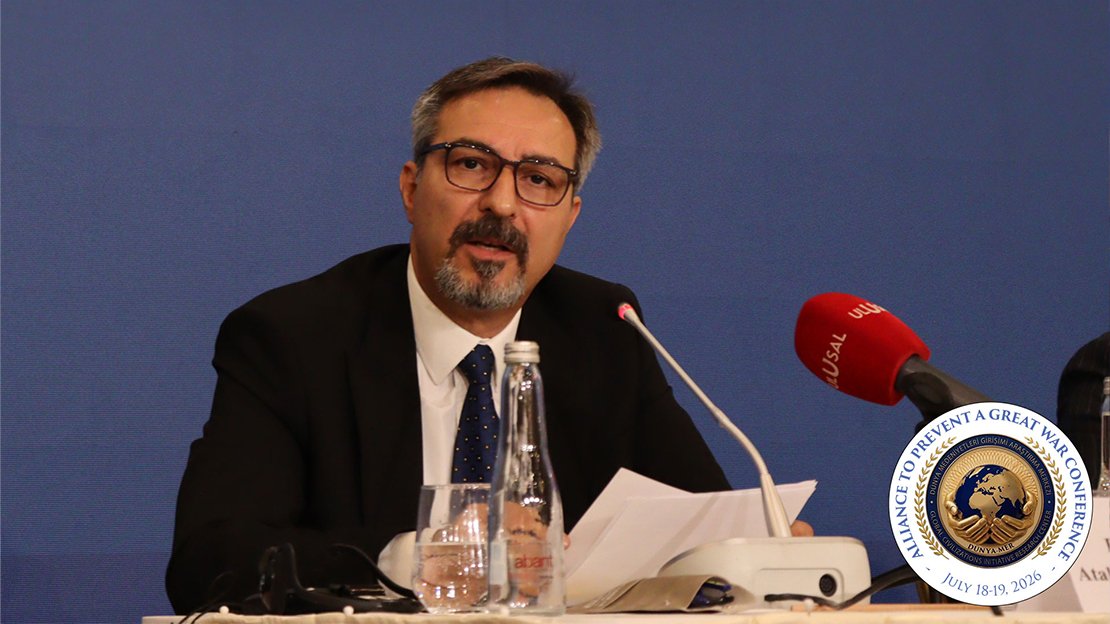
By Prof. Dr. Atakan Hatipoğlu, Faculty Member of Political and Social Sciences, Aydın Adnan Menderes University
The international conference entitled “The Alliance to Prevent a Great War,” organized by the World Civilizations Initiative Research Center, was held at the Meyra Palace Hotel in Ankara on 18–19 July 2026.
UWI will present the speeches held on the conference during the coming days.
The conference, which featured presentations by speakers from Azerbaijan, Belarus, France, Germany, Greece, Iran, Italy, Japan, Russia, the Sahrawi Arab Democratic Republic, South Africa, Spain, Switzerland, the Turkish Republic of Northern Cyprus (TRNC), Türkiye, the United Kingdom, and the United States, was attended by approximately 200 distinguished invited guests.
Ministers, members of parliament, ambassadors, retired generals, scholars, politicians, diplomats, military officers, and experts examined the question of the “Alliance to Prevent a Great War” from a wide range of perspectives.
Below, we present the speech of Prof. Atakan Hatipoğlu. The title was set by UWI.
I will try to complete my remarks within the allotted time. First, the structure of NATO and the problems faced by Türkiye as a NATO member state; second, the conditions of war, which is the topic of this symposium; and third, what needs to be done.
When we look at the history of NATO, it becomes evident that all the defense strategies it developed were a reflection of US national security strategies. NATO designated its first defense strategy as massive retaliation based on nuclear superiority. This was because, when World War II ended, the United States possessed an undisputed nuclear superiority. Consequently, it had the capability to strike a single, decisive blow against the enemy.
However, the Soviet Union also becoming a nuclear power led to the adoption of the flexible response strategy and caused the United States to abandon its guarantee of defending all NATO member states under its wing—meaning it effectively placed itself under protection. In this process, Türkiye, as a NATO member and a flank country, did not possess the guarantee of being protected by the United States in a potential World War III.
After the dissolution of the Soviet Union, debates took place regarding the idea that NATO’s purpose had disappeared. Yet, as a requirement of its own international hegemony, the United States chose to organize NATO as an intervention force in crisis regions and to define new types of threats, such as terrorism, mass migration, and the like. Today, the United States is once again attempting to chart a new path for NATO as part of its national security strategy against powers that threaten US global hegemony.
When we look at individual countries—and we experienced this much more distinctly as a NATO member state—at its core, this position entails acting as a watchdog for imperialist interests. We can even say that when we were admitted into NATO, it was partly because we promised to support military interventions in the Middle East. Ultimately, we see that we are in a position of defining ourselves within US interests, and other countries share this same position.
The United States has never viewed Türkiye or other NATO member states as equal partners. One of the standard debates at all NATO summits is that other NATO member states criticize the United States for taking decisions on its own initiative without consulting them, making binding statements, and failing to distribute power equally. We see that in 1967, Charles de Gaulle withdrew France from NATO’s military command over these criticisms, and following the 1968 invasion of Czechoslovakia, Canada and other countries criticized the United States for issuing binding statements on behalf of NATO without consulting the alliance.
Looking at this from our perspective, we see that NATO membership and a policy of balance cannot be pursued together. Today, the Turkish government claims to pursue a policy of balance. However, NATO membership entails certain binding commitments that make pursuing a policy of balance impossible.
We see that Atatürk’s foreign policy was a balanced policy—a region-centered, balanced policy based on the principle of full independence. A policy of balance, in a generic sense, is a type of policy that can be described as taking advantage of cracks between major imperialist powers and swinging between their pressures on you. In our own history, the policy pursued by Abdulhamid II or the policy pursued by İsmet İnönü during the World War II years can be defined as a policy of balance. However, Atatürkist foreign policy differs in that it is not merely a policy of balance, but a region-centered, fully independent, and balanced policy.
Full independence means complete independence in economic, political, financial, judicial, military, social, and cultural spheres. It is based on relying on the nation’s own strength. An economic structure dependent on borrowing or a security framework relying on weapons whose operation codes belong to other countries cannot be reconciled with the concept of full independence.
Throughout the NATO era, instead of relying on its own national intellect and interests for national security, Türkiye configured itself based on the threats defined and assigned by NATO, and by the United States at the core of NATO. This also led to certain economic problems; for example, Türkiye was virtually forced to purchase arms far beyond its actual needs.
The second principle of an Atatürkist foreign policy, alongside the principle of full independence, rests on the reality that the Turkish nation is Asian. Having led the liberation struggles of oppressed nations, Türkiye is objectively not part of the imperialist bloc or of those trying to partition the world. Furthermore, Türkiye’s geopolitical position requires it to follow a course in line with the Eurasian reality.
Thirdly, throughout history, Turks have always turned their faces toward the civilization centers of the world. As part of Islamic civilization, they played leading roles; though they missed the Industrial Revolution, they spent 200 years searching for ways to become part of Western civilization. Today, becoming part of the rising Asian civilization is a logical requirement of the historical journey of the Turks.
We can speak of a “NATO law.” If NATO member countries are externally under American control due to bilateral agreements or favorable international conditions, a period of internal stability occurs in those countries. However, if international conditions begin to encourage those countries to act more independently, the NATO law comes into play, and a process of internal destabilization begins in those countries.
For instance, when Türkiye realized after the 1967 flexible response doctrine that it would not be protected or supported in a potential war, and as domestic political developments in Türkiye began showing tendencies to slip out of control due to the rise of independent movements, a destabilization operation was launched in Türkiye. Throughout the 1970s, Türkiye was subjected to an operation bordering on civil war conditions, where 90% of the weapons seized in terror incidents were manufactured in NATO member countries.
Likewise, after the dissolution of the Soviet Union, as Türkiye’s tendencies to move along its own independent course increased, it was once again subjected to an internal destabilization operation, encountering issues such as intellectual assassinations and mass provocations. Therefore, attempting both to remain a NATO member and to pursue an independent policy brings with it exposure to this NATO law internally—that is, exposure to destabilization operations.
NATO member countries have sufficiently demonstrated through their patronage of ASALA terrorism, PKK terrorism, or the perpetrators of the July 15 coup attempt that they do not hold a friendly attitude toward Türkiye. Türkiye has suffered certain losses within NATO and the broader Western system: losing the opportunity to complete the Kemalist revolution, acquiring an economic system with structural distortions by articulating into Western capitalism, the tendency of foreign aid to create dependency, the Gladio regime, military coups, the sabotage of development plans, the demonization of the left, the destruction of a healthy dialogue ground between the left and the right, and the toxic social and cultural effects of Eurocentric ideological deviation and socio-cultural decay.
Under these conditions, we are discussing the possibility of war. When we look at the parameters of this possibility, we see the following: First, since 1971, when US President Nixon uncoupled the dollar from gold, the Western system has essentially uncoupled from production through the circulation of unbacked currency worldwide. This has allowed a ruling class—a rentier class making money from money—to take power in the United States and impose this model on the world.
Today, global trade volume stands at around 35 trillion dollars. The primary source of American hegemony is the trust felt toward this currency and the global acceptance of its circulation in trade. However, the fundamental contradiction is that while the world is being dollarized, the share of the United States—the owner of the currency that is supposed to make us trust that money—in the global economy is rapidly declining. In other words, the dollar, which was trusted based on American power after the 1970s, is today, under conditions where that power has vanished, literally an unbacked and untrustworthy currency.
The United States is trying to maintain its hegemony by circulating the dollar, but since it has lost the elements of trust, it has only one factor left in its hands: terrorizing the world, leveraging its military superiority to constantly ignite regional conflicts—as we have seen in Iraq, Libya, Somalia, Afghanistan, and other countries—and imposing a constant state of instability upon the world.
However, the flight from the dollar is an unstoppable movement because the objective conditions for the United States to impose the dollar have disappeared. Today, while humanity tends to seek a currency linked to economic power to replace the dollar, it is simultaneously experiencing the terrorized climate imposed from top to bottom based on American armed force.
Yet, the problem we face has a scope that spreads into different areas not limited to economic parameters. The unbacked nature of the dollar and the Western system’s detachment from production bring along the mafia-ization of the rentier bourgeoisie and an environment where a West detached from the material production of humanity finds it impossible to repeatedly offer values that will reproduce humanity.
What do we mean by this? Social institutions, cultural values, and relationships make a society an organized entity. A society being organized is closely related to the organization of economic life. If you do not organize economic life on the basis of concrete material production—namely agriculture, livestock, industry, mining, and similar fields—and instead base it on money-centered systems, hot money circulation, and derivative markets, after a while, you also lose your ability to reproduce social relations, institutions, and cultural values.
This is why today, the West exports to the world not just hot money, but also a series of problems: authoritarian populism and neo-fascism in politics; and drugs, psychological destruction, LGBT, transhumanism, individualism, consumerism, and the collapse of the family, religious values, and education on the cultural plane. Therefore, the issue we are discussing is not merely economic; it pertains to the entirety of an economic, social, cultural, and political package—a civilizational choice before humanity.
In the discipline of political history, centuries are not expressed chronologically. For example, the 20th century does not begin in the year 1900. It begins in 1914 with World War I, because the balances and relationships of the major political powers that will stamp that century shape it. Looking at it from this perspective, we see that we have not yet entered the 21st century. We are living in a prolonged 20th century because the forces that will shape the 21st century have not yet stamped their imprint on it.
Furthermore, looking at political history, we see that in the formation of dominant powers that enable one century to replace another, a dominant power has never voluntarily vacated its place without a fight. Today, the fundamental issue before the United States, and consequently before humanity, is whether the United States—having lost its ability to dominate the world and be a dominant power—can be persuaded to vacate its position peacefully. Will it fight? Will humanity open the 21st century by defeating it in war? Or will the United States be provided with the opportunity for an honorable defeat?
What I mean by an honorable defeat is persuading the US to accept a defeat that can be framed as “defeated on this path, yet victorious,” while creating the conditions for it to present this to its own public and world public opinion not as a defeat, but as a kind of victory.
Wars are fought to win, not to lose, and they are initiated when the calculation of winning holds true. The United States cannot initiate an all-out war unless it has the hope of winning. So, what are the factors that would give it this hope and courage?
When we look at these factors collectively, we see the following: First, the failure of rising Asian powers to form an alliance, remaining scattered and fragmented, will be a factor that emboldens the United States.
Second, because the American ruling class—the Bushes, Obamas, Bidens, Trumps—are spokespersons for the rentier, mafiocratic bourgeoisie they represent, they have disconnected from the collective conscience of humanity; thus, their ability to evaluate a war with responsibility and conscience has largely weakened. This is why they can tell lies so easily. We saw this in the case of Iran: Trump repeatedly lied to humanity before our eyes, claiming he gave Iran an unforgettable lesson, that they were defeated, apologizing, and so forth. The existence of a post-truth landscape is not independent of these factors of rentierism and mafia-ization.
However, there are also factors working against war. One of these is the uncertainty regarding the future of NATO. At the Ankara summit, the United States made a decision to distribute the economic burden of NATO to Europe. Europe also appeared willing. But will a NATO with more balanced economic power distribution also equally share the military power, intelligence power, communication power, technological power, and political power of the United States that has dominated NATO until now? Or will an actual state of inequality and hierarchy persist, where Europe merely assumes the economic burden while the United States refuses to relinquish its role as a primus inter pares in other domains? If the latter occurs, it will not be easy to persuade other NATO countries to fight alongside the United States as a homogeneous bloc.
Furthermore, what we call war will no longer resemble previous wars. Looking at studies in the sociology of war, we see that the structure of warfare has transformed. First, this factor must be evaluated: a nuclear war is only possible under conditions where the striking party will not receive a similar counterstrike—where it can deliver a decisive, conclusive blow without facing a decisive counter-response. Otherwise, there will be no winner in this war. Therefore, the force executing a nuclear strike must have calculated that such an outcome is certain.
Is such a situation possible? In today’s world, are there conditions where a power striking its enemy with nuclear weapons can be certain that it will not receive a similar response or that a sustainable war will not follow—that reciprocal strikes will not continue? This needs to be discussed.
As for a conventional war, as I mentioned, it has undergone a transformation because it requires maintaining an agricultural, industrial, and mining infrastructure capable of continuously mobilizing massive human resources to sustain the war effort. However, we cannot say that either the American public or the European public is very eager for a conventional war.
On the other hand, the level that global and economic integration has reached today reveals certain sectors where opposing sides in a war are simultaneously integrated with one another. This will be another factor requiring second thoughts before waging war.
The shift of production to Asia today means that, in terms of conventional war deterrence elements, Asia has gained superiority over the United States and the West in certain sectors. However, the relative superiority of the United States and the West continues in areas such as intelligence and armed strength. Therefore, the possibility of war makes it difficult for us to make a definitive prediction.
However, we can determine what needs to be done. To prevent a potential war today, the first task—since I am speaking from Türkiye—is to define a responsibility regarding Türkiye. It is to make the alliance we refer to as TRCI (Türkiye-Russia-China-Iran) an option within the country itself, and to build a political balance of power that will enable Türkiye to adopt this orientation. We must build a TRCI arithmetic.
Second, until this happens, we must keep the government in Türkiye under democratic pressure—that is, we have a duty to build a public opinion that will put the government under democratic pressure to move in the direction of Asia, keep a distance from NATO (perhaps not leaving, but acting with more distance), and develop tighter relations with the rising Asia.
And thirdly, we must build this public opinion on a global scale as well. In other words, a global Asian alliance public opinion that will prevent a world war must be constructed. To this end, all anti-imperialist forces must act within a more intense, tighter institutionalization of relations.
There is a global vision we must put before us. We must contemplate the construction of a new global financial system, a new global reserve currency, and a new global defense and security doctrine. And overall, we must maintain a more visionary, broader-horizoned discussion on how a new system of international relations can be built.
An alliance centered on Türkiye, Russia, China, and Iran is the product of historical conditions and is objective. Because this geography is also a geography of empires, a geography of great states, and it possesses an axis that validates the “Law of National State Resistance,” put forward by the Vatan Party as a law of the globalization era.
Türkiye, in its own practice during the July 15 coup attempt, demonstrated that the national state will resist global integration, and that even if it does not fully enter the path of complete independence, it will not relinquish the national state-centered gains that enable it to enter that path.
Therefore, the upcoming period will be one in which the factors that will prevent war remain as vibrant and alive as the factors of war itself.
I conclude my remarks with a quote from Great Atatürk, the founder of the Republic of Türkiye: “Peace at home, peace in the world.”
Respectfully yours.