


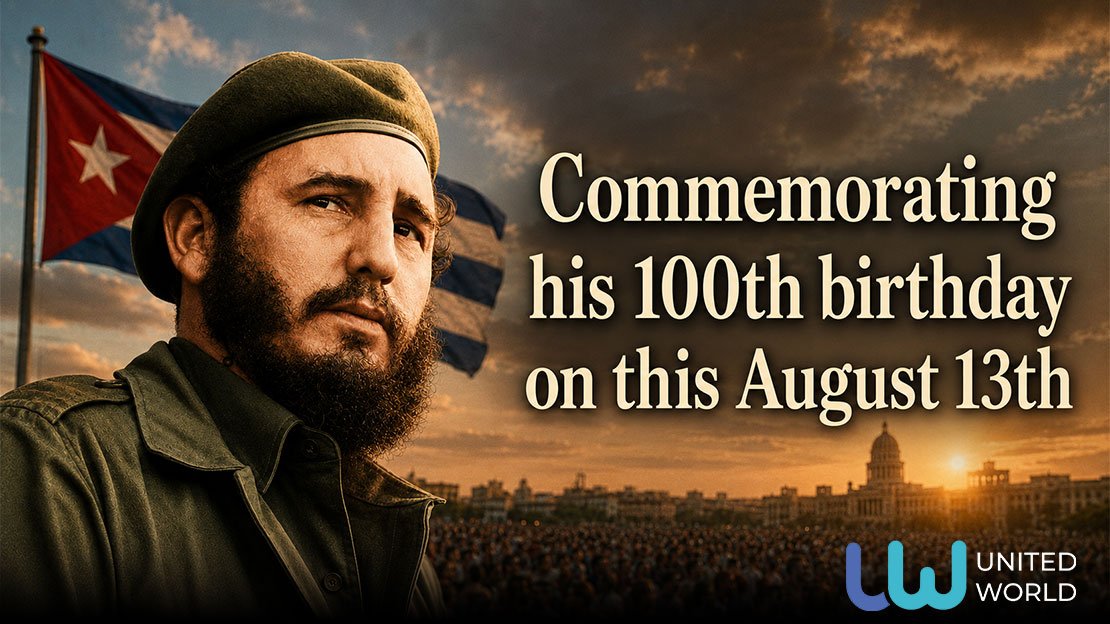
Note: The following lines are an excerpt from a book in progress in which I recount some of the vicissitudes of my life. In this instance, I reveal for the first time the details of my first personal encounter with Fidel. I had been with him as part of the group preparing to travel to Nicaragua to join that country’s war of liberation, but this was the first of several private and confidential meetings. At that time, I was a member of the Communist Party of Chile, and in that capacity, I assumed a responsibility that led me to meet and work with Fidel on a specific mission I was given. Here is the text:
The next day, very early, I returned to the safe house and resumed my routine. After a while, Fernando arrived and told me I shouldn’t go out and to expect visitors. However, the day passed without anything happening. Nevertheless, almost at the end of the afternoon, as it was getting dark, Alejandro appeared. Contrary to his usual calm demeanor, he was agitated. He told me to get dressed and ready quickly to leave. I asked him if I needed to take anything, and he said no, reiterating that I should hurry.
A few minutes later, we were speeding off down 5th Avenue. He never once told me what it was about; strangely, given how talkative he usually was, he was silent. I understood that I shouldn’t ask questions. When we reached Paseo Avenue, we turned right and started going uphill. I very faintly began to suspect something, but it was so far-fetched that I told myself what I was thinking was impossible. I started to consider possible scenarios. When we reached Revolution Square, we turned left toward the Ministry of the Interior building. The possibility of another meeting with General Abrantes was now off the table.
We turned right and quickly entered the parking area of the Palace of the Revolution. There was the answer: Commander Piñeiro had decided to meet with me and had asked Alejandro to take me. The Palace of the Revolution, seat of the highest political and governmental bodies in Cuba, is divided into two parts: the Central Committee of the Communist Party of Cuba operates in the west wing, which we passed by. The likely meeting with Piñeiro had been ruled out.
In the east wing are the offices of the Council of State, including those of the President of the Council of State. At that moment, I began to get nervous. Alejandro remained impassive. We were received in the basement, which is located beneath the grand staircase of the Palace. We went directly to an elevator. Alejandro finally spoke: “Do you know where we’re going?” I looked at him and said nothing; I couldn’t. What was going through my mind was so improbable that I preferred to remain silent. The only thing he told me was: “When someone asks you something, only answer if you know the answer. Don’t make things up or speculate.” A lesson that, from then on, became part of my daily life. Years later, when I had the good fortune to work with Commander Chávez, it proved extremely useful in my work.
The elevator stopped and we were shown into a waiting room. Silence filled the space. Neither of us spoke, we didn’t even look at each other! A few minutes passed that seemed like an eternity, the door opened and there he was, in his formidable stature—not only physical, but also ideological, political, and moral—the Commander-in-Chief of the Cuban Revolution, Fidel Castro Ruz. We stood up immediately. Instinctively, I went to attention. The years I had spent in the Armed Forces were forever etched in my memory, but this time my legs began to tremble. Luckily, at that moment his phone rang, and instead of going into the room, he went out into the hallway to take the call.
Alejandro, noticing my rapture and astonishment and the nervous movement of my legs, whispered in my ear, “Act like a man, damn it!” I managed to calm down in time to greet the Commander when he returned to the room.
He gave me a big hug, asked how things had gone in Chile and how my comrades were doing, we walked down the hall and into his office. Still not quite grasping the moment, I tried to take it all in. The office wasn’t very big and was simply furnished. Just his desk, a small bookcase, and a sitting room with a table and chairs—I imagine where he received guests, as in this case. I was struck by the fact that one of the few pictures there, besides the one of José Martí, was of Commander Camilo Cienfuegos. He gestured for us (Alejandro and me) to sit down in the sitting room. I couldn’t stop thinking that just 13 months ago, I had been a simple captain in the FAR (Revolutionary Armed Forces), and now I was in the Commander-in-Chief’s office, about to start a conversation with him.
He told me that Abrantes and Alejandro had informed him of my clandestine entry into Chile and my return to Havana, as well as the mission I had been entrusted with. He immediately indicated that he would, of course, receive the delegation from the leadership of the Communist Party of Chile (PCCh) who wished to come to Havana to discuss aspects of Cuba’s collaboration and support for the PCCh’s efforts in the fight against the dictatorship.
He asked me if I knew who was coming. I remembered Alejandro’s warning and told him no, but that I assumed it would be Roberto, head of the Military Commission. He then wanted to know who he was and what his real name was, and I told him I didn’t know. Much later, after the return to democracy, I learned that his name was Guillermo Teillier. I told him about my activities in Chile, my meetings with Salvador (Sergio Apablaza) and Rodrigo (Raúl Pellegrin), and informed him that they were the ones who had taken me to speak with Roberto, but I knew nothing more. He laughed a lot when I briefly recounted the epic journey from La Paz to Buenos Aires and how I had left Roberto waiting in that city. I explained what I knew about the Uprising Plan and the need to know if Cuba could support us with weapons, resources, and increased training for commanders and officers. In short, it was about ending the dictatorship.
Then he said something that surprised me, pointing to where I was and the path I was taking. The Commander said that in due time they would find out who Roberto was and learn his true identity, but that we, the officers of the Communist Party of Chile, both in our work in military units in Cuba and in carrying out missions in the Nicaraguan war and in the creation of the Sandinista People’s Army (EPS), had demonstrated a solid political and ideological foundation and a high level of professionalism. He added that if Salvador and Rodrigo were the ones who had brought me to Roberto and who had decided on my return to Cuba, that was sufficient proof for him to accept the visit and explore the possibilities of working together.
We delved into a profound analysis of the political situation in Chile. Like an avalanche, Fidel asked everything from the simplest things, like how soldiers sat when being transported in a truck for deployment, to the dismantling of the main units of the Chilean Armed Forces. I answered, always keeping Alejandro’s advice in mind. When I didn’t know something, I let him know. What seemed like a disjointed collection of data took shape when, after a long question-and-answer session, it transformed into a reflection on the enemy’s strengths and weaknesses, the foundations of Pinochet’s regime’s stability, the operational structure of his Armed Forces, and the elements upon which his economy rested, among other topics. I was astonished. I understood that I was in the presence of an exceptional person. I felt privileged to have had the opportunity to participate in that meeting. But it wasn’t over yet.
We moved on to discussing more specific topics. He asked me about Salvador, whom he knew and admired personally. He inquired about the other officers and how they had adapted to the country and what roles they were fulfilling. Without waiting for a visit from the CCP leadership, he decided that Cuba would collaborate. He immediately began taking steps. He said that since I had been the one to establish this connection, for security reasons I should also be the one to maintain it. The fewest possible people in Chile and Cuba should know the extent of this cooperation. I told him that I couldn’t decide that, that my leadership would, but that they would surely take his recommendations into account, especially those related to security. He considered my opinion correct.
We discussed the possibility of other socialist countries joining in this mission. Fidel considered it positive, particularly if the Soviet Union could provide assistance, but he felt it was necessary to assess the situation when such an eventuality arose and analyze each case individually.
I consulted him about our idea of sending weapons and logistical support by land with Nicaragua’s assistance, and he agreed, but warned that this had to be completely separate from Cuban support. He recommended that the logistical bases be entirely isolated from one another. In the end, the Commander-in-Chief, as if thinking aloud, was already speculating on the quantities and types of weapons and the costs of the operation.
Without realizing it, almost five hours had passed. During that entire time, he only got up once, for a few minutes, to take a phone call. Otherwise, the conversation was continuous and uninterrupted. Implying that the meeting was drawing to a close, he stood up and asked if there was anything pending. I explained that I had a meeting scheduled with Commander Piñeiro and asked him what I should do. He told me I should speak with him, and gesturing with his arm, indicated that I should only discuss political matters with Piñeiro. Anything related to our discussion about potential cooperation should remain between us. The only way to communicate would be through Alejandro. He then turned to Alejandro and ordered him to develop a disinformation plan. Alejandro was about to ask him something, but sensing what it was about, the Commander-in-Chief clarified: “Not for the enemy, but for our own.” With that, he adjourned the meeting.
We got out in silence; the car was waiting for us. Only when we were inside did Alejandro speak: “We’ll meet tomorrow to start working.” I could only manage to confirm. The emotions had been overwhelming; my brain was still processing everything that had happened. It was almost midnight on January 8, 1985. That day, my life changed forever.