


By Oscar Rotundo
What is happening in Bolivia today is not an isolated event or a passing conflict. It is the culmination of a historical process that began almost two decades ago, when a political and social transformation broke with centuries of inequality, and which today faces an attempt to reverse it, jeopardizing the very future of the country. To understand why the Bolivian people are demanding the resignation of President Rodrigo Paz Pereira, we must first look at what was built, what was lost, and what is at risk when a government serving the elites and foreign interests makes workers the primary victims of an austerity program that solves nothing but only deepens poverty.
The process that broke down: from transformative change to political fragmentation
Between 2006 and 2019, Bolivia was recognized throughout Latin America as the most ambitious experiment in social transformation. The gas industry was nationalized, revenues flowing to the state tripled, extreme poverty fell from 38 to 15 percent, and a Plurinational Constitution was approved that recognized collective rights, territorial autonomy, and the dignity of the Indigenous nations that had been excluded for centuries. This project was not the work of a single individual: it was the result of decades of struggle, marches, road blockades, grassroots assemblies, and social organizations that transformed discontent into real power. Miners, farmers, Indigenous communities, and workers from all sectors were the protagonists: they were subjects of rights, the decision-makers, the builders, and the recipients of their labor.
But that process began to deteriorate over time. Serious mistakes were made when the interests of extractivism clashed with territorial rights, the state apparatus sided with large corporations; laws were modified to allow indefinite re-elections, breaking the agreements that had built consensus; and, most seriously of all, the social organizations that had been the driving force behind change ceased to be spaces for deliberation and became tools for ratifying state power. When the state entered into crisis, the movements no longer had the autonomy to separate themselves from it.
Then came the 2019 coup, which left dozens dead and showed that the old order still held sway, followed by internal strife within the popular movement itself. The MAS, which had been the embodiment of hopes for change, splintered into factions that fought for power, resources, and candidacies, disregarding the interests of the people. Demonstrations ceased to be about demands and became instruments of pressure between opposing sides, while the social base grew disoriented, divided, and weary.
A government without a plan: The neoliberal adjustment that is imposed on everything that has been built
In August 2025, the defeat of the MAS was not the triumph of a stronger political force: it was the result of the popular movement being fractured, of people tired of broken promises, and of the alternative presented being a man who represented exactly what the process of change had fought against. Rodrigo Paz Pereira, a businessman from the private sector, owner of large businesses that had operated under both progressive and old-style governments, came to power with an empty promise: he spoke of “capitalism for all,” but what he delivered was a package of measures that exactly replicated the prescriptions of the International Monetary Fund and were identical to those applied in other countries in the region, such as the laws being promoted in Argentina.
The turning point came with the approval of Supreme Decree 5503, an instrument that modifies the role of the Central Bank, paves the way for unconditional foreign investment, grants tax breaks to large corporations, and dismantles the gains built up over years: it cuts subsidies, reduces the State’s presence in the economy, eliminates worker protections, and opens the door to the privatization of public companies. The government’s argument is that this serves to “stabilize the economy,” but the reality is very different: the prices of diesel, electricity, and food have skyrocketed, the minimum wage of 3,300 bolivianos is not even enough to cover half of the basic food basket, and workers, farmers, transporters, and all those who produce and sustain the country are the ones who pay the price for the adjustment.
What is even more serious is that this government is not only attacking the economy: it is also attacking institutions and democracy. To govern without checks and balances and without accountability, Decree 5515 was passed, creating the unconstitutional figure of the “Remote Presidency,” allowing the president to exercise his duties from abroad, as he did when he traveled to the World Economic Forum in Davos. At the same time, the vice president’s powers are being reduced, and his decision-making capacity is being diminished, while opposition is growing even within his own circle: Vice President Edmand Lara has joined the opposition, denouncing that Paz “was born with a silver spoon in his mouth” and that his government serves only the interests of the rich, while the poor subsidize the economic elites with their labor and their future.
The people rise up: from disillusionment to demands for resignation
When people realize that the promises were a lie, when they see their living conditions worsening every day and the government acting as if it doesn’t exist, the response is swift. What we see today in the streets of Bolivia is the return of historical memory: the people remember what was built, they remember that rights were respected before and that the State existed to protect them, and they are not willing to accept a return to the past.
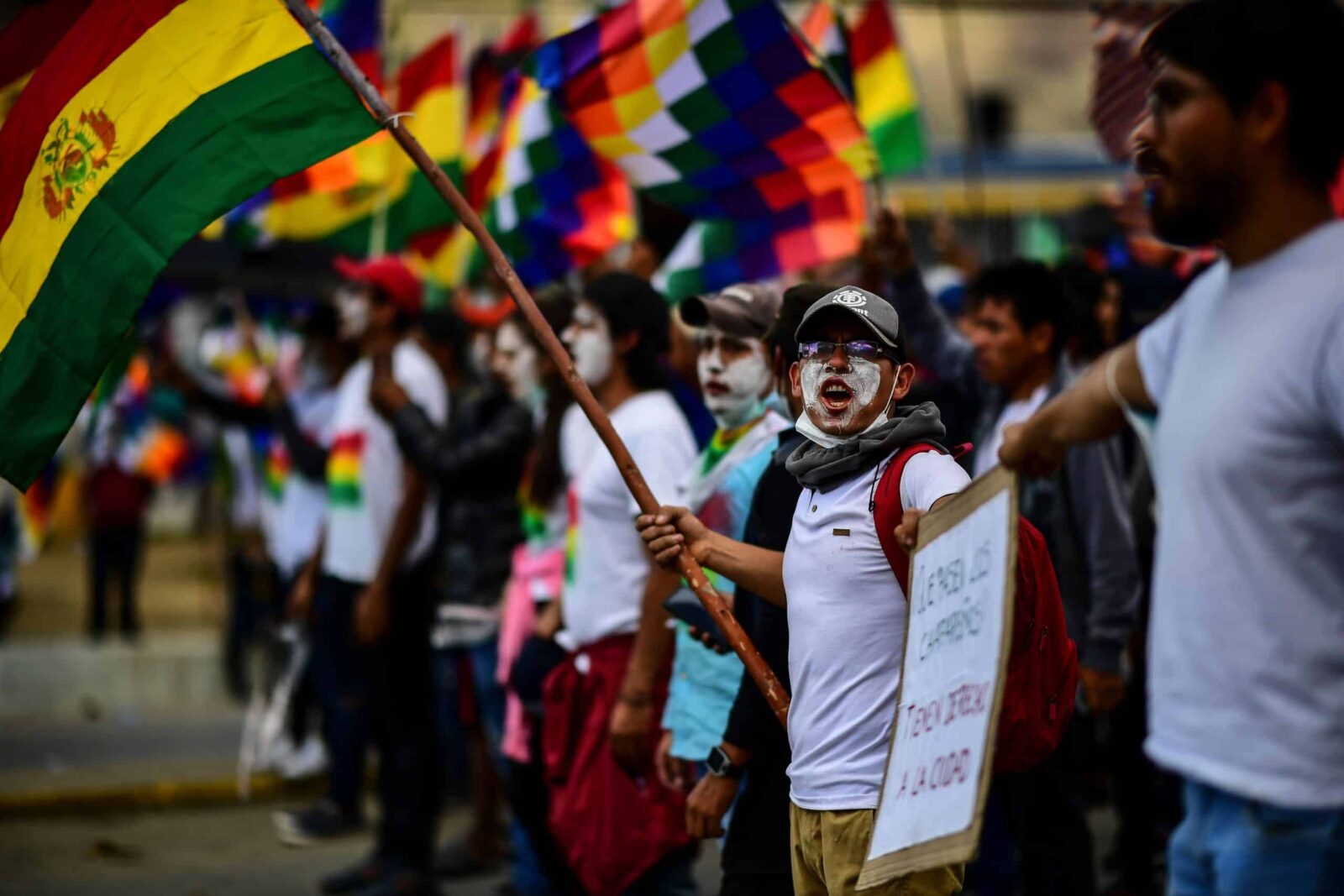
The Bolivian Workers’ Central Union, along with mining, peasant, teachers’, healthcare workers’, and Indigenous community organizations, have taken to the streets with a clear demand: the complete repeal of Decree 5503, decent wage increases, a halt to the privatization of state-owned companies, and, above all, the resignation of a president who no longer represents anyone but his friends and the powers that put him in office. The road blockades, demonstrations, and strikes are not acts of disorder, as the government tries to portray them: they are how people defend their rights when they have no other avenue to be heard.
Faced with resistance, Paz’s response has been repression: thousands of police and military personnel have been deployed, tear gas has been used against protesters, dozens of people have been arrested, and workers are being accused of being criminals or linked to drug trafficking. Measures such as the construction of “model” prisons have also been announced—a response presented as a solution to insecurity, but which is actually a way to militarize the state, divert attention from real problems, and apply the same authoritarian logic that has already proven to solve nothing, but only generates more violence. What the government seeks is to impose a vision that considers problems solved with higher walls and narrower cells, without addressing the root causes of inequality and poverty.
The meaning of the struggle: For a democracy at the service of the workers
What is at stake in Bolivia today is much more than the continuation of a president’s term. It is a question of what kind of democracy we want: one that serves those who work, produce, and build the country, or one that serves only the interests of powerful minorities and external powers.
The Bolivian people have learned from their history: they know that for years the State was a tool to protect them, to redistribute wealth, and to give a voice to those who were previously excluded. Now they see how that model is being destroyed and how the country is reverting to the logic of its resources going abroad or becoming concentrated in the hands of a few, while the majority continues to suffer. The struggle for Paz’s resignation is, at its core, a struggle to recover sovereignty, to defend what has been built, and to prevent the return of a model that has already proven to be unjust.
It is true that social movements went through difficult times, that there was division, and that the grassroots lost their way for a while. But that division is not permanent: the organizations still exist, the memory of what was achieved remains alive, and historical experience teaches that when workers unite and defend their rights, they are capable of changing the course of history. The interregnum that Bolivia is experiencing today—a moment in which the old order is not yet dead, and the new order has not yet been born—is both a danger and an opportunity: a danger because the damage could be irreversible if the austerity measures are allowed to proceed, but an opportunity because it is the moment in which stronger, more autonomous, and more conscious foundations can be rebuilt, foundations that are better equipped to construct a just country.
Bolivia has an advantage few countries possess: its people have a long memory. They know what was built, how it was built, and what mistakes were made. This memory doesn’t guarantee success, but it is the most valuable resource there is. Because democracy isn’t just about voting every so often: it’s about decisions being made with the people in mind, resources being distributed fairly, and no one being left behind. This is the democracy Bolivia is fighting for today, and it is for this democracy that the fight is worth continuing.
The Bolivian people are demanding Paz’s resignation because they understand that his government represents a step backward, because they know that the imposed austerity measures bring not progress, but only misery, and because they are determined to reclaim the leading role that is rightfully theirs. This is not a fight against a person, but a fight for the future of the country, for the dignity of the workers, and for building a society where everyone has a place.