


By Mohammad Sabreen, from Cairo / Egypt
Day after day, it becomes clearer to everyone that the war the United States and Israel are waging against Iran is not an easy walk or a swift military campaign. While the battles rage, the scope of the war expands, discontent grows, oil and gas prices are exploding, and fears of a severe inflationary wave are escalating. However, the fundamental question is whether Washington will achieve its goal, which is to get rid of the old Iran and engineer a new one.
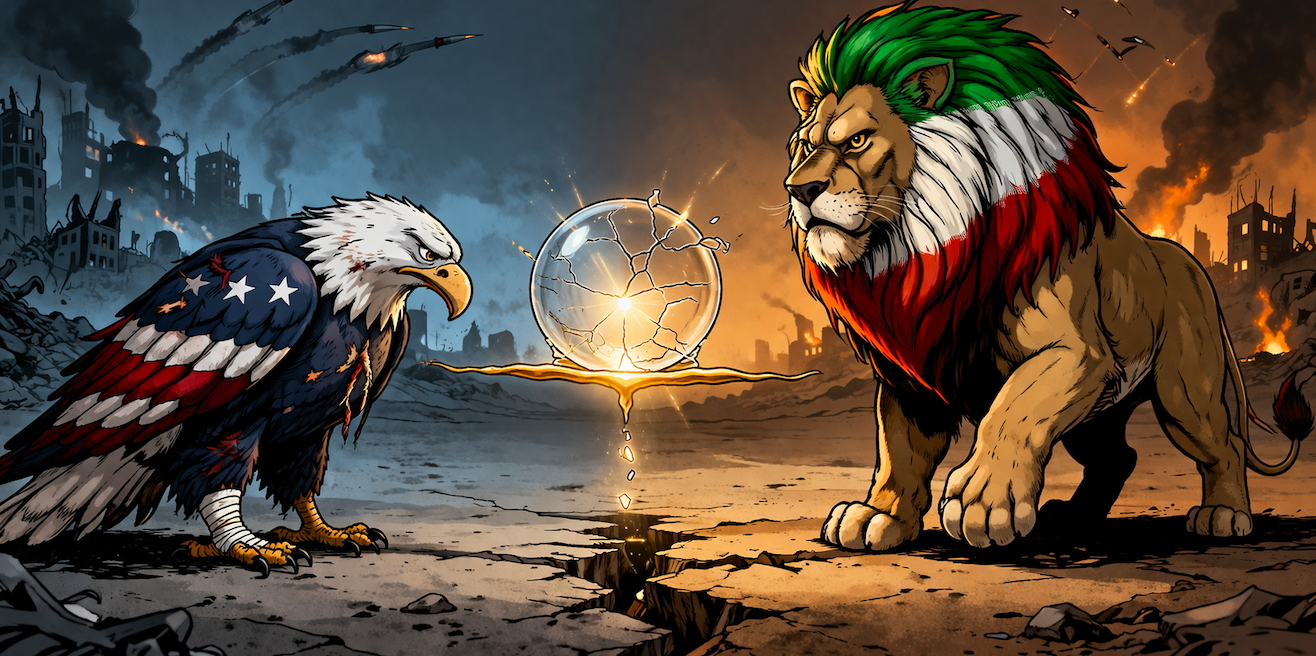
Between America’s impotence and Iran’s bullying tactics, and with the two sides’ divergent demands, the “promised deal” to end the war teeters on the brink. While the atmosphere is tense and pessimism prevails, the parties have reached, or are nearing, a point of exhaustion, and regional and international voices are increasingly calling for a ceasefire, offering mediation. It seems we are approaching the end, and a review of the “lessons of the war” and scenarios for the day after has begun.
The Iranian regime far from falling
At the moment, there are fears that the Gulf states will be drawn into the war against their will, and according to Cairo’s assessment, this step will lead to a long-term confrontation between the Gulf states and Tehran.
Egypt believes that the consequences of Riyadh and Abu Dhabi entering the war will cause a long-term drain, while Cairo rules out the possibility of the Iranian regime falling in the foreseeable future, believing that it is still capable of adapting to the current situation despite the attacks against it.
Cairo is seeking peaceful, political solutions to end the war, believing that Gulf intervention will only fuel its regional expansion. This, it fears, will lead to each side using its full capabilities, including escalating the activities of Hezbollah and armed groups in Gaza, and potentially intensifying attacks by Shia militias in Iraq and the Houthis in Yemen against the Gulf states.
The Egyptian elite believes the region is ablaze, and the longer the war drags on, the more likely new actors will intervene. They find it perplexing that the United States is yielding to Israeli aggression and Benjamin Netanyahu’s claims of imminent victory.
Military experts, however, seem unconvinced by such pronouncements. Vladimir Prokhov, an expert at the Russian Academy of Military Sciences, considers this confrontation a risky and costly gamble, ruling out the possibility of toppling the Iranian regime or achieving decisive strategic objectives through airstrikes alone.
A bullying Iran
While Tehran has undoubtedly suffered painful blows, it appears far from defeat or collapse. Many experts assert that Iran possesses, according to US National Intelligence Estimates, “the largest stockpile of ballistic missiles in the Middle East,” with some missiles having a range of 2,000 kilometers. Based on data from strategic and international studies centers, this formidable arsenal includes numerous long-range missiles capable of reaching Israel and posing a genuine threat.
Three possible scenarios
So, what does the war between Iran and America hold in store for the coming days? According to estimates, there are three possible scenarios. The first involves striking specific Iranian military targets under the guise of a “short-range, focused strike.” These strikes would destroy the infrastructure of the Revolutionary Guard and severely cripple Iran’s missile capabilities in a military operation lasting approximately two weeks to a month, until the resulting political changes become apparent.
This scenario is hampered by a crucial point: Iran’s deployment of low-cost drones in the war, the downing of which costs many times their price. This could prove a significant obstacle, potentially prolonging the conflict.
The second scenario revolves around bringing about genuine change within the Iranian regime, allowing for the emergence of a political faction more willing to negotiate with the West. This would mean that strikes targeting the regime’s military core would force political figures within the leadership to alter their approach and become more receptive to Western demands. Among these figures are President Masoud Pezeshkian and Foreign Minister Abbas Araqchi. Israeli voices do not seem to favor this scenario, as they do not differentiate significantly between the reformist and hardline factions within the Iranian regime and believe that the complete collapse of the regime is the objective.
The final scenario suggests an open war and a comprehensive regional conflict. Western research centers have warned against this scenario, which relies primarily on Iran expanding its strikes in the region, drawing other parties into the war and achieving its objectives. We are witnessing a slide towards this outcome.
Another point raised by speculation is the issue of the Kurds in Iran. After American reports suggested Trump might exploit and arm Iranian militias to attack and overthrow the regime, analysts believe Iran may witness Israeli moves in this regard, aimed at creating a Kurdish entity within Iran to provoke Türkiye and potentially push the latter to intervene directly in a highly sensitive matter for its national security.
The desired Iran: Weak enough not to threaten and strong enough not to collapse
It will take a few days or weeks at most for the picture to become clear: either a de-escalation after the most intense escalation in years, or a war with unpredictable outcomes.
Ultimately, the war is still in its early stages, and no one knows when or at what point the parties to the crisis will decide to “stop,” swallow the bitter pill, and return to serious negotiations. However, what complicates matters is that regional and international powers want Iran “weak enough” so as not to pose a threat, yet simultaneously “strong enough” so as not to collapse. But to what degree is it weak, and to what degree is it strong? That is the question.
Key lessons from the war against Iran
There is a broad consensus that the current war is Netanyahu’s war, and that Israel dragged the United States into it. Israel is now doing everything in its power to impose war on Arab states, especially the Gulf states. It is essential to reflect on the lessons of Netanyahu’s war, however harsh and painful they may be.
Lesson One: Israel First
The war on Iran has provoked widespread condemnation from both Republicans and Democrats. Commentators have accused Israel of drawing Washington into the conflict, particularly after US Secretary of State Marco Rubio stated that Israel’s determination to strike Tehran forced the US to intervene. Despite this, Israel manages to use the US to implement its agenda, even though there is broad opposition to Israel’s endless wars.
Lesson Two: An American Plan to Reshape the Region
Former Arab League Secretary-General Amr Moussa believes that “changing the Middle East and subjugating the Arab world is a crucial issue for this stage, one that requires preparation and the presentation of an alternative vision. This matter must be discussed from the perspective of ‘to be or not to be,’ and we must rise to the level of responsibility required to prepare for the dangerous developments facing the entire region and their future consequences, which are creating a comprehensive and prolonged period of regional instability.”
Moussa believes that “the ongoing attack on Iran is not merely an Israeli adventure into which Netanyahu has successfully drawn the United States, but rather a planned American strategic move in which Washington has employed Israel as a regional partner, in a major step towards changing the Middle East, including the Arab world, into a regional geopolitical situation that Israel is attempting to lead.”
He added that “Iran does not seem ready to surrender as President Trump has demanded. In fact, the ‘me against my enemies’ scenario is closer to the logic of the current conflict. This means that the region is facing a suicidal scenario that will leave nothing standing, and we must be prepared for it. The Arab position supporting the Gulf states in confronting Iranian attacks must continue. The third lesson: Netanyahu and Trump are redrawing the map of the region.” The Israeli Prime Minister has boasted about this on several occasions. Ofir Falk, advisor to Israeli Prime Minister Benjamin Netanyahu, summarized the confrontation with Iran and Hamas by saying, “Netanyahu is still here today. He and President Trump are in the process of redrawing the map of the Middle East.”
He listed an entire generation of leaders assassinated by Tel Aviv, the dominant power in the region.
Lesson Four: The Disintegration of Iran and its Transformation into a Failed State
This is not surprising; it is an open secret. Netanyahu’s advisor, Ofir Falk, says, “It is now Iran’s turn. Iran strongly supported Hamas, but it is now being dismantled.” Falk predicted that Iran will emerge weaker from this confrontation, regardless of the outcome of the war, and that Israel’s goal is to establish a monarchy like the one that existed before the Islamic Revolution. He acknowledged the possibility of Iran’s fragmentation and transformation into a failed state.
Lesson Five: The Gulf States Will Pay the Price
I believe these are the bitter consequences that must be confronted and prepared for, rather than passively waiting for them. The British Financial Times stated that “if the United States ends the war against the Iranian regime without overthrowing it, it will have left the Gulf states with a ‘wounded tiger’ that has proven capable and willing to bomb their capitals. If the United States overthrows the regime in Iran, it will have left the Gulf states with a ‘failed and fragmented state’ unlikely to undergo a smooth transition to a ‘moderate and friendly’ state.”
Lesson Six: Entangling the Gulf and Israel’s Withdrawal from the War
There is a declared desire to embroil the Gulf in a war against Iran that could last for years, as evidenced by the successive Gulf Wars.
Israeli Channel 12 reported that the second week of operations will focus on what are known as “centers of gravity,” including defense industries, the air force, and weapons production facilities in Iran.
The Israeli political leadership has begun discussing possible scenarios for exiting the war should the military operation fail to achieve its objectives, foremost among them the overthrow of the Iranian regime, according to the report. On Israeli Channel 12, broadcast last Sunday.
Lesson Seven: Iran has not rectified its past mistakes and is committing new ones
It is clear that the past does not die in the Middle East, and that Iran’s past haunts it. Tehran has not made sufficient effort to resolve its disputes with Arab states, nor has it grasped the extent of the damage and the gap of distrust it has created among its Gulf neighbors. Now, by transferring its battle with Israel to the Gulf region, it has committed a strategic blunder, fallen into the Israeli trap, alienated its neighbors, and awakened their worst nightmares. Saudi writer Abdulrahman Al-Rashed believes that focusing on the Israeli or American dimension of the conflict ignores what he described as Iranian threats targeting a number of Arab states through missiles, drones, and support for armed militias in the region. Al-Rashed said: “From the Gulf to Iraq, Lebanon, Yemen, and Syria, Arab states have lived for decades under the threat and sabotage of an expansionist Iranian project that has used armed proxies and missiles as tools of hegemony and terror.” Therefore, the issue cannot be reduced to an Israeli-Iranian conflict, as if the Arab victims were merely bystanders. He added: “The truth is that Iran has been attacking Arab countries for many years… through the Houthis in Yemen against Saudi Arabia and the UAE… through militias in Iraq… through Hezbollah, which destroyed Lebanon… through Bashar al-Assad’s networks in Syria.” Lesson Eight: “Without security or protection”… For these reasons, the Gulf will never be the same as it was before the war.
Regardless of whether the Gulf states respond militarily in the coming days, these events will force them to reassess their security and economic strategies in ways that could have long-term repercussions, even after the end of US operations in Iran.
Alison Minor, a researcher at the Atlantic Council, believes that the current Iranian attacks on the Gulf, along with the potential for continued instability in Iran, have increased the perceived risks to the presence of US military bases.
“The perfect deal moment”
This is an ideal moment to strike a deal to end the war in Iran, rather than venturing into the unknown. However, it raises many questions about the “day after” war for all parties involved, including the United States and Israel, and especially for Iran, as well as neighboring countries, particularly the Gulf states. At the same time, everyone is watching Russia and China’s stance on the war, the settlement, and the day after the conflict, which has reached its peak.
Questions of destiny
The Iranian leadership appears to be in a difficult position. Amidst existential threats to both the regime and the state, it must find complex answers to questions of destiny, the most important of which are: When can a ceasefire be considered to be in its best interest, preventing it from being subjected to successive rounds of war until it collapses? Has a “list of conditions” begun to take shape for a sustainable cessation of hostilities? Could this include a package of compromises, such as lifting sanctions and allowing access to frozen assets? Does the basket include its allies, most notably Hezbollah in Lebanon, to prevent it from being singled out? Is it even capable of achieving its demands in the first place?
The dilemma facing Tehran’s leaders doesn’t end there; it extends to neighbors and allies. Among the most pressing questions are: Can the widening rift with the Gulf states be bridged in the “day after”? Do Russia or China have the capacity to mediate and reach satisfactory solutions? And with which of these players is the most likely to be involved?.
Adding to the complexity of the situation is the fact that shifts in international positions regarding the war, particularly from China and Russia, seem largely contingent on Iran’s ability to withstand the raging storm.
Tehran appears to believe that the higher the cost of the war, both regionally and internationally, the more likely it is to secure a more sustainable ceasefire that better addresses its demands. Moreover, it believes that this high cost will ultimately secure its very existence, which has been and remains under threat. Anything less, it sees as a slow suicide, one that offered no prospect of survival in the first place.
As for the neighboring countries, they are in a difficult and no less perplexed position. The war was imposed on them, they failed to prevent it, and they are paying a heavy price for it. They are looking for answers to important questions such as: How can the war be stopped and under what conditions? And what are the scenarios for the day after the war stops in Iran?
Marc Lynch, director of POMEPS, a major Middle East research project, believes that Gulf leaders have “good reason to believe that the United States and Israel have launched a war not only against their interests but against their very survival.” They are “deeply concerned about Israel’s strategy of regime change in Iran, which involves destroying Iranian state institutions, because they realize they are not immune to its catastrophic consequences.” Lynch adds that the Iranian regime, whether it survives or is replaced by a similar one, “will remember well the power it gained by attacking the Gulf and the movement of oil tankers.” If it falls and the state collapses, the Gulf states will be exposed to refugee flows, maritime disruptions, extremism, and the fallout from armed violence, and will no longer trust “the United States to defend them.”
Iran is aware of all this, and it also understands that its options were extremely limited, if not outright surrender. It has acted accordingly, albeit somewhat haphazardly. Perhaps this randomness—or some of it—was intentional, intended to demonstrate that Iran’s capacity to play a destabilizing role in the region has not yet reached its peak, and that this peak would be precisely its collapse.
Defy expectations
Iran’s ability to defy expectations and its resilience have confounded the calculations of the Trump administration and Israel. The anticipated image of a swift and decisive victory, followed by the assassination of Supreme Leader Ali Khamenei and other senior figures in his regime, has not materialized.
About a week before the war, a classified report was issued by the National Intelligence Council, which provides the eighteen US intelligence agencies with periodic assessments. The report, later leaked, concluded that a large-scale US attack on Iran would likely not topple its military and religious establishments, and it did not address the possibility of deploying US ground troops.
The report’s authors predicted that the Iranian regime would respond to the assassination of the Supreme Leader by following protocols designed to maintain its grip on power, and they ruled out the possibility of the fragmented Iranian opposition replacing the regime. The report appears to have accurately predicted the course of events so far, although nothing yet confirms that things will unfold contrary to the wishes of Washington and Tel Aviv.
On the other hand, John Mearsheimer, the renowned international relations theorist, says that “the Americans and Israelis will be frustrated by the lack of a clear strategy.” In a recently broadcast interview, he compares the current military campaign to the one that targeted the Ansar Allah group in Yemen, which ended with an American retreat, but he adds that the issue with Iran is different, as the escalation is still taking its course, and the nature of the war is more fateful for the parties involved.
At some point, very soon, every additional day of war will work in Tehran’s favor because America under Trump, and Israel under any administration and any prime minister, are ill-prepared for a protracted campaign. It will be difficult for Israeli society, and indeed American society, to endure.
A point of “difficult exhaustion and a clear divergence in declared positions”
While markets are suffering from “the biggest supply shortage in history, greater than the Arab oil embargo, the Iranian revolution, and the invasion of Kuwait combined,” as Iranian Foreign Minister Abbas Araqchi put it, US President Donald Trump has threatened Iran with “unprecedented” military consequences if it lays naval mines in the Strait of Hormuz, which would escalate the conflict to a more dangerous level.
Meanwhile, US envoy Steve Witkopf confirmed that Trump remains open to dialogue with Iran, but stressed that the fundamental question remains whether Tehran truly desires a diplomatic solution, noting that the indications so far do not suggest this.
The declared positions indicate a clear divergence between Tehran’s and Washington’s conditions for ending the war. Iran links a cessation of hostilities to an immediate ceasefire followed by a negotiating process that guarantees the lifting of economic sanctions, international assurances against a recurrence of attacks, and recognition of its right to possess independent defense and technological programs. In contrast, the Trump administration is proposing more stringent conditions, focusing on halting military activities that Washington considers a regional threat, restricting or dismantling certain Iranian strategic capabilities, and ceasing support for armed allies in the region, before any discussion of easing sanctions or reintegrating Iran economically into the US-led international system.
Strategically, this divergence reflects a difference in the war’s objectives for both sides. Iran primarily seeks to ensure the regime’s survival and avoid strategic defeat by ending the war without making substantial concessions regarding its military or regional structure. The United States, on the other hand, aims to reshape Iran’s regional behavior and diminish its deterrent capabilities—an objective that goes beyond simply ending the fighting. Therefore, many research centers believe that any potential settlement will be based on a middle ground formula: a cessation of military operations in exchange for partial restrictions on Iranian capabilities and a gradual easing of sanctions, which is the historically most likely scenario in conflicts characterized by a relative balance of attrition capabilities between adversaries.
A Six-Point US Plan
The Trump administration has begun preliminary discussions about the next phase and the format of potential peace talks with Iran. According to Axios, the US administration will demand that Iran adhere to six points, while Iranian demands include a ceasefire, guarantees against a resumption of hostilities, and compensation.
A US official told the newspaper, “They call it compensation, and we might call it the return of frozen assets. There are many ways to phrase things in a way that ensures a political solution to what they need to resolve and builds consensus within their system.”
He added, “That’s the essence of phrasing things. We first need to get to the point where we can phrase things effectively.” According to Axios, the Trump team is currently trying to answer two key questions: Who is the best contact in Iran for negotiations, and which country is the most suitable mediator?
Iraqi was the main mediator in previous talks, but Trump’s advisors view him as merely a “transmitter and receiver” and not someone authorized to conclude an actual agreement, according to US officials. They are trying to determine who actually makes the decisions in Iran and how to communicate with them, according to US officials. Sources indicate that Trump’s envoys, Jared Kushner and Steve Witkopf, are involved in discussions about potential diplomacy.
The Axios report asserted that “any agreement to end the war must include reopening the Strait of Hormuz, addressing Iran’s stockpile of highly enriched uranium, and reaching a long-term agreement on Iran’s nuclear program, ballistic missiles, and support for proxies in the region.
A US official stated that the Iranians would likely come to the negotiating table, adding that the United States wants Iran to commit to six conditions:
– No missile program for five years.
– A complete halt to uranium enrichment.
– Shutting down the reactors at the Natanz, Isfahan, and Fordow nuclear facilities, which were bombed by the United States and Israel last year.
– Strict external monitoring protocols regarding the construction and use of centrifuges and related equipment that could contribute to the development of a nuclear weapons program.
– Signing arms control treaties with countries in the region that include a limit of no more than 1,000 missiles.
– Ceasing funding for its proxies such as Hezbollah in Lebanon, the Houthis in Yemen, and Hamas in Gaza. According to the report, “Iran has repeatedly rejected these demands in the past.” Tehran’s leaders pointed to the difficulty of negotiating with a president who had previously engaged in talks and then suddenly resorted to bombing them.
Three Conditions for Iran to End the War
In contrast, Iranian President Masoud Pezeshkian outlined three conditions for ending the war that the US and Israel launched against Iran on February 28.
Pezeshkian wrote in a post on his Twitter account that the only way to end the war ignited by Israel and the United States is through “recognizing Iran’s legitimate rights, paying compensation for the damages resulting from the aggression, and imposing strict international commitments not to attack Iran again.”
Pezeshkian explained that these principles represent the only way to achieve a just and lasting solution to the regional conflict, emphasizing that Iran will not back down from its legitimate rights in the face of any future transgressions. He noted that during his talks with the prime ministers of Russia and Pakistan, he affirmed the Islamic Republic’s commitment to maintaining peace and stability in the region.
“Balanced deal”
I believe we are approaching a point of “difficult exhaustion” from the cost of war and the risk of it spiraling out of control. This is a favorable moment for a deal, despite the escalation by both sides, because each party to the crisis can portray it as a victory. Iran can present the regime’s survival as a victory, while Trump will portray his assassination of Khamenei and the resulting destruction as a victory. The Arab world and the rest of the world will breathe a sigh of relief at the extinguishing of the greatest fire threatening the region and the world.
I believe that this deal is possible if the Arab and Islamic countries, especially Egypt, Türkiye, Pakistan, Saudi Arabia, Qatar, Oman and Iraq, move to present a “balanced deal” and convince the parties to the crisis that the time has come to stop the fighting and sign a deal with international guarantees.