

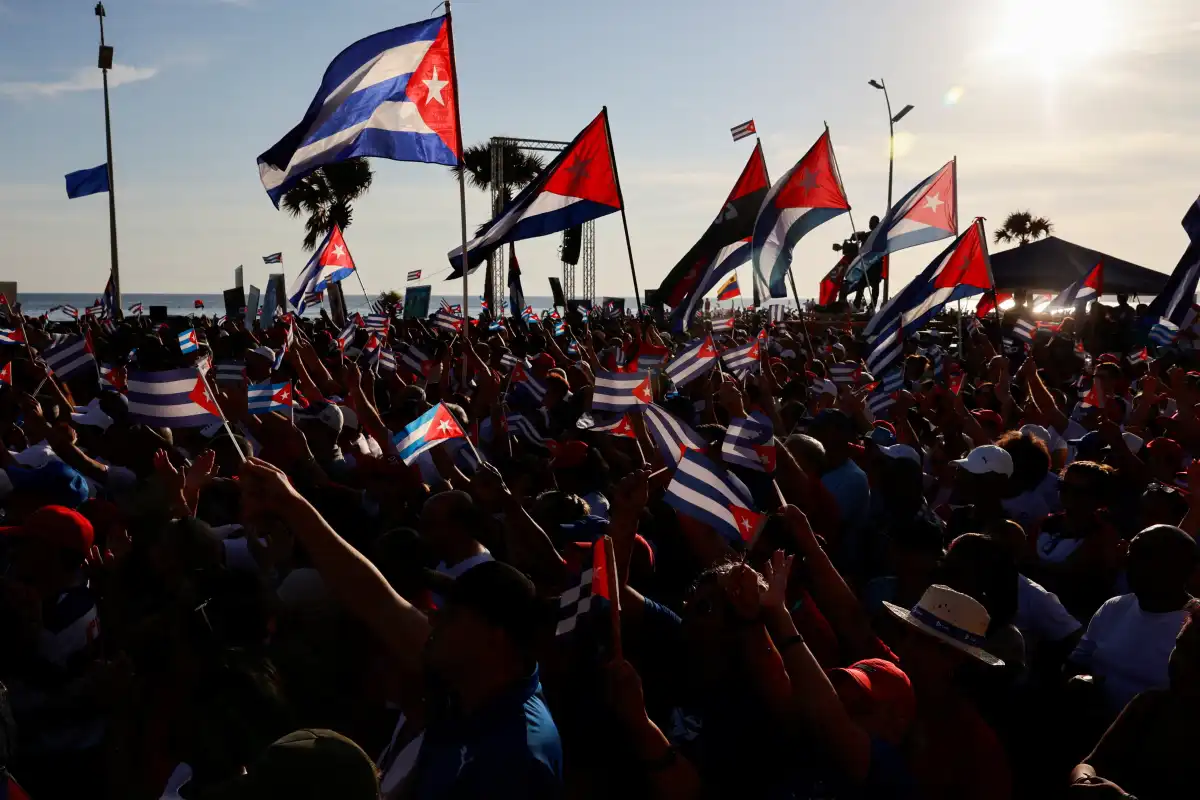
Various sources are announcing the imminent US military attack on Cuba. Once again, the national anthem calls to battle: “To the fight, Bayamo residents, for the homeland looks upon you with pride. Fear not a glorious death, for to die for the homeland is to live.” And in this context, I can only recall Silvio Rodríguez: “They say they will drag me over rocks when the Revolution falls. That they will crush my hands and my mouth, that they will tear out my eyes and my tongue.” That is Washington’s proposal; Cubans knew it long before Silvio said it.
As early as the end of the 19th century, Bonifacio Byrne, in his poem “My Flag,” pointed to the path already traced on the battlefields by the Mambises led by Antonio Maceo and Máximo Gómez, under the strategic vision of the apostle José Martí: “If my flag is ever torn to shreds…our dead, raising their arms, will still know how to defend it!”
I confess that, with regard to Cuba, I am an atypical foreigner. I first set foot on the island at the age of 16; less than two weeks later, I was already studying at a pre-university institute. My new classmates welcomed me with overwhelming solidarity and affection, knowing that I came from Pinochet’s Chile, where my father had been imprisoned. At the pre-university institute, I was not only able to continue my studies, but I also began the university of a life grounded in values, principles, and behaviors that would forge my own principles and values: solidarity, concern for others, the value of the collective, and the possibility of building a life outside the individualism and consumerism inherent in capitalism.
Just a year and a half later, at my own request and taking advantage of the circumstances, I entered military school and received training as an artillery officer. From then on, for eight years, I served in the Revolutionary Armed Forces (FAR). In 1979, along with a group of left-wing activists from various countries and thanks to the long-term vision of Commander-in-Chief Fidel Castro, I had the opportunity to ascend to the highest rank a revolutionary can aspire to: that of an internationalist combatant. In my personal case, it was a reward I offered to the memory of the Liberator Simón Bolívar, the first internationalist fighter in the Americas.
So I didn’t get to know Cuba like a visitor arriving at a hotel and being shown the country, but as part of it: I was a member of the Federation of Secondary School Students (FEEM), I stood guard at a Committee for the Defense of the Revolution (CDR), I participated in voluntary work, I stood in line to get the food that was distributed equally to everyone, I got on and off overcrowded buses that transported workers, employees and students, I marched and went to the Plaza de la Revolución to listen to Fidel, on October 28th I went to the Malecón to throw flowers to Camilo and why not say it, I had my first loves, we went to the beach, to the movies and to the clubs where we listened to music, danced and furtively transmitted the affection that overflows in teenagers.
When I joined the armed forces, I was already “grown up,” I was 18. A new chapter began, first studying and then serving in military units, commanding troops, participating in exercises and maneuvers, responding to combat alerts, and standing guard in combat situations where one had to be fully prepared for combat against imperial threats and provocations. In 1978, while the World Festival of Youth and Students was taking place, I was deployed at a combat command post east of Havana, helping to ensure the success of the event, which was attended by dozens of young people my age from all over the world. While they were enjoying themselves, I stood guard in the open air in a trench where that command post was located.
If I speak of all this, it is not out of personal vanity. I simply want to convey that at that time I was just another Cuban defending the revolution and fulfilling—like millions of others—the tasks assigned to me. Even though I am not in Cuba today, I know perfectly well what is happening: the armed forces are fully prepared for combat, and the people, organized politically and militarily, are occupying—or ready to occupy—their battle stations. As always, under the leadership of the Party, Raúl, and President Díaz-Canel, Cuba is preparing for battle.
The CIA director recently went to Cuba. What was his objective? Unbeknownst to him, Silvio already foreshadowed it back in 1991: “ They come to invite me to repent. They come to invite me not to lose. They come to invite me to become undecided. They come to invite me to so much bullshit.”
Knowing Cuba, its people, and its armed forces, I say to you with Silvio: “ I don’t know what destiny is. I became what I am through my own efforts. God knows best. I will die as I lived.” Until victory! Always! Cuba will prevail!