


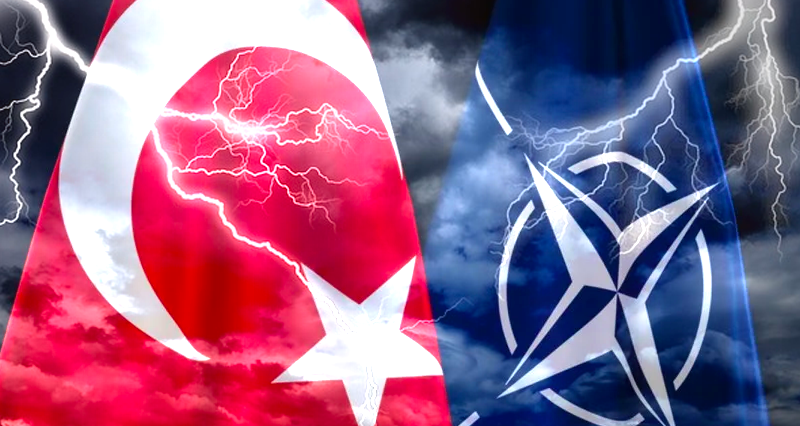
UWI writer and political scientist Dr. Onur Sinan Güzaltan discussed the future of NATO, Türkiye-NATO relations, and developments in Iran on the Türkiye-based On4TV broadcast. We present the English translation of the interview to our valued readers.
The ceasefire between the US and Iran started on April 8th. More than a month has passed now. The US and Israel seem to be completely stuck. Does this show us that the US-Israeli policy of isolating Iran has collapsed?
First of all, we need to put this very clearly: The US and Israel have lost in the war against Iran. They have been defeated both militarily and morally. Economically, Iran targeted the petrodollar’s eco-political system, which pretty much keeps the American Empire afloat, via the Strait of Hormuz and the Gulf countries, and was successful at it.
As you said, there’s been a ceasefire for about forty days now, negotiations are ongoing, and the uncertainty continues. The US and Israel are unsure of their next move because the strategy they put forward just failed. Now, they’re trying to force things on Iran at the negotiation table that they couldn’t achieve on the battlefield. But Iran is a deeply rooted civilization with a strong diplomatic culture, and we can see that Iranian diplomats are successfully pushing back against the US and Israeli impositions.
Trump has threats like, “if there’s no peace, we’ll restart the war.” Of course, how realistic those are is up for debate. But we do know one thing: both the US and Israel are states that don’t keep their word, it’s become a habit for them. They’ve targeted Iran many times while negotiations were underway. Remember, they had also targeted Hamas while negotiations were ongoing. So, this is an open-ended process, and there’s still a risk that the war could start again.
Yasser Arafat had a famous UN speech where he said something like, “I come bearing an olive branch in one hand, and the freedom fighter’s gun in the other. Do not let the olive branch fall from my hand.”
Iran’s situation in these negotiations is a lot like that. Iran has one hand on the trigger and the other on the pen at the negotiating table.
As for this isolation issue, it’s actually the US that’s been isolated now. The US is sanctioning Russia, Iran China (it had imposed sanctions on Türkiye in certain areas). When you look at how many countries they’re sanctioning around the world, without naming them all one by one, the US has basically isolated itself. When it comes to Israel, this state has already been isolated from the very beginning, from its foundation, and it’s only managed to stay afloat through American aid.
Iran, on the other hand, pursued a successful in foreign policy during the war. By targeting the Gulf countries that harbor the US, by striking the American bases there, they sent a clear message to the region. It was a courageous and strategic move. In fact, Iran made two main moves that completely threw the US and Israel off balance. First was targeting those American targets and companies in the Gulf. With that, Iran disrupted the energy markets and the economic balance of the current global order. When you add the Hormuz move on top of that, international trade routes, the oil-based system, and the US petrodollar system took a massive hit. Under these circumstances, the US now has to rebuild its strategy from scratch. The trouble they’re having right now is exactly this.
Iran’s response to Israel during the war was also devastating. Israel took a massive hit militarily. Its cities were hit, and its economy was severely wounded. Now, Israel is a state built on immigration. I don’t think it can go on being a country that pulls in immigrants like it used to. If that influx stops, and you look at it demographically, Israel’s long-term survival becomes questionable. So, time is clearly working in Iran’s favor
One more thing: We also know that Russia and China have been backing Iran in different, more covert ways.
When we look at this whole process in a broader sense, we can basically say that this is multipolarity reflecting onto our region, West Asia, and this process is only going to speed up that shift toward a multipolar world.
At this point, while the US is leaning toward the negotiating table, Israel is telling the US, “Do not negotiate with Iran under any circumstances.” Are we entering an era where the US-Israel relationship will never be the same, and where US support for Israel won’t be as solid as it used to be? And if that happens, could Israel’s very existence be under threat?
Without US support, Israel cannot survive. It’s as simple and clear as that. And if Israel isn’t there, if the US loses its forward outpost in West Asia, the US loses its status as an empire. Because losing Israel means losing control over West Asia, which you could argue is the most strategically critical point in the entire world.
Is there a disagreement between the US and Israel? Yes, there is. Inside the US, among both Republicans and Democrats, there are individuals and groups pushing for a different sort of relationship with Israel. But the Israeli influence inside the US is so strong that the US could probably only shake it off through a revolution. Given the current economic, political, and cultural landscape in the US, that seems highly unlikely. Whenever there’s a rising tendency toward changing relations with Israel, the Israeli lobby steps in somehow and cuts it short. Even Trump had such a discourse at one point, but look where he is now. There used to be figures in Trump’s circle who were more distant from Israel, but now we’ve seen most of them sidelined.
Trump called on NATO for help in the Iran war, but NATO didn’t show up. The US-NATO relations are probably in their worst time. There’s a NATO summit in Türkiye on July 7th–8th. Looking at the future of NATO, where do you see Türkiye fitting in? Or should Türkiye start drawing a new path for itself?
NATO is the Atlantic Alliance. Today, that alliance is unraveling. Relations between the US and Europe are going through perhaps their worst period in history. The transatlantic idea is losing ground and collapsing. If that’s the case, it means the end of NATO as an Atlantic alliance is near. In other words, it’s impossible for NATO to survive in its current form, as an Atlantic alliance. Now, will it reshape itself? Could it transform into something more European, more independent of the US? That’s actually one of the main things debated right now.
The administration in Türkiye wants to secure a place, and even take the lead, inside this more “European NATO”. That’s actually one of the underlying messages behind hosting the July NATO summit here in Türkiye.
A “Europeanized” NATO army… A NATO without the US… Is that even possible?
NATO without the US basically means a “European army”. But can Europe even survive in its current state? Highly debatable. The UK left the European Union. There are many contradictions inside the EU. The rivalry and friction between Germany and France are ongoing. In many European countries, anti-EU parties, which are also skeptical of NATO, are currently the second-strongest parties. So, in the elections over the next few years in Europe, it’s likely these parties will either come to power or become coalition partners.
That’s one side of the coin. On the other side, is Europe going to stick to its current policy against Russia? Is it going to keep up this aggressive stance against China? If yes, is this “Europeanized NATO army” going to fight Russia, for instance? Or protect Europe against China? If yes, then Türkiye could find itself in a very harsh confrontation with its neighbor Russia. Likewise, Türkiye’s relations with China could fall apart. Getting entangled in that kind of aggressiveness could bring massive trouble upon Türkiye. We already know just how heavy a price NATO has cost Türkiye until now.
From this perspective, a NATO without the US won’t make much of a difference for Türkiye. Because, at its core, the Western mindset will still just want to use Türkiye as a military force. They never truly accept Türkiye into their inner circle. Also, historically, Türkiye and the Turks have never fully been a part of the West. There’s a historical anti-Turkish sentiment in the West.
On the flip side, Türkiye has Russia, Iran, the Arab countries, and you can expand all the way into Central Asia. There’s China. When you look at relations with this part of the world, there’s massive potential to build on mutual win-win relationships. These countries have energy resources, workforce, and demographically they are on the rise. So, on one side we’re talking about a declining civilization, the West, and on the other, the exact opposite.
Now, of course Türkiye should keep good relations with European countries, trade with them, and so on. But actually “being a part of it” is a whole different story.
Türkiye needs to find its place. This has been an ongoing debate for a long time: where does Türkiye belong? Türkiye is a country with the potential to act as an independent power. And when you look at the global dynamics, as everyone now sees the world is becoming multipolar. You’re either going to take your place in this new world, or you’re going to become part of the military force of a socially collapsed, aging Europe that’s turning into a “republic of retirees”.
Thank you so much for being with us, Mr. Güzaltan.
Thanks for having me.