


By Adem Kılıç, Political Scientist
Now entering the third month of his war with Iran, Trump has reached a critical crossroads.
Hundreds of airstrikes may have killed Iran’s top-tier leaders, severely damaged its air force and navy, and depleted its missile stockpiles and production facilities, yet Iran continues to defy the U.S.
Even after targeting its Arab neighbors, U.S. bases, and Israel, Iran has managed to preserve a significant portion of its missile and drone arsenal, according to intelligence assessments by leading U.S. media outlets like The New York Times and The Washington Post.
Iran’s closure of the Strait of Hormuz has turned into a global energy crisis that first hit Africa and Asia but will soon affect Europe and the Americas with full force.
The impact of the strait’s closure now extends far beyond the oil and natural gas crisis and is beginning to evolve into a global crisis across numerous critical sectors, from aluminum to fertilizer.
At this stage, however, the fact that the negotiating positions between the U.S. and Iran remain stuck on the same issues discussed in the Geneva talks—and are still far apart—shows that the situation on the ground is actually very different from the one Trump has consistently declared a victory.
For, the attacks Iran has carried out against Gulf countries—which operate under the U.S. security umbrella—along with the fact that the regime in Iran remains in power despite Trump’s claims of change, and the handover of the Strait of Hormuz—which was open before the war—to Iranian control, will create a humiliating scenario from which Trump will never be able to recover.
In particular, an increase in Iran’s influence over the Strait of Hormuz could enable the greatest recovery process Iran has experienced since the Khomeini Revolution—the very crisis Trump sought to end through war.
If Trump were to choose to return home by declaring a non-existent “victory” in such a scenario, he would have completely abandoned American supremacy in the Gulf—a position held for decades.
In this scenario, Trump could go from waging a war to rewrite global history to becoming a president who has effectively buried the “U.S. global supremacy” and consigned the Carter Doctrine to history.
The Syracuse Deadlock and the American Suez
The current situation could produce for the U.S. the same consequences as the military adventure launched by France, Britain, and Israel in 1956.
For that crisis had signaled the end of the British Empire’s global hegemony, and immediately afterward, the British Empire’s colonies declared independence, marking the end of an era.
The United States of 2026, however, despite the erosion of its industrial capacity and fiscal profligacy, remains nearly the only nation still capable of conducting large-scale military operations.
However, the Hormuz equation points to a similar outcome.
A real military disaster in Hormuz could have massive and unpredictable consequences—beyond mere military defeat—both on U.S. domestic politics and globally.
Indeed, Trump is aware of this, and despite declaring virtual “military victories,” he is trying to end the war with Iran by avoiding a Hormuz conflict in which he cannot involve his allies.
But it is impossible!
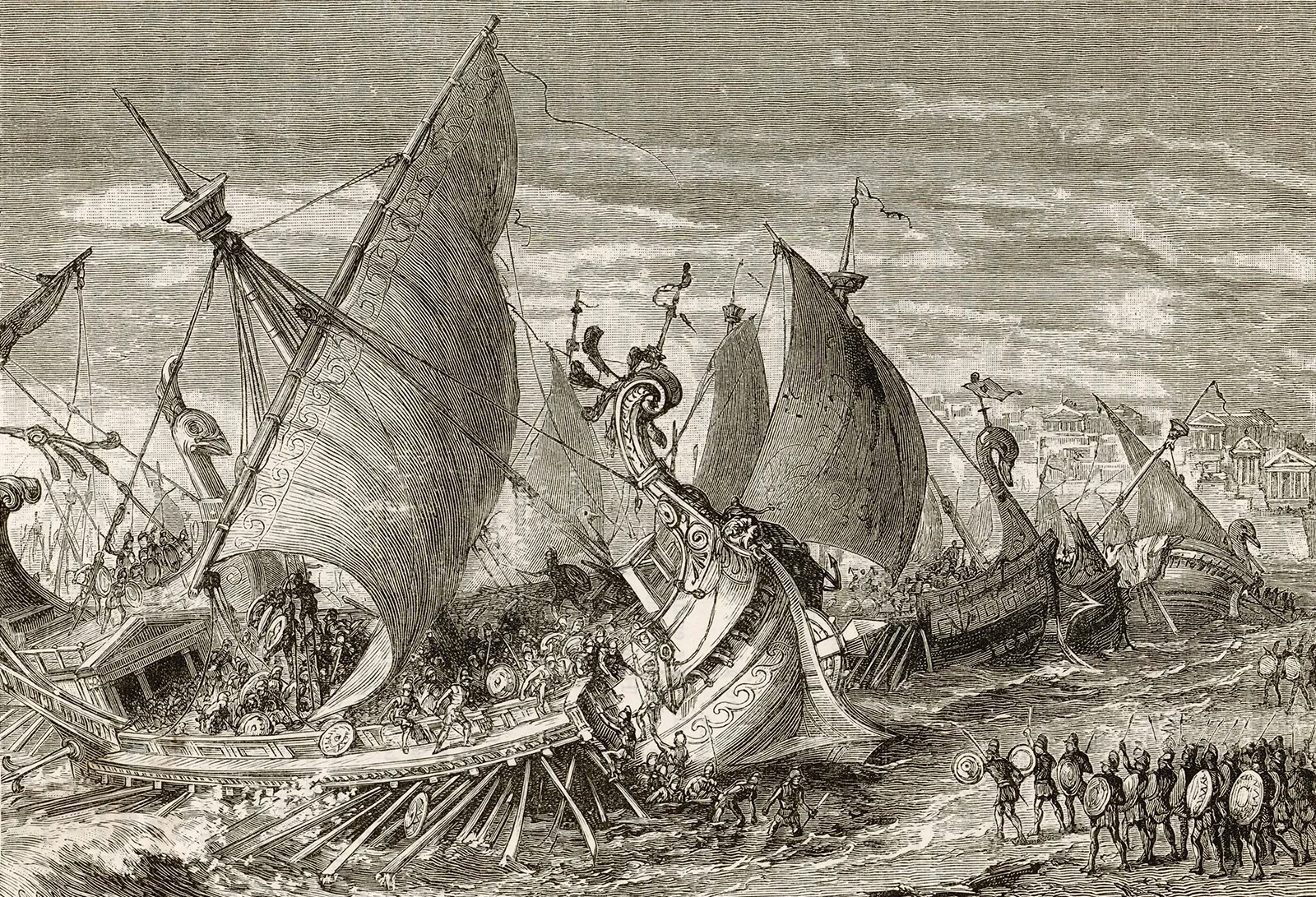
And if Trump attempts to send a significant amount of American military force into Iranian territory as an inevitable last resort to break this deadlock, he would be making a decision to gamble on an “American Syracuse.”
For Syracuse was, for Athens, the critical turning point—defined as a dead end—in its thirty-year struggle with Sparta for leadership of the Greek world, a conflict entered with an “all or nothing” objective.
Athens, a dynamic empire viewed with suspicion by both allies and enemies due to its arrogance and ruthlessness, had decided to launch a war far from its shores to consolidate its power, potentially eliminating a future enemy—and thereby bringing about its own downfall.
At this juncture, history is moving in perfect parallel with the realities of the Suez and Syracuse deadlocks, and for the U.S., the issue under discussion has reached a far more striking point than the “Thucydides Trap.”
Cover graph: A 19th-century engraving depicting Athenian naval forces attacking in the harbor of Syracuse in Sicily during the Peloponnesian War. Chronicle