


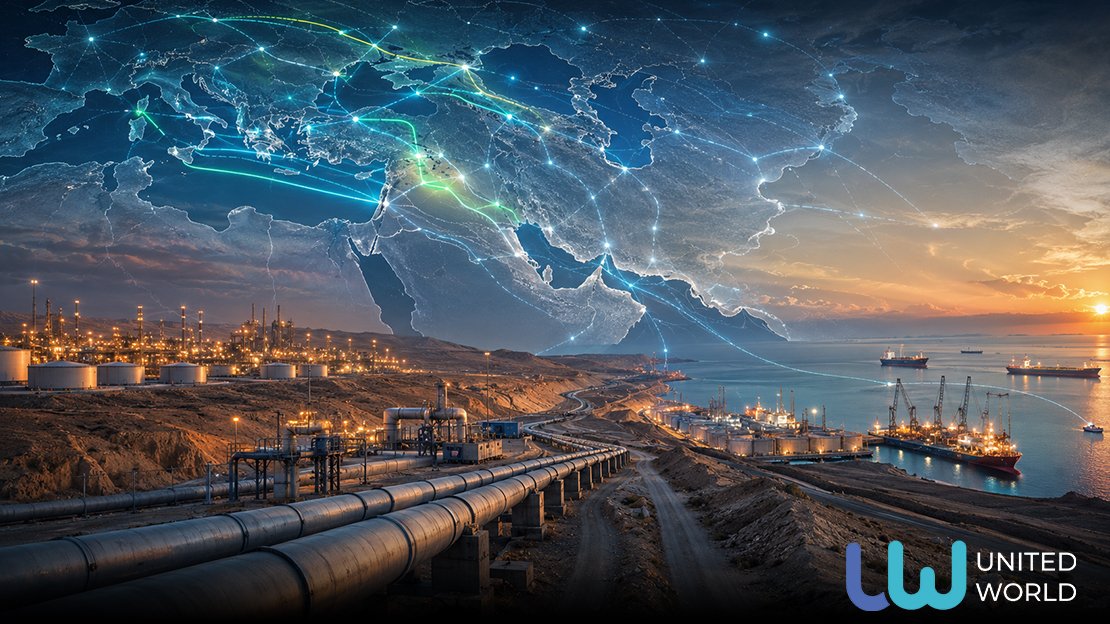
Energy pipelines have never been merely engineering projects. Throughout the modern history of the Middle East, they have served as instruments of geopolitical influence, strategic leverage and regional power projection. Every major pipeline has reshaped political calculations as much as it has redirected the flow of oil. The decision by Iraq and Syria to revive the historic Kirkuk–Baniyas oil pipeline therefore represents far more than the restoration of an energy asset that has remained dormant for more than two decades. It reflects the emergence of a new strategic reality in which energy infrastructure is becoming one of the principal drivers of regional diplomacy, economic integration and geopolitical competition.
Signed on 17 July 2026, the memorandum of understanding between Baghdad and Damascus seeks to rehabilitate one of the Middle East’s oldest strategic energy corridors. Constructed during the 1950s, the Kirkuk–Baniyas pipeline stretches for approximately 800 kilometres, linking Iraq’s northern oil fields around Kirkuk with Syria’s Mediterranean port of Baniyas. For decades it provided Iraq with a valuable western export outlet, reducing reliance on Gulf shipping lanes while offering direct access to European markets. Operations ceased following the 2003 Iraq War amid widespread damage to energy infrastructure, prolonged instability and the collapse of cross-border energy cooperation. According to current estimates, restoring and modernizing the pipeline will require roughly 36 months, involving extensive repairs to pumping stations, control systems and large sections of the pipeline itself.
The revival of this historic corridor comes at a time when global energy markets are undergoing profound strategic change. Recent regional conflicts have exposed the vulnerability of traditional export routes, particularly maritime chokepoints whose disruption can rapidly trigger global economic consequences. The search for alternative export corridors has therefore become not simply an economic objective but a strategic imperative. Governments across the Middle East increasingly recognize that resilience depends on diversification—creating multiple pathways to international markets rather than relying on a single gateway.
Great Iraqi Expectations
For Baghdad, the decision to revive the historic Kirkuk–Baniyas oil pipeline represents far more than the rehabilitation of aging energy infrastructure. Iraqi officials increasingly present the project as a strategic pillar of a broader national vision aimed at strengthening economic resilience, diversifying export routes and restoring Iraq’s historic role as a bridge between the Gulf and the Mediterranean.
Speaking during the U.S.–Iraq Business Summit in Washington on 17 July 2026, Iraqi Prime Minister Ali Al-Zaidi described his government’s economic policy as an “open-door policy,” stressing that Iraq welcomes international investment and seeks broad partnerships to modernize its energy sector and infrastructure. The summit witnessed the signing of agreements and memoranda of understanding worth more than $60 billion with international companies operating in the energy, technology and healthcare sectors, including projects linked to the rehabilitation of the Iraq–Syria oil corridor.
Although the Prime Minister did not portray the Kirkuk–Baniyas pipeline as a substitute for Iraq’s traditional export outlets, his government’s approach reflects a broader strategy of reducing dependence on any single corridor. Iraqi officials increasingly argue that expanding export options is essential in an era when geopolitical tensions can quickly disrupt maritime trade and energy supplies.
This strategic approach has also been reflected in the statements of Oil Minister Bassem Mohammed Khudair, who has repeatedly emphasized that Iraq is pursuing parallel export routes through the Gulf, Türkiye and Syria. In interviews following the July agreements, Khudair underlined Baghdad’s commitment to accelerating pipeline projects while maintaining its obligations within OPEC, describing export diversification as a necessary component of Iraq’s long-term energy strategy rather than a temporary response to regional crises.
Official statements issued by the Iraqi government also present the rehabilitation of the Kirkuk–Baniyas pipeline as part of a wider effort to transform Iraq into a regional center for energy and infrastructure investment. This vision extends beyond increasing crude oil exports to include modern transport corridors, logistics networks and closer economic integration with neighboring countries. The pipeline is therefore increasingly linked to Iraq’s broader development agenda rather than being treated as an isolated energy project.
Support for the project has also been evident within Iraq’s legislative institution. Haibat Hamad Abbas Al-Halbousi, the current Speaker of the Iraqi Council of Representatives and former Chairman of the Parliamentary Oil and Energy Committee, has consistently emphasized the importance of modernizing Iraq’s energy infrastructure and expanding the country’s export capacity as part of a broader strategy to strengthen economic resilience. His long experience in parliamentary oversight of the energy sector has given additional political weight to calls for diversifying Iraq’s export corridors and integrating major infrastructure projects into the country’s long-term development agenda.
The renewed emphasis on infrastructure reflects lessons learned from recent regional disruptions. The interruption of exports through the Strait of Hormuz highlighted the risks associated with excessive dependence on a single maritime route. Against this backdrop, Iraqi policymakers have sought to develop alternative outlets capable of improving the country’s strategic flexibility while maintaining stable supplies to international markets. The planned rehabilitation of the Kirkuk–Baniyas pipeline, with an initial target capacity of around 2 million barrels per day, forms part of this broader effort.
Baghdad’s strategy also coincides with renewed international interest in Iraq’s energy sector. During the Washington summit, major international companies, including Chevron, ConocoPhillips and BP, announced new agreements or investments covering upstream production, field redevelopment and export infrastructure. Iraqi officials presented these agreements as evidence of growing international confidence in the country’s economic prospects and institutional reforms.
At the same time, Iraqi policymakers have avoided presenting the Syria corridor as an exclusive option.
The Iraqi Strategic Perspective
Similar views have been expressed by Dr. Luay Al-Khatteeb, former Minister of Electricity and founder of the Iraq Energy Institute, and veteran oil expert Dr. Fadhil Chalabi, former Executive Director of the Centre for Global Energy Studies, have long argued that Iraq’s strategic strength depends not only on increasing production but also on expanding secure and diversified export outlets capable of withstanding regional geopolitical shocks.
Iraqi strategic thinking approaches the project from a different angle. For policymakers in Baghdad, the pipeline primarily represents an instrument of national resilience and economic sovereignty.
For decades, Iraq has depended overwhelmingly on Gulf export terminals. While these facilities remain indispensable, recent geopolitical developments have demonstrated the risks associated with excessive reliance on a single export direction. A western corridor to the Mediterranean would provide Iraq with greater strategic flexibility and reduce vulnerability to future regional disruptions.
Iraqi analysts also emphasize that the project complements the country’s broader economic transformation. Rather than viewing the pipeline as an isolated investment, they increasingly associate it with Iraq’s Development Road Project and other initiatives designed to position Iraq as a regional transportation and logistics hub connecting the Gulf with Europe.
This perspective reflects a broader shift in Iraqi strategic planning, where infrastructure is becoming a central component of foreign policy, economic diversification and national security.
Türkiye cooperation
On the other hand, the negotiations with Türkiye on renewing and expanding bilateral energy cooperation have continued in parallel, reflecting Baghdad’s preference for maintaining multiple export channels. During Prime Minister Al-Zaidi’s visit to Ankara in late July 2026, both Iraq and Türkiye reaffirmed their intention to conclude a comprehensive energy cooperation agreement, underscoring Iraq’s determination to diversify—not replace—its strategic export routes.
Taken together, these official positions reveal a coherent strategic direction. Iraq is seeking to move beyond a traditional producer-exporter model toward a more diversified role within the regional energy system. Rather than relying exclusively on production volumes, Baghdad is investing in connectivity, infrastructure and multiple export corridors capable of strengthening national resilience and enhancing Iraq’s geopolitical importance.
Whether these ambitions can be fully realized will depend on sustained political commitment, regional stability, financing and successful implementation. Nevertheless, the revival of the Kirkuk–Baniyas pipeline has already become one of the clearest expressions of Iraq’s aspiration to redefine its position within the changing geopolitical landscape of the Middle East.
Economic Transformation
For Syria, meanwhile, the project could mark the beginning of a broader economic transformation. Re-establishing its role as a transit country would generate new revenues, attract international investment and restore part of the strategic importance that Syria historically enjoyed as a bridge linking the Gulf with the Eastern Mediterranean. At a time when regional diplomacy is increasingly driven by infrastructure, logistics and connectivity, energy transit has become a critical component of economic recovery and political reintegration.
The agreement also reflects a wider regional shift in which pipelines, railways, ports and economic corridors are gradually replacing traditional geopolitical rivalries as the principal tools of influence. From Iraq’s Development Road Project to new transport initiatives linking the Gulf with Europe, governments are increasingly measuring strategic success through connectivity rather than confrontation. Energy diplomacy has become inseparable from economic diplomacy.
The project has also attracted considerable international attention. Washington has expressed support for closer Iraqi-Syrian energy cooperation as part of broader efforts to strengthen regional energy security and diversify export routes. International energy companies have likewise shown growing interest in participating in infrastructure rehabilitation, reflecting the belief that energy connectivity can contribute to long-term regional stability as well as commercial opportunity.
Beyond Iraq and Syria
Yet perhaps the most revealing measure of the project’s strategic importance is the reaction it has generated beyond Iraq and Syria. In an assessment published on 27 July 2026, the Jerusalem Institute for Strategy and Security (JISS) argued that the rehabilitation of the Kirkuk–Baniyas pipeline carries significant geopolitical implications for Israel. Researcher Vita Abrahamov suggested that while the project broadly supports Western efforts to diversify Middle Eastern energy export routes and reduce dependence on vulnerable maritime chokepoints, it simultaneously creates a direct Mediterranean export corridor that bypasses Israeli territory.
According to the JISS assessment, this development could gradually reduce Israel’s long-term geopolitical ambition to position itself as a principal regional energy transit hub linking Gulf producers with European consumers. Over the past decade, various proposals have envisioned Israel’s ports and infrastructure—including the Eilat–Ashkelon pipeline—as potential components of future regional energy networks.
A fully operational Iraq–Syria corridor, however, would provide producers with an alternative land route to the Mediterranean, potentially diminishing both the economic attractiveness and the strategic necessity of some Israeli transit initiatives.
Whether or not one agrees with that assessment, it underlines a broader reality: competition in the Middle East is increasingly shifting from control of energy resources to control of energy corridors.
Larger transformation
Geography itself has become a strategic asset. Iraq, Syria, Turkey, Egypt and Israel all seek to strengthen their positions within an evolving network connecting the Gulf, the Eastern Mediterranean and European markets. In this new geopolitical environment, countries that succeed in becoming indispensable transit hubs may acquire influence extending far beyond their energy resources alone.
The rehabilitation of the Kirkuk–Baniyas pipeline should therefore be understood not simply as the reopening of an old oil route, but as part of a much larger transformation reshaping the strategic map of the Middle East. It reflects the growing importance of economic connectivity, infrastructure diplomacy and regional integration at a time when governments are increasingly seeking stability through shared interests rather than geopolitical confrontation.
How Strategic Think Tanks Read the Iraq–Syria Pipeline
The decision by Iraq and Syria to revive the historic Kirkuk–Baniyas oil pipeline has generated considerable interest among strategic research institutions across the Middle East, Europe and the United States. Although the project is still in its early stages, analysts increasingly agree that its importance extends far beyond energy transportation. It has become a test case for understanding how infrastructure is reshaping geopolitical competition, regional integration and global energy security.
What makes the project particularly significant is that it emerges at a time when the Middle East is witnessing an unprecedented reconfiguration of its economic geography. Energy corridors, railway networks, logistics hubs and maritime infrastructure are rapidly becoming the new instruments of geopolitical influence. Consequently, the debate surrounding the Iraq–Syria pipeline is no longer limited to engineering feasibility or commercial profitability. Instead, it has evolved into a broader discussion about the future balance of power across the region.
The American Perspective
Most American analyses approach the project from the perspective of energy security rather than regional politics alone. Since the disruptions that affected Gulf energy exports, policymakers and analysts have increasingly emphasized the importance of diversifying export routes in order to reduce dependence on vulnerable maritime chokepoints.
From this perspective, reopening the Kirkuk–Baniyas pipeline contributes to strengthening the resilience of global energy supply chains. Rather than replacing existing Gulf export routes, the corridor would create an additional outlet to the Mediterranean, offering greater flexibility during future crises. This logic aligns with a broader American strategy aimed at ensuring uninterrupted energy flows while encouraging regional economic cooperation.
Many observers also view the project as part of Washington’s wider effort to promote economic stabilization in Iraq and Syria through infrastructure development. The participation of major international energy companies further reinforces the perception that the pipeline is expected to serve not only commercial objectives, but also broader strategic interests related to regional stability.
The Israeli Perspective
Among the most detailed strategic assessments published so far is the analysis released by the Jerusalem Institute for Strategy and Security (JISS). In a paper published on 27 July 2026, researcher Vita Abrahamov argued that the rehabilitation of the Kirkuk–Baniyas pipeline carries significant geopolitical implications that extend well beyond the energy sector.
The report notes that Israel may indirectly benefit from any initiative that weakens Iran’s ability to influence regional energy flows by encouraging alternative export routes that reduce dependence on the Strait of Hormuz. In this sense, the project broadly supports a strategic objective shared by several Western governments.
However, the JISS assessment simultaneously identifies an important strategic challenge. By creating a direct Iraqi export corridor to the Mediterranean through Syria, the project could reduce Israel’s long-term ambition to position itself as a principal regional energy transit hub. For years, Israeli strategic thinking has included proposals aimed at connecting Gulf energy resources to Mediterranean markets through Israeli infrastructure, including the Eilat–Ashkelon Pipeline system. A functioning Kirkuk–Baniyas route offers producers another option that bypasses Israeli territory entirely.
The report therefore concludes that while the project may strengthen regional energy resilience, it also alters the competitive landscape among Middle Eastern transit corridors. The competition, according to this assessment, is increasingly about geography rather than production.
The Arab Perspective
Arab analysts generally frame the project within the broader concept of regional economic integration. Rather than interpreting the pipeline as a purely bilateral Iraqi–Syrian initiative, they increasingly see it as a building block for a wider network connecting Iraq, Syria, Jordan, Egypt and potentially the Gulf states.
This vision corresponds with growing Arab interest in developing integrated electricity grids, natural gas cooperation, petrochemical industries and cross-border transport infrastructure. Within this framework, the Kirkuk–Baniyas pipeline is viewed as one component of a much larger regional architecture designed to strengthen economic interdependence while reducing external vulnerabilities.
Some Arab researchers also argue that the project reflects a gradual shift from conflict-oriented regional politics toward infrastructure-based diplomacy. Economic corridors are increasingly replacing traditional geopolitical rivalries as governments search for sustainable models of cooperation.
The European Perspective
European analysts generally assess the project through the lens of energy diversification and supply security. Since the disruption of traditional energy markets in recent years, European policymakers have attached increasing importance to expanding the number of available supply routes connecting producers with European consumers.
Although the Iraq–Syria pipeline alone cannot fundamentally transform Europe’s energy balance, it represents another element in the gradual expansion of Mediterranean energy connectivity. From a European perspective, every additional export corridor contributes to greater market resilience and reduces exposure to geopolitical disruptions affecting individual transit routes.
Consequently, many European observers regard the project as part of a broader transformation in which the Eastern Mediterranean is emerging as one of the world’s most strategically significant energy regions.
Converging Assessments, Diverging Priorities
Although strategic think tanks differ in their political perspectives and institutional priorities, their assessments of the Iraq–Syria pipeline reveal an important area of convergence. Few analysts dismiss the project as simply another oil pipeline.
Instead, most regard it as part of a broader geopolitical transformation in which infrastructure, rather than military power alone, is becoming one of the principal determinants of regional influence.
This emerging consensus reflects a profound shift in the way the Middle East is being analysed. Traditional security concerns remain important, yet increasing attention is now devoted to economic corridors, logistics networks, ports, pipelines and cross-border connectivity. In this evolving strategic environment, countries capable of linking producers with international markets may acquire geopolitical leverage comparable to that once derived primarily from military capabilities or hydrocarbon reserves.
Nevertheless, the similarities among these assessments end where national interests begin.
For Washington, the project is primarily viewed as a contribution to global energy resilience and regional economic stabilization. American analyses generally focus on supply-chain security, diversification of export routes and the creation of greater flexibility in responding to future geopolitical disruptions. The underlying assumption is that stronger regional connectivity contributes to broader strategic stability.
Israeli strategic assessments approach the issue from a more competitive perspective. While recognizing the advantages of diversified regional energy routes, they also highlight the possibility that Syria’s re-emergence as a Mediterranean transit state could reduce Israel’s future role within regional energy architecture.
The debate therefore reflects not only concerns about energy security but also competition over strategic geography and infrastructure.
Iraqi analysts, by contrast, view the project through the prism of national sovereignty. Their principal concern is reducing excessive dependence on a single export corridor while strengthening Iraq’s ability to respond independently to future regional crises.
For Baghdad, diversification is not simply an economic objective but a strategic necessity.
Arab research institutions generally place greater emphasis on regional integration.
Many analysts argue that the pipeline should not be viewed as a bilateral Iraqi–Syrian undertaking but rather as a potential cornerstone of a broader Arab energy network connecting Iraq, Syria, Jordan, Egypt and eventually the Gulf states. Such a network could facilitate cooperation in oil transportation, natural gas, electricity interconnection and petrochemical industries while supporting wider economic integration.
European perspectives occupy a somewhat different position. European analysts are primarily interested in the project’s contribution to supply diversification and long-term market resilience. Although few expect the pipeline to transform European energy security on its own, many regard it as one element within a wider strategy aimed at increasing the number of available energy corridors linking the Middle East with European markets.
Different Perspectives
These different perspectives illustrate an important reality: the same infrastructure project can generate distinct strategic meanings depending on the observer. For Iraq, it represents strategic autonomy; for Syria, economic recovery; for the United States, supply-chain resilience; for Europe, energy diversification; for Israel, a potential reconfiguration of regional transit competition; and for Arab states, an opportunity to revive economic integration through infrastructure.
Another notable feature of current strategic assessments is the recognition that the project cannot be analyzed in isolation. Increasingly, think tanks compare the Kirkuk–Baniyas initiative with other major regional infrastructure projects, including Iraq’s Development Road, Turkey’s long-established energy transit corridors, the Eastern Mediterranean energy network and the India–Middle East–Europe Economic Corridor (IMEC). Rather than competing through a single route, the Middle East is evolving into a region characterized by multiple overlapping corridors, each seeking to attract investment, trade and geopolitical relevance.
A zero-sum game
This competition, however, should not necessarily be interpreted as a zero-sum game. Several analysts argue that future regional prosperity may depend less on exclusive control of one corridor than on the successful integration of multiple transportation and energy networks. From this perspective, the emergence of additional routes increases the resilience of global supply chains while offering producing countries greater strategic flexibility.
The pipeline also raises broader questions about the future of regional diplomacy. In recent decades, Middle Eastern politics has largely been framed through military conflicts, ideological rivalries and security crises. Today, however, economic connectivity is increasingly shaping diplomatic priorities. Pipelines, railways, ports and industrial zones are becoming instruments of foreign policy, creating incentives for cooperation that extend beyond traditional political alignments.
Yet optimism should be tempered by realism. The rehabilitation of the Kirkuk–Baniyas pipeline will require sustained political commitment, substantial financial resources, technical expertise and, above all, a stable security environment. International sanctions, investment risks, regional rivalries and evolving geopolitical dynamics will all influence the pace and ultimate success of the project. Whether the pipeline becomes a transformational strategic corridor or remains an unrealized ambition will depend on decisions taken over the coming years rather than on the memorandum of understanding alone.
A larger transformation
Ultimately, the debate surrounding the Iraq–Syria pipeline reflects a larger transformation taking place across the Middle East. The region is entering an era in which economic geography is becoming as strategically important as military geography. Energy corridors, transportation networks and logistics infrastructure are emerging as central pillars of regional power, altering long-established assumptions about influence, connectivity and strategic competition.
Against this backdrop, understanding Iraq’s own strategic vision becomes essential. How does Baghdad assess the opportunities and risks associated with the project? Can the pipeline become a catalyst for wider Arab energy integration? What role might Turkey, Egypt, Jordan and the Gulf states play in this evolving landscape? And how does Iraq balance economic pragmatism with the region’s complex geopolitical realities?
All these questions will require answers from the Iraqi government, and more importantly, swift, tangible steps on the ground that demonstrate the readiness of the new Iraq to write a success story, so desperately needed in the Middle East. Conversely, some fear that the project could be the beginning of a new chapter in the Great Game, this time concerning who controls the next energy corridor?