


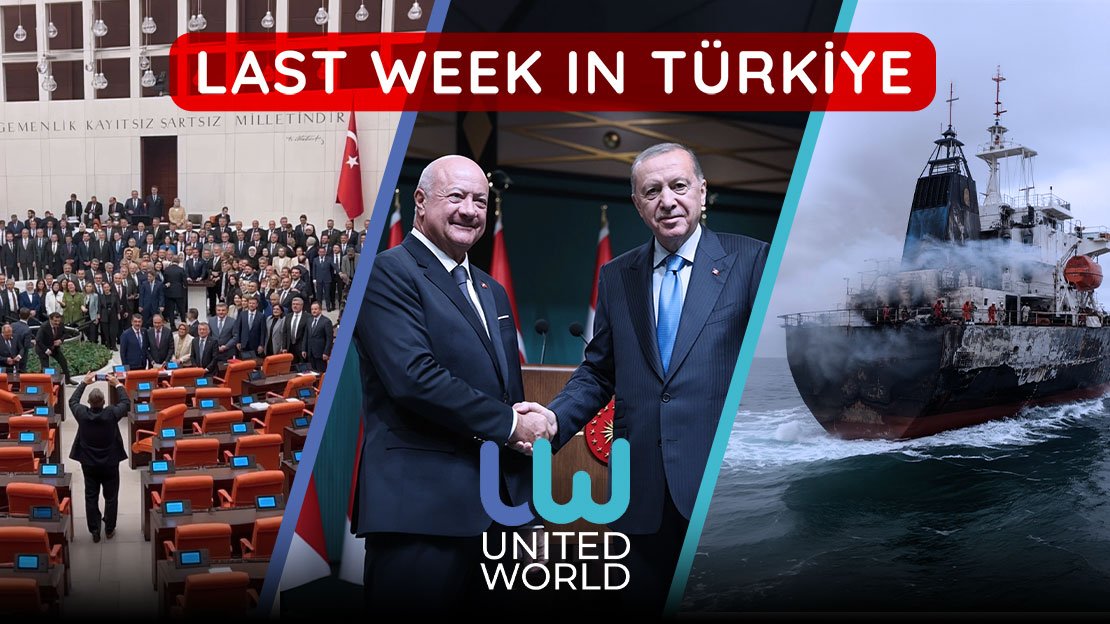
Türkiye had another busy week on the political agenda.
The “Framework Law,” which sets out the legal basis for the process called “Terror-Free Türkiye” by the government was passed after a vote in Parliament.
Another news of the week was the meeting in Ankara between President Recep Tayyip Erdoğan and Austrian Chancellor Christian Stocker.
Meanwhile, political reactions to Ukrainian attacks targeting Turkish ships in the Black Sea were also among the week’s important developments.
“Terror-Free Türkiye” law
On August 10, the “Bill on Strengthening National Solidarity and Social Integration,” also known as the “Framework Law,” which provides the legal framework for the government-initiated “Terror-Free Türkiye” process, was put to a vote in the Grand National Assembly of Türkiye, and approved.
The bill, which sparked controversy between the government and the opposition and was criticized by some opposition parties on the grounds that it granted concessions to the PKK terrorist organization, passed Parliament with 467 votes in favor, 88 against and 7 abstentions.
Alongside the governing bloc of the Justice and Development Party (AKP) and Nationalist Movement Party (MHP), the Republican People’s Party (CHP) (where Kemal Kılıçdaroğlu returned to the party leadership following the court’s nullity ruling) and Peoples’s Equality and Democracy Party (DEM) also voted in favor.
Özgür Özel, the former leader of the CHP and the chairman of the New Party, which split from the CHP after the court’s nullity ruling, announced that he would personally vote in favor of the bill but would allow the party’s MPs to vote freely. As a result, 54 New Party MPs voted against the bill, while 35 voted in favor.
The Good Party also voted against the bill.
The Framework Law provides for the suspension of prosecutions and sentences in cases linked to the PKK/KCK terrorist organization, although the government maintains that the legislation does not amount to a “general amnesty”.
For the law to be implemented, the National Security Council must first adopt a decision stating that the PKK/KCK and affiliated organizations have effectively ceased to exist and completely laid down their arms, and this decision must then be published in the Official Gazette. Once this decision is issued, those seeking to benefit from the provisions of the law will have six months to apply.
Under the legislation:
- For offenses carrying prison sentences of 15 years or less, investigations, prosecutions and the execution of sentences will be suspended for five years.
- For offenses carrying sentences of more than 15 years, life imprisonment or aggravated life imprisonment, the suspension period will be 10 years.
- If the relevant individuals commit no new terrorist offense during the suspension period, the sentence will be deemed to have been served.
The law excludes certain offenses and individuals from its scope. Intentional killings committed as part of an organization’s activities, as well as offenses committed before June 1, 2005 that carry life or aggravated life sentences, are not covered by the legislation.
Debate continues over whether Abdullah Öcalan, the imprisoned leader of the PKK terrorist organization, and other senior figures in the organization will be eligible to benefit from the new legislation.
The implementation of the law is to be overseen by an eight-member board chaired by the Vice President, as well as a Monitoring Commission operating under the Office of the Speaker of Parliament.
Following the vote, Parliament Speaker Numan Kurtulmuş said, “This achievement does not belong to one party alone. It is an achievement for all of Türkiye.”
PKK-linked DEM Party Co-Chair Tuncer Bakırhan said, “This law is neither a concession, nor a victory, nor a defeat.” He added that they expect further legislative measures in October.
Good Party Chairman Müsavat Dervişoğlu, who opposed the legislation, argued that the real purpose of the bill was “to pave the way for Erdoğan to remain president for life.”
After the bill was submitted to Parliament, President Erdoğan said: “I hope this step, which aims to permanently free Türkiye from the threat of terrorism, reinforce our national unity and solidarity, and strengthen the climate of peace in our country and our region, will bring beneficial results.”
MHP Chairman Devlet Bahçeli followed the voting process in the Parliament and underlined his full support for the legislation.
Vatan Party Chairman Doğu Perinçek, meanwhile, described the law as incomplete during a television appearance, although he expressed his support. Perinçek argued that individuals seeking to benefit from the legislation should be legally required to “explicitly declare their willingness to integrate with the Republic of Türkiye and the Turkish nation”.
He also said that the title of the bill did not fully reflect its intended objective, arguing that the concepts of “national solidarity” and “social integration” were too general and ambiguous. Instead, Perinçek proposed changing the title to include the phrase “for the purpose of integration with the Republic of Türkiye and the Turkish nation.”
Perinçek also raised legal objections concerning the implementation of the bill. In particular, he said it remained unclear according to what criteria individuals who are not yet under investigation or have not received a final conviction would be assessed, warning that this could create serious problems in practice.
Erdoğan hosts Austrian Chancellor
Another news of the last week was the meeting between President Erdoğan and Austrian Chancellor Christian Stocker in Ankara. Erdoğan welcomed Stocker to the Presidential Complex with an official ceremony.
According to media reports, the talks covered bilateral relations, Türkiye-European Union relations, and regional and global developments.
At a joint press conference, Erdoğan said the two countries had significant potential for cooperation in areas including green energy, critical minerals, advanced technology, transportation and the defense industry.
“We believe that we will raise the approximately $4.5 billion in trade volume we achieved in 2025 to our target of $5 billion this year,” Erdoğan said.
He also proposed establishing a Joint Economic and Trade Committee in place of the existing Joint Economic Commission in order to further develop bilateral trade relations, expressing hope that its first meeting could be held before the end of the year.
Erdoğan said the two leaders had also exchanged views on Türkiye-EU relations, adding: “I emphasized that steps to be taken by the EU, particularly on modernizing the Customs Union and advancing the visa liberalization dialogue, would be in all of our interests.”
Erdoğan also said Türkiye attaches importance to Austria contributing to Syria’s reconstruction process.
Stocker, for his part, described Türkiye as a “key country.”
Expressing appreciation for Türkiye’s efforts to bring the Russia-Ukraine War to an end, Stocker told President Erdoğan: “We particularly appreciate your personal efforts as well.”
Stocker said Türkiye carries significant weight in the Middle East and that “diplomacy and dialogue” is the only solution for the region.
He also noted that more than 300,000 people of Turkish origin living in Austria make significant contributions to the country’s economy, culture and society.
Pointing to the potential for cooperation between the two countries on cross-border railway projects, Stocker also mentioned investments by Austrian companies in Türkiye.
Politicians react to attacks on Turkish ships in the Black Sea
Türkiye keeps seeing Ukrainian attacks targeting Turkish ships in the Black Sea. Most recently a Turkish-operated Ro-Ro vessel carrying fresh fruit and vegetables off Novorossiysk was attacked.
Oddly enough for many, the government remains silent. But AKP’s coalition partner MHP raised its voice against the Ukrainian attacks on Turkish vessels.
MHP Deputy Chairmen İsmail Özdemir and Prof. Dr. İlyas Topsakal said in statements posted on social media that bilateral relations with Ukraine should be comprehensively reassessed and that Türkiye’s sovereign rights, the security of regional trade and the “Middle Corridor” logistics route must urgently be protected.
Özdemir wrote:
“The latest attacks on our commercial vessels sailing in the Black Sea and carrying fresh fruit and vegetables are unacceptable. Despite all the notices, warnings and concerns that our official authorities have previously conveyed to the Ukrainian side, these attacks, carried out with an attitude that goes beyond irresponsibility and amounts to malicious intent, have now become the last straw.
Since the war between Russia and Ukraine in 2022, Türkiye has maintained a responsible and constructive position aimed at preventing the conflict from spreading into the Black Sea, bringing the fighting between the parties to an end and moving toward peace. Our decision to exercise the rights granted to us under the Montreux Convention has undoubtedly disturbed those seeking to spread the war into the Black Sea. It has become clear that the Western mindset that blames Russia at every opportunity is, in fact, the one seeking such an outcome.”
İlyas Topsakal mentioned the “geopolitical rupture”:
“Attacks targeting commercial vessels in the Black Sea and Caspian basins can no longer be regarded as isolated security incidents. They are signs of a new geopolitical rupture that is directly affecting our region’s maritime transportation system. The attack on a Turkish-operated Ro-Ro vessel off Novorossiysk has clearly demonstrated that this rupture is no longer merely a theoretical risk. (…)
What is being targeted in the Black Sea is not merely a single ship, it is Türkiye’s maritime trade, the reliability of the Middle Corridor, the logistics routes connecting the Turkic world, and the fundamental principles of international maritime law. At a time like this, the security of the Black Sea cannot be regarded solely as a matter for the littoral states. Stability in this basin is a strategic necessity for our region’s economic security, the sustainability of transportation corridors and regional peace.
Türkiye must remain firmly committed, with its historical responsibility, geopolitical position and diplomatic capacity, to preserving the Black Sea as a sea of security, stability and international cooperation.”