


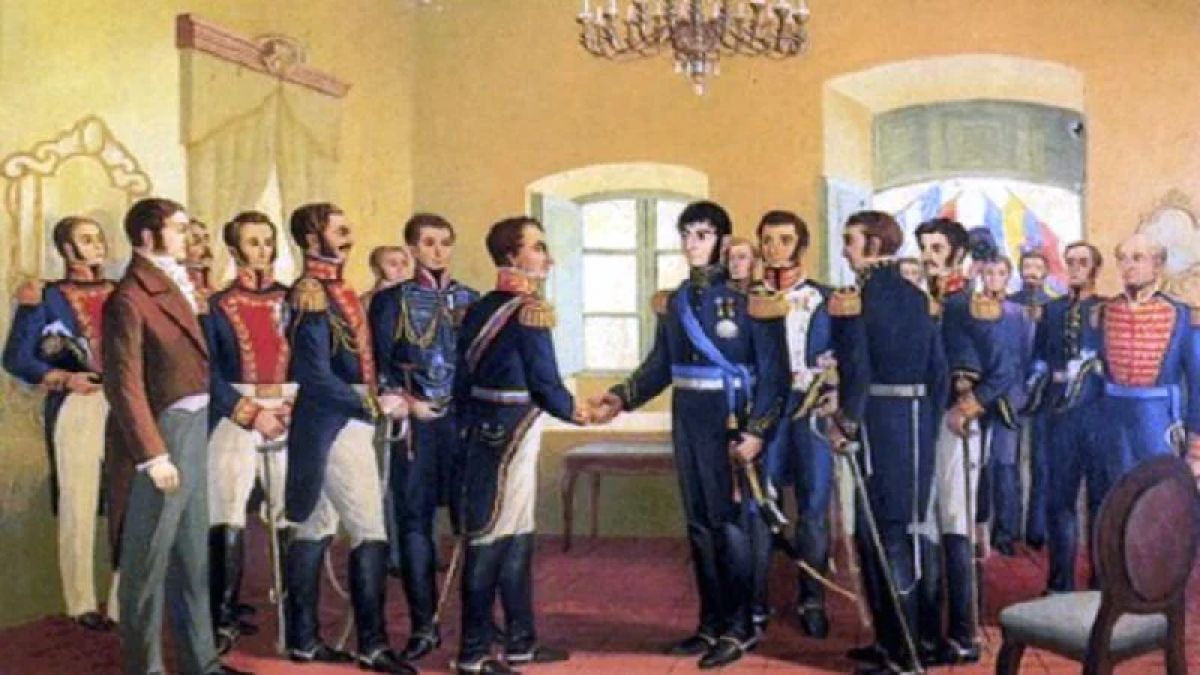
I am in Coro, the capital of Falcón state in western Venezuela, where I was invited to participate in the meeting “The Enduring Relevance of Bolivarian Diplomacy: 200 Years After the Amphictyonic Congress of Panama.” This event continues the commemoration of the bicentennial of that important continental gathering.
Organized by the Simón Bolívar Center for Studies, the Falcón State History and Heritage Network, the Rómulo Gallegos Center for Latin American and Caribbean Studies (Celarg), and other institutions, and sponsored by the Coro City Hall and the Falcón State Government, the event took place in the Chema Saher Hall of the City Hall. I was responsible for one of the two keynote addresses, which I titled “The Amphictyonic Congress of Panama: A Magnificent Work of the Liberator Simón Bolívar. Context and International Repercussions.”
Traveling to the interior of the country and escaping the capital is completely restorative in every sense. Although all the decisions are made in Caracas, its stifling atmosphere makes much of what is said and done feel artificial and premeditated. In the interior, there is a different energy, a sense of fulfillment that is felt from the moment you arrive at the airport and throughout every place you visit. If the spirit of camaraderie and fraternity is one of the defining characteristics of Venezuelan identity, the people of Falcón take the cake for a warmth and hospitality that far surpasses the national average.
My presentation focused on the urgency of the Liberator Simón Bolívar to ensure the realization of the Congress in Panama despite the doubts and uncertainty that permeated the elites who governed the new American republics formerly Spanish after the end of the war of independence.
Bolívar knew what was at stake in Panama, and, deeply aware of the momentous nature of the decisions to be made there, he made persistent efforts to convince Vice President Santander of the extraordinary significance of this project. Far from the seat of government, the Liberator realized with utter helplessness that it was Santander, from Bogotá, who could pull the strings regarding the convening, preparation, and execution of this momentous meeting. Therefore, he began to think that he had to make an immediate decision to change the atmosphere of ambiguity that permeated the air surrounding this crucial matter.
On December 7, 1824, knowing that the decisive battle for the independence of South America was approaching, and although he did not know it, almost on the eve of it taking place, from Lima, the Liberator, writing in the first person, that is, personally assuming responsibility, issued a circular addressed from the highest magistracy of Peru to the heads of government of the former Spanish American republics (Colombia, Mexico, Río de la Plata, Chile and Guatemala), summoning them to the great continental event.
That document summarized the integration efforts of the previous 14 years and the need to move toward the union of republics. In that context, many considered this Congress and the possibility of integration to be nothing more than a pipe dream. Bolívar remained misunderstood; his peers did not grasp the necessity and urgency of holding a conclave of this nature.
Bolívar proposed the creation of a supranational, federal authority to prepare for joint negotiations with Spain. He was concerned about the imperial ambitions of the European powers, grouped in the Holy Alliance. At that time, he was also beginning to develop an unease about the expansionist and hegemonic tendencies of the United States following President Monroe’s address to Congress in December 1823.
The Bolivarian ideas expressed by the Liberator as early as 1815 in the Jamaica Letter have their culmination in the aforementioned Call to the Congress of Panama of December 7, 1824, which was to serve as the basis for the deliberations and agreements that, according to him, the Congress would have to adopt, in which it was hoped that an agreement would be reached between equal parties related by bonds of fraternity and cooperation between their peoples.
Therefore, the Congress was convened with the Liberator’s conviction that: ” The day our plenipotentiaries exchange their powers, an immortal era will be established in the diplomatic history of America.”
In the instructions prepared by Bolívar for the plenipotentiaries who would represent Colombia in Panama, the parameters that would serve as the basis for fulfilling the mission were established: “Nothing at this moment is of greater interest to the government of Colombia than the formation of a truly American League. It is essential that you emphasize the need to lay the foundations now for an amphictyonic body or assembly of plenipotentiaries that will promote the common interests of the American States, that will resolve any discord that may arise in the future between peoples who share the same customs and habits, but who, for lack of such holy instruction, may perhaps ignite the disastrous wars that have ravaged other, less fortunate regions .”
These instructions reveal aspects of Bolívar’s integrationist thinking that were intended to be included in the document to be signed in Panama. Certain points printed in the signed documents establish principles that were meant to serve as the foundation for the legal framework they sought to construct.
The instructions clearly outlined the ideas that needed to be sown to take root in Panama. They emphasized the mutual commitment the parties had to make not to agree to a definitive peace with Spain except on the basis of accepting and recognizing the independence and integrity of all. The possibility of signing an agreement to create a common citizenship was even established.
A first problem arose when differing proposals emerged regarding whether to invite the United States to the conclave. Gual and Santander believed that the northern power should be present in Panama. They thought that in this way they could influence the US to foster closer ties with the southern republics, but Bolívar did not share this view. Behind Bolívar’s back, Santander and Gual invited the United States.
Regarding this matter, the Liberator expressed his disagreement in separate letters to Santander dated March 8, May 8, May 30, July 7, and October 21 and 25, 1825, but the vice president continued his undermining work by involving other actors in the invitation.
Bolívar was wary of the United States, foreseeing its expansionist tendencies, but above all, he repudiated its pro-slavery practices. The Liberator believed that the Assembly of Panama should adopt a firm resolution not only against the slave trade, but also a condemnation of slavery as an institution in the American countries. This would greatly influence Bolívar’s decision not to invite the United States or Brazil.
It is important to note that, in the same year he wrote the Jamaica Letter, in another letter addressed to the English businessman Maxwell Hyslop and dated May 19 from Kingston, the Liberator called for greater involvement from England in the cause of the Spanish American struggle. He warned that “perhaps when England tries to turn its gaze toward America, it will not find it!”
He made this known to the British politician Richard Wellesley in a letter also dated Kingston, May 27, 1815: “If I had retained a glimmer of hope that America could triumph on its own, no one would have coveted more than I the honor of serving my country without degrading it to the humiliation of requesting foreign protection: This is the cause of my departure from the Mainland. I come to seek aid: I will go in search of it to that proud capital; and if necessary, I will march to the Pole; and if all are insensitive to the voice of humanity, I will have fulfilled my duty, albeit in vain, and I will return to die fighting in my homeland.”
Now, ten years later, in preparation for the Congress and when he was only thinking about its success, Bolívar was still pondering that a strategic alliance with England should be established in order to isolate the main enemy and achieve the immediate objective, which was to build the unity of the formerly Spanish American republics.
But this idea always had a tactical character. Nowhere in his extensive work will one find that he was inclined to favor any particular power as a strategic objective. Therefore, it must be understood that in establishing the need for an alliance with England, the Liberator was accurately interpreting the international political situation of the time, taking advantage of the emerging contradictions between Great Britain and the United States, who were vying for markets and maritime routes.
In any case, he harbored no illusions about either side, neither the United States nor England, but acting with exquisite political acumen, extraordinary strategic vision, and a keen diplomatic sense, he issued warnings in this regard and explained the significance of the Congress to be held in Panama and what would need to be done to prepare for it. He wrote to Santander in a letter dated March 8, 1825, from Lima: “The English and the Americans are temporary and very selfish allies. Therefore, it seems prudent to enter into friendly relations with these allied gentlemen, using sweet and insinuating language to elicit their final decision and, in the meantime, buy time.”
From the first days of April 1826, when he sent a letter from Lima to Pedro Gual, the Liberator kept a close eye on the news arriving from the isthmus. However, the escalating conflicts plaguing the new republics began to occupy most of his time, and he seemed to lose interest in what was happening or was about to happen in Panama. Communication difficulties prevented him from receiving news from the isthmus as quickly as he desired.
By May, his correspondence began to reveal a deep concern about the anarchy and chaos engulfing the political and economic climate of nearly all the republics. Four days later, on June 7, Bolívar reiterated to Santander Colombia’s commitment to the Congress of Panama and his concern about the delay in the arrival of the Mexican delegates, which was postponing the start of the debates. He again expressed his belief that the Bolivian plenipotentiaries would travel soon, which never came to pass. Nevertheless, the Liberator continued to follow events with keen interest, and on June 23, he wrote to Santander to inform him that he had met with the British ambassador in Peru.
A cursory review of the Liberator’s correspondence and activities during those days reveals a complete shift in his focus and efforts toward achieving stability for Colombia, particularly in Venezuela, where General Páez was displaying autocratic tendencies and already expressing the idea of destroying Colombia by separating Venezuela from Cundinamarca. He was also concerned about the stability of Peru, which had effectively become his base of operations. In his messages, he began to reveal his conviction that he must return to Colombia to avert the impending shipwreck he foresaw. Nevertheless, in a letter to Santander dated July 8th, he paused to offer, for the first time, an opinion on the Congress in Panama. He was very pessimistic about it, and, within the context of the letter, he also revealed his concern and powerlessness regarding the situation in Venezuela and the conduct of General Páez.
He was most likely receiving news of what was happening in Panama. Communication difficulties meant there was a delay of about two months between the drafting of a report and its arrival in his hands, and another two months for those who issued it—in this case, the plenipotentiaries—to receive a response. Finally, on August 11, he decided to write directly to Gual and Briceño Méndez. By that date, the Assembly had concluded, but he was unaware of this. In a way, this communication is prescient; it seems that even before the conclave began, the Liberator feared its failure. This led him to take direct action. In this letter, he vehemently expresses his assessment of the Panama negotiations, even without having all the information. He even, in a sense, outlines his decision to modify the original proposal in order to salvage the agreements and the Treaty.
It could be said that at the end of the Congress, Bolívar was at the pinnacle of his glory. Although at this time the Liberator was president of Colombia, dictator of Peru, and president of Bolivia; the Dominican Republic had joined Colombia, Cuban patriots sent him representatives, Central America ordered his portraits to be placed in offices, and the Mexican general Vicente Guerrero offered him the position of commander-in-chief of his army, the truth is that after that moment at the summit, his own decline began to manifest itself .
The economic situation was critical, and the oligarchies that seized power after independence lacked a development vision suited to modern times. Although Bolívar’s integrationist ideals retained their value, it was the national oligarchic forces themselves that pushed for a US-dependent proposal that embodied a hegemonic paradigm and a subordinate integration. Thus began the decline.
Bolívar would only learn the results of the Panama Assembly in September. He had embarked from Callao on the 3rd, arriving in Guayaquil on the 13th, after three years away from Colombia. Upon arriving in Guayaquil, he was met with a large volume of correspondence. Already thinking about the future and the complexities he foresaw, the day after his arrival, he hastened to write to General Briceño Méndez. In that letter, he could not conceal his pessimism and asked that “the treaties not be ratified before I arrive in Bogotá, and before I have examined them carefully and thoroughly with you and others.”
In general, Bolívar, who had called himself “the man of difficulties,” would not be intimidated by these trials. His thinking was imbued with a strategic and long-term vision that was very advanced and hardly perceived in his time, even by some of his closest collaborators. In fact, even today, two hundred years later, the Liberator remains misunderstood. He believed in total independence and in the creation of a nation of nations that would give South America solidity and presence in the international arena. He could not conceive that a single country, however powerful, could face the vicissitudes of the world he foresaw alone. Hence his supreme effort for the success of the Assembly of Panama.