


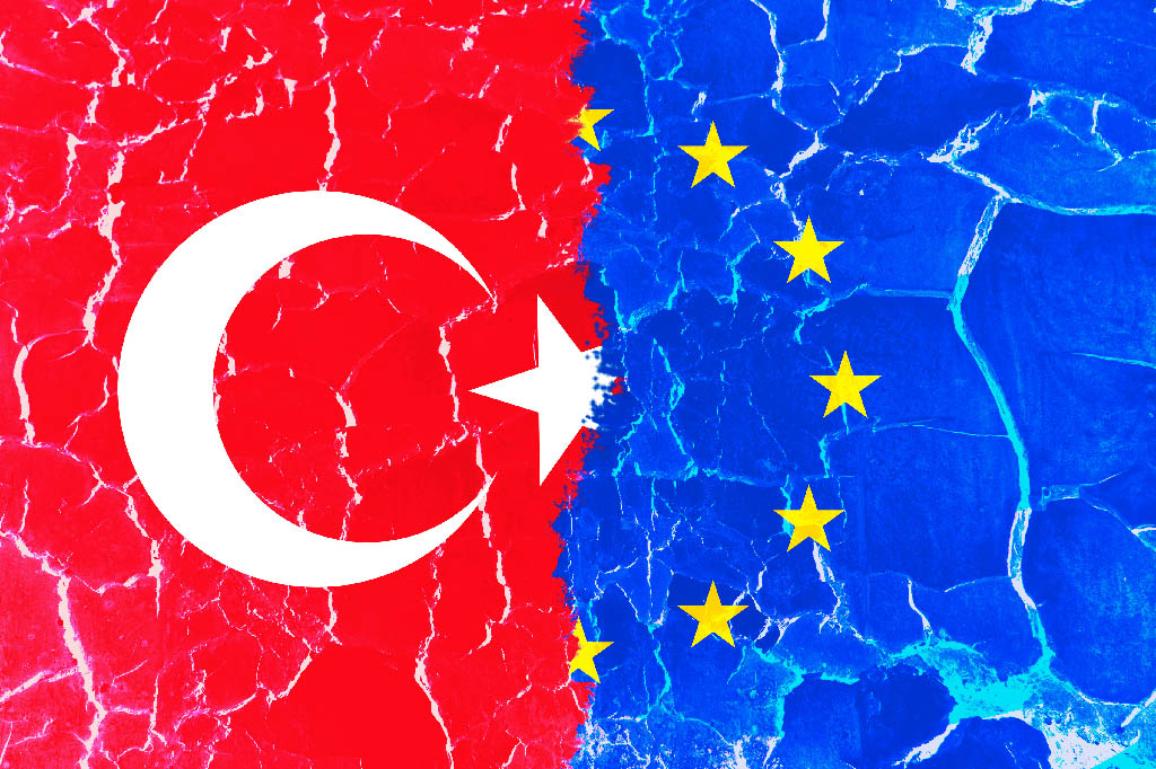
Relations between the European Union and Türkiye are continuing to be tense. Despite the customs union, a long tradition of cooperation between the sides on a number of issues, both the progress of Türkiye’s membership and its inclusion into a debated European Security Architecture seem to be stalled. We spoke about the reasons for that with Professor Vişne Korkmaz from the Nişantaşı University.
Recently, a commission of the European Parliament decided by vote to exclude Türkiye from defense related projects financed by HORIZON. How do you evaluate this?
It appears that these funds from the European defense structure are not currently open to Türkiye’s application. You didn’t need to be a member of the European Union to use them. These funds would also have been open to partner countries.
Why is this important? The goal is to establish joint production and interoperability. In other words, this isn’t just about funds in exchange for technology. It is about building interoperability and the ability to operate together on the ground. In that sense, it also has symbolic importance.
Of course, I understand that issues have arisen in other applications as well, albeit in different forms, but Türkiye is a NATO member, and there is already a framework for working side by side and in coordination with many European countries and the security pillar of the European Union within the NATO context.
The new global context
Did you expect this to happen, and in which context do you interpret this decision?
It was unexpected because Europe faces the necessity of building its own security and defense—that is, building its own capabilities and determining its own security and defense strategy. The current situation has brought about this necessity. We all know what Trump’s world is like. We are moving toward a “burden-shifting” model. In other words, it’s not about “burden-sharing” anymore.
The United States now defines competition differently and believes that partners must shoulder a greater share of conventional responsibilities within this framework. This is a 100% commitment, and it has an economic policy dimension. Consequently, it seems clear that the United States will no longer assume 100% of Europe’s defense responsibilities. As you know, they don’t even classify Russia as a threat. Even if NATO were to define Russia as a threat, there are differences in the defense documents of NATO partners.
So, for the United States, Russia is not a threat. For Europe—and for many European countries—Russia is a direct threat. It is both an internal threat, an external threat, and a hybrid threat.
The burden of providing conventional defense at specific locations falls entirely on the allies. The Americans take this matter seriously. Furthermore, the Americans could also pose a risk to European security in certain areas. For this reason, Europeans must work within NATO with actors who are NATO partners but not direct members of the European Union—namely the United Kingdom, Norway, and Türkiye.
What do you conclude from the decision for the Turkish-European relations?
It indicates that there is a strained situation in Türkiye-Europe relations. This strained situation has been going on for quite some time.
But there is also an expectation that this strained situation might turn into something sour-sweet, more like lemonade. Because Europe needs that.
For them, conventional forces—and even these conventional forces will be led by Germany—are ready to deploy and fight beyond their own borders. In fact, they are in the process of building a very ambitious, substantial force of troops capable of operating not only within their own borders but also in interconnected regions, and they’re talking about ensuring technological superiority and so on.
Confusion in Europe
The Germans have also shown interest in the areas of focus of that Strategic Compass. They mention the Middle East, the Sahel, North Africa, and West Africa. Consequently, they’ve established a strategic vision that essentially encircles the Mediterranean from the south. They’re clear on this, but Finland, for example, is adopting a more global vision. They say, “Let’s develop a more global vision, let’s align with the Global South,” and so on. The French, of course, want nuclear deterrence, but they also want national deterrence—national autonomy. In the end, France is saying, “Let there be nuclear deterrence and strategic autonomy.” As you can see, everyone has a different opinion.
Of course, until this is fully clarified in their minds, it’s not easy for Europeans to define Türkiye’s place and engage in real negotiations, make real preparations, or make real investments regarding it. This is the first reason for the problems in the relations.
In my view, the second reason—which is actually interesting and ironic from Europe’s own perspective, in terms of its own identity—is more important.
I don’t want to overstate it, of course, but when we look at the context of von der Leyen’s speech, yes, it was a speech about the Western Balkans.
You mean where she stated that Europe had to integrate to continent to avoid Russian, Chinese or Turkish influence expanding?
Yes. You know, the promises Europe has made to the Western Balkans amount to a long list, and they’ve never been fulfilled. But regardless of the context, the issue is that Türkiye is defined as the “other” there. A radical “other,” because China and Russia are Europe’s radical “others.”
So, the decision-makers’ own visions also come into play. The language they use and the choices they make in that language also play a role. What we’re seeing, in other words, is that European bureaucracy—when we talk about the European Union—is far more significant than the individual decision-makers of European countries. Because while the European Union may not have achieved much, it has succeeded in creating its own supranational bureaucracy. And that bureaucracy is the backbone of the European Union.
That bureaucracy has begun to define Europe in very identity-based and ideological terms. In other words, they have a certain image of Europe in their minds, and there are those who belong to that Europe and those who do not. It’s very rigid; it used to be more flexible.
The Cyprus factor
Because Europe, in this context—particularly with the war in Ukraine, Russia’s emergence as a threat, and the widespread perception of this threat—can serve as a vehicle for such widespread fear of Russia. Because the bureaucracy is using precisely this to build power, an identity, and a role for itself.
Let’s not fail to mention a third reason—the most obvious one, of course. That is, the Cyprus issue and the Government of Greek-Cypriot Administration. Because, as we can see, starting in 2004, another obstacle was added to these already strained relations due to the problems created by that government. This is a separate issue altogether. The Greek Cypriot Administration is using the Cyprus issue—not merely to balance Türkiye against whoever is within its reach, such as the United States, Europe, other countries, or Israel, or even Russia in the past—but beyond that, as part of a coercive strategy aimed at forcing a resolution to the Cyprus issue on its own terms.
The EU integrates everyone around Türkiye
What reactions do you observe on the Turkish side?
In the past, the liberal segment of public opinion viewed the European Union—or the dream of EU membership—as a source of motivation, a driving force, or an incentive for democratization, civilianization, and so on. And looking back, that was indeed the case. Whether this was a self-generated incentive or whether the Europeans actually intended to encourage it, that’s gone now. So, even the liberals aren’t really dreaming anymore, in my view.
The state, of course, is looking at the situation in a state-like manner—it isn’t dreaming either. If there were political will in Brussels, Türkiye is a pragmatic country. Furthermore, Türkiye is aware that it is strong in conventional terms. It also produces technology. Perhaps this technological age does not involve technology that will provide a technological advantage.
The European Union generally bypasses Türkiye and prefers to collaborate with smaller actors in its vicinity. So, let’s say Southern Cyprus is their own member, but they go to the small actors in the Caucasus, then to Central Asia—or elsewhere if it were someone else. In other words, they’re leaving a void in the middle, working with actors surrounding Türkiye and aiming to build Europe exclusively. The fact is, Europe doesn’t want a strong Türkiye, nor does it want a Türkiye that can hold its own in negotiations. It’s impossible not to get that message.
Türkiye looking for alternatives
President Erdoğan stated that Europe needs Türkiye more than Türkiye needs Europe.
That’s a jab. Yes, that’s a response. Here’s the thing: that’s true. Europe is trying to build strategic autonomy, and Türkiye is trying to build its own strategic autonomy. Both are trying to do this in conjunction with NATO.
Türkiye is closer to this than the European Union. Because we are an actor without complications. We make decisions. We produce. We identify needs. We negotiate on our own. Türkiye is closer to this. Türkiye also currently possesses conventional deterrence capabilities.
The strategic threats facing Europe are actually far more severe, far more challenging, and far more real than the strategic risks facing Türkiye; in other words, Türkiye finds itself in an extremely risky environment. However, at present, this risky environment is mitigated by both Türkiye’s strong deterrent capabilities and the deterrence derived from its NATO membership. Additionally, Türkiye is implementing diplomatic measures and policies on the ground. It is applying diplomatic policies in practice, creating a flexibility that is evident to all. In fact, it is working through models oriented toward the future.
Because Türkiye has investments in many alternative projects. I mean, it’s not just one. Four seas, three seas… Routes, like the Hijaz route, a bunch of alternative ports, and so on. It’s unclear what will happen with the Gulf, but regarding this old Arab pipeline issue, we don’t know which ones will be revived or which ones will be fully operational—but Türkiye has invested in many alternative routes in the region.
So, what does a project that focuses on working with Türkiye’s neighbors while leaving the middle ground vacant actually achieve?
Türkiye creates a rival project. The likelihood of Türkiye implementing that rival project is far greater than Europe’s chance of saving anything by doing business with the region. Where did we see this? We saw it in EASTMED. It didn’t work out.
Europe has a lot to fear right now. They’re afraid of Trump, they’re afraid of the Russians, and as far as we can tell, they’re afraid of the Turks. There are many things they’re afraid of.
On the other side, Eastern countries like Türkiye have this kind of policy of patience. Policies of great patience, strategies of patience.
Relations between Europe and Türkiye will always exist. They will never be completely severed. How could they be? We have a presence there. They have an influence here. We share a historical past. We share a geography. Even if NATO were to dissolve—and I’m among those who don’t think it will—there will still be a security institution.
If you ask for my real forecast, one day Türkiye will be strategically autonomous. It will be strategically autonomous in the true sense of the word.