


By Kiyoshi Hoshino (RIMPEACE Editorial Board / Part-time University Lecturer)
Attack on Iran from Yokosuka
This war, which began on February 28, 2026, with a preemptive strike by the US and Israeli militaries that clearly violated international law, is using US military bases in Japan as launching points.
By the time the attack began, three destroyers based in Yokosuka—the USS Milius, USS Higgins, and USS John Finn—had already been dispatched to the Indian Ocean. All three were Arleigh Burke-class destroyers equipped with 90 (Milius and Higgins) or 96 (John Finn) vertical launch systems (VLS), essentially “mobile missile launch bases.”
The US military has acknowledged that Milius and John Finn participated in the attack on Iran, and photographs of Milius firing Tomahawk missiles have been released. On the other hand, Higgins’ whereabouts have not been revealed, but Higgins did call at Diego Garcia Island on February 26, which is believed to be used as a forward basis for the attack, raising suspicions that Higgins may have been involved in the attack on Iran.
Later in April, another Arleigh Burke-class destroyer, the USS Rafael Peralta, arrived in the Arabian Sea from Yokosuka and joined the operation.
This ship was deployed in the naval blockade operation. Furthermore, it cannot be ignored that the tanker SL Hawaii, chartered by the US Navy’s Military Sealift Command, which is tasked with resupply, docked at the Yokosuka base’s oil storage facility in mid-March before heading to Diego Garcia Island. It appears that Yokosuka is being used not only as a launching point for the attack on Iran, but also as a resupply base.
Deployments from Atsugi, Sasebo, and Okinawa
It’s not just warships from Yokosuka that are participating in the attack on Iran. The US military has released a photo of sailors loading missiles onto helicopters of Helicopter Maritime Strike Squadron 51 (HSM51) from Atsugi Air Base on the deck of the USS John Finn, which is participating in the attack. HSM-51 is a unit that normally conducts training, including ultra-low-altitude flights, in areas such as Sagami Bay and Yokohama Port in Kanagawa Prefecture and around Tokyo.
From Sasebo Naval Base, the amphibious assault ship USS Tripoli and the dock landing ships USS New Orleans and USS Rushmore are also heading towards the Arabian Sea. While amphibious assault ships are also light aircraft carriers capable of carrying F-35 fighter jets, all three of these landing ships are carrying Marine units.
In addition to the above, the minesweepers Pioneer and Chief are also heading to the Arabian Sea from Sasebo. Minesweepers are small warships tasked with removing naval mines, but the US Navy currently only possesses four of them, all stationed in Sasebo.
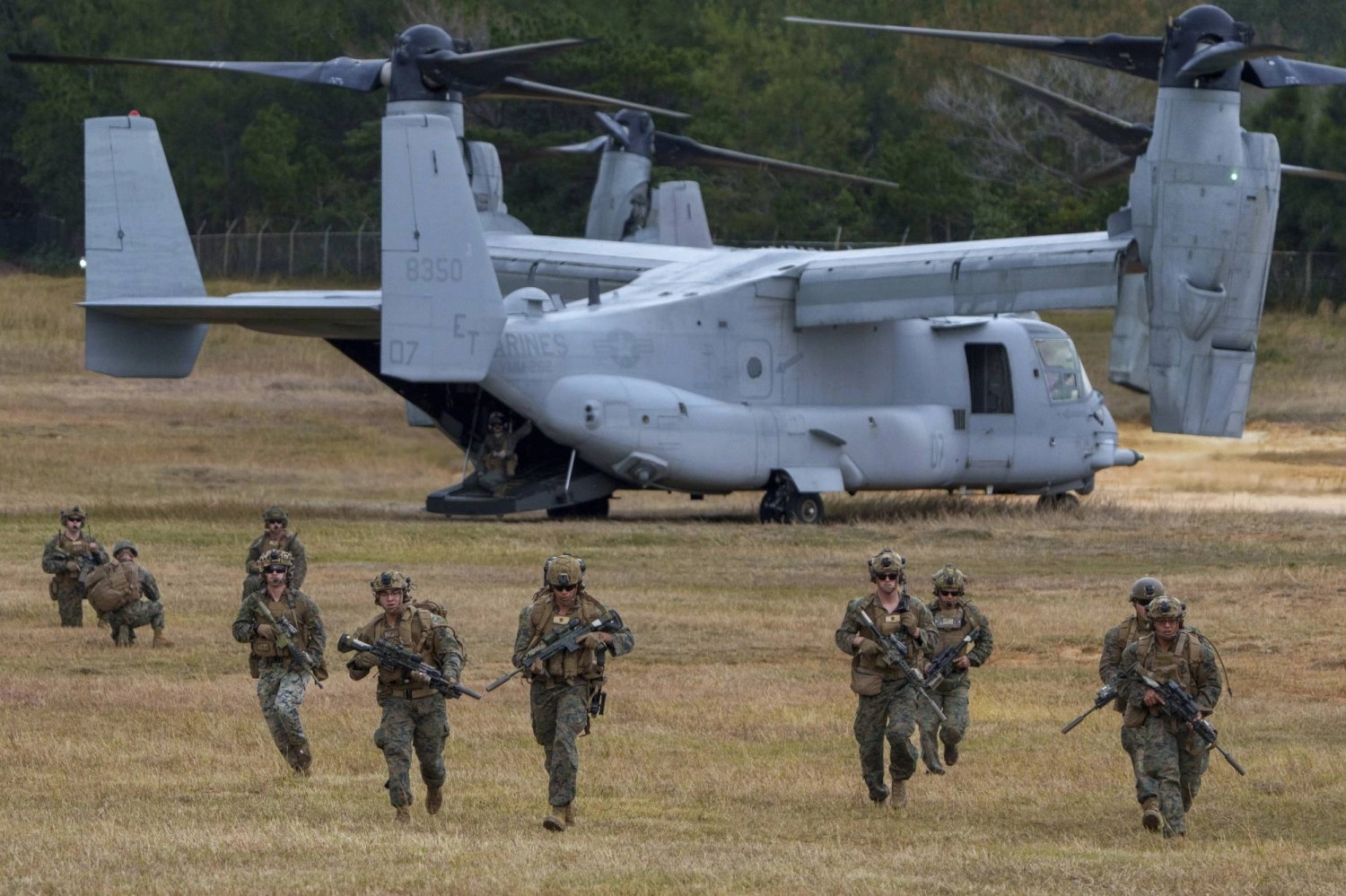
Furthermore, 3,500 members of the 31st Marine Expeditionary Unit (31st MEU) from Okinawa have boarded amphibious assault ships and are heading to the Arabian Sea, while the 18th Wing at Kadena Air Base is also participating in the operation.
These Deployments Violate the US–Japan Security Treaty
In Yokosuka, on March 1, 2026, the day after the attacks began, citizens held a protest standing in front of the base’s main gate and submitted a letter of protest to the commander of the US Navy in Japan. A similar protest was held on March 8, immediately after it became clear that the Yokosuka-based ship was participating in the attacks. Furthermore, silent standing protests by citizens have been held daily from March 9 to April 5, and three times a week thereafter, in front of the base’s main gate. According to the “NonNuclear Citizens’ Declaration Movement – Yokosuka,” a total of 658 citizens participated between March 9 and April 5.
What was striking about the standing protests was the surprisingly large number of positive reactions from US military personnel entering and exiting the gates by car, such as thumbs-ups and words of thanks from their open windows. This suggests that criticism of the attack on Iran is spreading even within the US military.
The US military launching an attack on Iran from Japanese bases, far beyond the “Far East,” violates even Article 6 of the Security Treaty, and the participation of US forces in Japan in combat without prior consultation violates the “Kishi-Harter Exchange of Notes” concerning the implementation of Article 6 of the Security Treaty. If we continue to uncritically allow such actions by the US military, it will mean that the Japanese people themselves will be on the side of the aggressor. It is unacceptable for the people living in Japanese society to become perpetrators of a war of aggression.
Published in Shiso-Undo News – May 2026