


Three developments stood out on Türkiye’s international agenda last week.
The first was President Recep Tayyip Erdoğan’s visit to Kazakhstan.
Another agenda was Foreign Minister Hakan Fidan’s interview with Al Jazeera where he made assessments regarding Iran.
And the other topic was the “normalization” between Türkiye and Armenia.
President Erdoğan in Kazakhstan
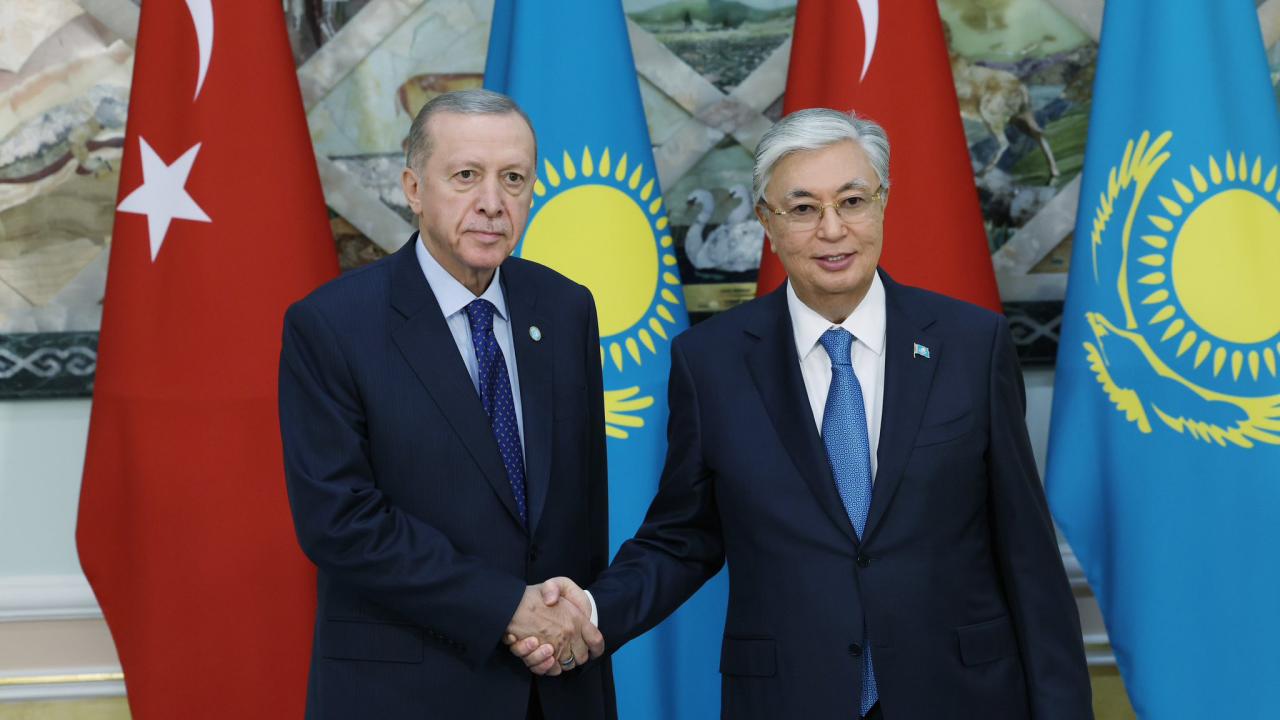
President Recep Tayyip Erdoğan paid a visit to Astana, the capital of Kazakhstan, on May 14, 2026.
During his visit, Erdoğan held a bilateral meeting with his Kazakh counterpart Kassym Jomart Tokayev at the Palace of Independence in Astana.
As part of the visit, the 6th meeting of the Türkiye-Kazakhstan High-Level Strategic Cooperation Council was held, co-chaired by President Erdoğan and President Tokayev.
Following the meetings between the delegations, Erdoğan and Tokayev signed “Declaration of Eternal Friendship and Partnership between the Republic of Türkiye and the Republic of Kazakhstan”. Also, 13 other agreements were signed between the two countries in a wide range of fields from defense and energy to trade and education.
Both leaders reaffirmed their goal of boosting the bilateral trade volume to 15 billion dollars.
Erdoğan also attended an informal summit of the Organization of Turkic States held in Astana as part of his visit. Here, he addressed the participants.
Emphasizing the importance of solidarity among Turkic states, Erdoğan stated:
“We are here today for a stronger future. The Turkic world holds the key not only to its own geography but to global peace and stability as well. By further strengthening our bonds of brotherhood, we must march confidently toward our common goals.”
Drawing attention to “global crises”, Erdoğan said:
“Today, while our world grapples with global uncertainties on one hand, it also presents new opportunities on the other. As Turkic states, we must strengthen our shared strategic vision and deepen our cooperation in every field, from trade and energy to defense and transportation, in this new era.”
Erdoğan added, “The crises in Palestine, Lebanon, Iran, Ukraine and many others indicate that we need to strengthen our defense and increase our cooperation in the industrial sector”.
Erdoğan emphasized that the “Middle Corridor” will continue to be a priority by saying: “As the crisis centered on the Strait of Hormuz shows today, transportation projects connecting the Turkic world, especially the Middle Corridor, will continue to be our priority for many years to come.”
On his flight back from Kazakhstan, Erdoğan made remarks to journalists regarding the international agenda.
Regarding the upcoming NATO Leaders Summit, which Türkiye is set to host on July 7–8, 2026, President Erdoğan noted:
“We expect important decisions to be made in Ankara regarding the future of the Alliance and the subsequent shaping of the global security architecture. Today’s world is not a continuation of the world from back when NATO was founded. A new world has been established, and NATO’s position in this new world is vastly different.”
Erdoğan also touched upon Türkiye-European Union relations. He stated the following regarding visa liberalization:
“We have made progress with the EU on visa liberalization. In particular, our recent performance in combating migrant smuggling and terrorism has led Europe to adopt a more constructive stance on this issue. If mutual trust is established, we can resolve this problem in a very short time.”
Foreign Minister’s assessment on Iran
Foreign Minister Hakan Fidan gave a comprehensive interview to Al Jazeera regarding international developments. Fidan’s remarks concerning Iran were worth attention.
Fidan emphasized that Türkiye has been making efforts to end the tension between Iran and the US, stating that Türkiye remains in contact with both sides.
Touching upon the crisis in the Strait of Hormuz, Fidan said: “The reopening of the Strait of Hormuz benefits the global economy, and its closure serves no one’s interest.” Fidan expressed his opposition to the use of force to reopen the Strait and called for diplomacy.
Indicating that the negotiations between the US and Iran have reached a critical point, Fidan said “Reaching an agreement requires flexible approaches and political will from both sides.”
Expressing Türkiye’s support to the negotiation process since the very beginning, Fidan added that Iran has not responded to US proposals as quickly as expected due to its own security sensitivities.
Regarding Israel, Fidan noted: “Regional states support a cessation of conflicts, but Israel is pursuing different objectives.”
He also warned that the war in Iran has diverted global public attention away from the Palestinian issue. Foreign Minister said that Israel is extensively violating the ceasefire in Gaza.
Making a call for regional solutions, Fidan stated: “Countries in the region must take responsibility for their own future and security. Solutions should not be expected from foreign powers. The region possesses vast resources and capabilities. When united, problems can be resolved.”
Türkiye-Armenia “normalization”
The normalization process initiated between Türkiye and Armenia continues to move forward.
The two countries are preparing to launch direct trade for the first time in 33 years.
According to a statement by the Turkish Ministry of Foreign Affairs, bureaucratic preparations regarding direct trade between the two countries have been completed. Ministry Spokesperson Öncü Keçeli stated that within the framework of the normalization process pursued between Türkiye and Armenia since 2022, “bureaucratic preparations for the initiation of direct trade were finalized as of May 11, 2026.” Keçeli also shared that the process concerning the opening of the land border is ongoing.
Under this new regulation, it has now become possible for goods that have been transported between Türkiye and Armenia via a third country, to explicitly state “Türkiye/Armenia” as the final destination or country of origin on customs documentation. This means that trade, which previously had to be done through third countries and required re-documentation, can now be done under direct trade status.
Armenia has also issued statements indicating that the process is continuing positively. Armenian Foreign Ministry Spokesperson Ani Badalyan welcomed the direct trade step, describing it as “an important move toward developing full-fledged and normal relations” between the two countries.
In early May, Turkish Vice President Cevdet Yılmaz traveled to Armenia to attend the 8th European Political Community Summit. Yılmaz’s visit marked the first time a high-level Turkish official has visited Armenia since 2008. Yılmaz had met with Armenian Prime Minister Nikol Pashinyan. In a statement following the meeting, Yılmaz remarked: “Progress is being made day by day in Azerbaijan-Armenia relations. Both sides are taking positive steps. The parallel efforts between Türkiye and Armenia are fostering a new atmosphere in the South Caucasus.”
Yılmaz also emphasized that Türkiye’s steps in its policy towards Armenia are being taken in close coordination with Azerbaijan.