


By Mehmet Enes Beşer
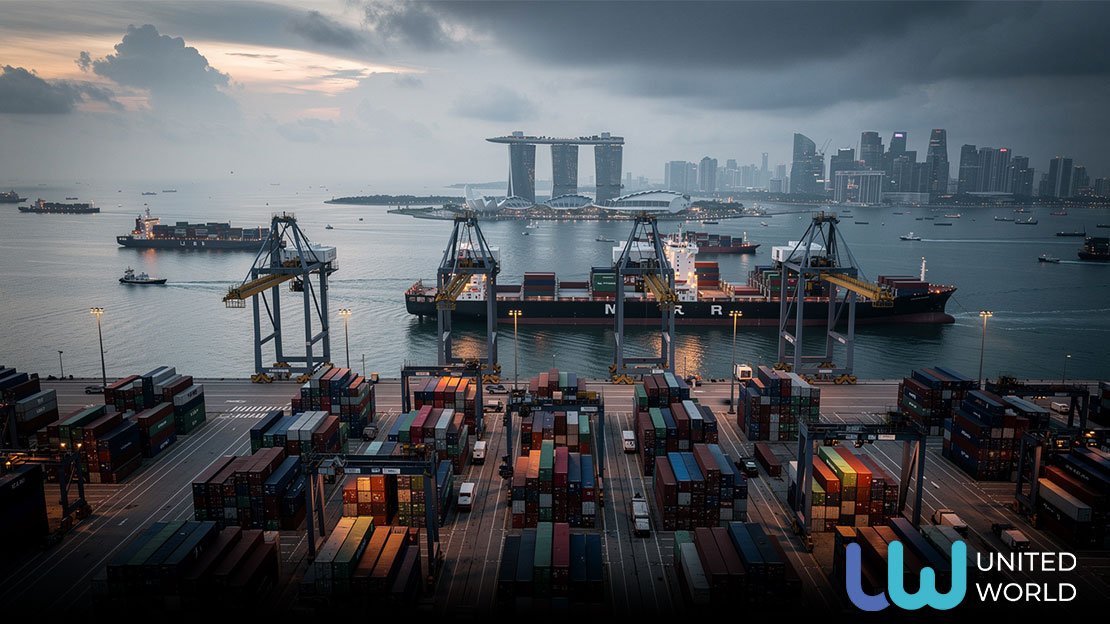
Singapore’s ascendancy as a maritime nation-state is perhaps one of the best instances of strategic foresight and anticipation in modern economic history. Through leveraging favorable geographical location, superior infrastructure, and strong governance, the city-state has established itself as a vital link in global supply chains, making use of its ports and other facilities. However, the international political situation, as well as competitive dynamics, is rapidly changing in ways that require Singapore to develop new strategic responses.
Singapore’s strength lies in its location at the southern tip of the Strait of Malacca, the route that 30% of global trade travels through. However, this strategic advantage alone no longer ensures the city-state’s supremacy. Ports like Malaysia’s Port Klang and Tanjung Pelepas, as well as ongoing investments into upgrading Indonesian ports, provide alternative destinations that promise lower rates and greater flexibility. The once clear-cut hierarchy of Asian ports is becoming more fluid and competitive.
One possible strategy for overcoming this competition would be the continued focus on innovation and capacity expansion in terms of the country’s ports. The construction of a mega-port called Tuas is currently underway and expected to complete in the late 2030s. This will result in the consolidation of Singapore’s container operations in a single mega-port capable of handling up to 65 million twenty-foot equivalent units (TEUs) per year (twice as much as now). This is made possible by advanced logistics based on automation and artificial intelligence.
However, Singapore’s ports will remain vulnerable without strategic foresight and planning beyond mere capacity enhancement. The maritime economy is rapidly changing both geopolitically and technologically. Increasing military tension in places like the Red Sea, South China Sea, and the Taiwan Strait is creating risks for shipping businesses when it comes to route selection and hubs choice. Singapore remains potentially vulnerable because of the possibility of the spill-over effect due to its proximity to major actors like the US and China that pursue different maritime strategies that threaten global trade flows.
Further complicating matters is the changing nature of global maritime shipping itself. The process of transitioning towards a decarbonized maritime economy through means like the implementation of the International Maritime Organization’s greenhouse gas strategy makes it necessary for countries like Singapore to make corresponding adaptations in their port infrastructure. In response to these pressures, Singapore made progress in developing a green bunkering hub that focuses on liquefied natural gas (LNG), ammonia, and hydrogen. Yet, relying on oil-based maritime services remains a weakness. Singapore will have to overcome many barriers, including technological limitations and changing labor relations, to realize a fully green shipping industry.
Increasingly complex and diverse security issues have added further to the list of challenges facing Singapore. The rise of cybercrime means that highly automated ports are more vulnerable to attacks than before. With Singapore taking full advantage of the concept of the smart port, its digital infrastructure must be resilient enough to withstand even systematic cyberattacks. An attack targeting this system can paralyze the operations of the whole of the port and spread to the entire maritime network of Singapore throughout the Indo-Pacific region.
Finally, changes in the very nature of global shipping may pose a threat to Singapore’s dominant position as a maritime port hub. The trend towards near shoring and regionalization of supply chains in the face of disruptions like the current geopolitical crisis, pandemics, and globalization fatigue will diminish the number of long-distance container traffic. If manufacturing processes gradually shift closer to their end markets in Asia, Latin America, and Africa, this may render megahub ports obsolete.
Under-exploited human capital may also pose a risk to Singapore’s port operations. Its maritime labor is currently some of the most competent and efficient in the world; however, the advent of automation and decarbonization makes a significant change in workforce skills inevitable. Therefore, ensuring adaptation of the local labor force may be just as important as capacity expansion and technology procurement.
Given these dynamics, it would be a mistake to focus on efficiency and sheer capacity growth. What Singapore should do instead is become flexible, capable of evolving its business models, and navigating complex geopolitical conditions. In this regard, the strategy that would allow Singapore to maintain its dominance includes increased cooperation with neighboring ports, transformation from a transshipment hub into a logistics center, and leading positions in innovation and sustainability.
Conclusion
It would be wrong to assume that Singapore can continue to benefit from its geographic and infrastructural advantages forever. The current processes that are shaping the global shipping economy call for a more sophisticated strategy that takes into account digitalization, decarbonization, geopolitics, and regionalization of shipping. In order to remain a global leader, Singapore should focus on being a system innovator, which implies taking a leading position both in volume and in resilience and sustainability.
To succeed in this effort, Singapore will need to conduct some far-reaching changes in its policy and engage in active regional diplomatic cooperation. These reforms, innovations, and investments are necessary to ensure Singapore can address the changing challenges of modern global shipping.