


By Tuğba Almışlar
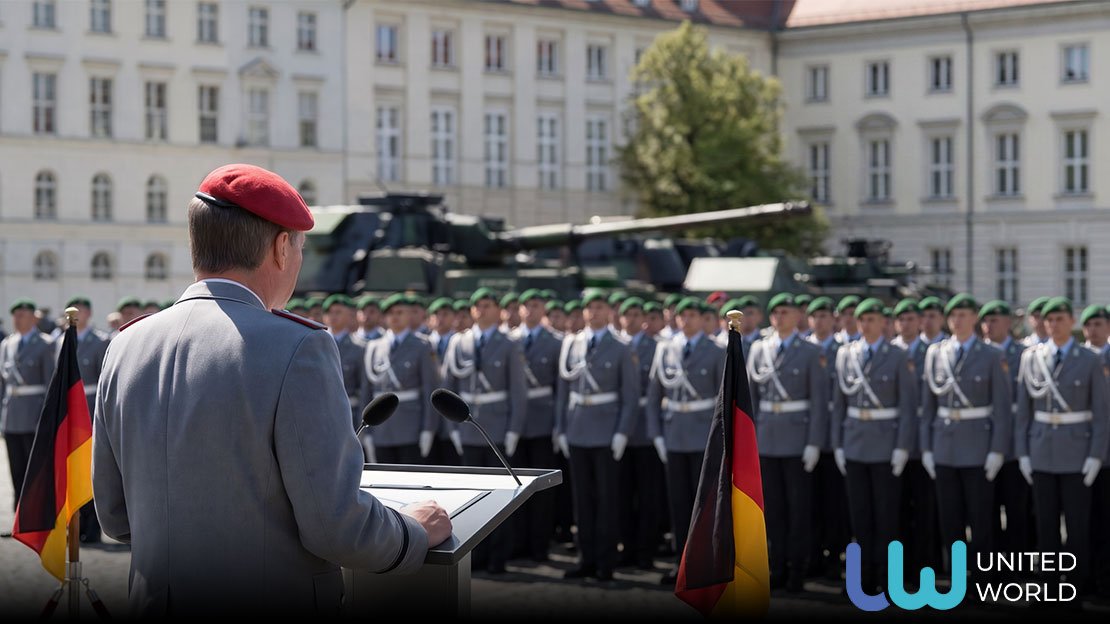
Location: Berlin’s Bendlerblock. Date: July 20, 2026. At an official ceremony of the German Armed Forces, young recruits took their oath in the presence of Defense Minister Boris Pistorius, Chief of Defence Carsten Breuer, and numerous political leaders.
The guest of honor was the writer, Navid Kermani. Taking the podium, Kermani issued a striking appeal to German soldiers: “If, in the future, a German government seeks to draw you into an unlawful war like the one waged by the US and Israel against Iran, it will be your duty to refuse the order.”
Kermani also criticized Chancellor Friedrich Merz over his approach to international law. But was all this simply part of the July 20 tradition, or was the German military signaling something deeper?
July 20, 1944 was the day Claus von Stauffenberg and a group of fellow German officers attempted to assassinate Hitler and overthrow the Nazi regime. The operation was directed from Berlin’s Bendlerblock, but ultimately failed.
Stauffenberg and several officers involved in the resistance were executed by firing squad there that same day.
After the war, the Bendlerblock became one of the foremost symbols of German military resistance to the Nazi regime. According to the German Armed Forces, that military resistance forms part of the Bundeswehr’s historical tradition, and this is why an oath-taking ceremony and commemoration are held at the Bendlerblock every July 20.
Kermani’s call for soldiers to say “no” when necessary is then no alien to the historical meaning of July 20. What set Kermani’s speech apart, however, was that he did not present this principle merely as a historical lesson drawn from the Nazi era, but he brought it directly into the Germany of today and linked it to the foreign policy of the current government.
Kermani’s message to the troops went well beyond the customary appeal to “remain loyal to the Constitution.” Harshly criticizing what he described as the selective application of international law in line with political interests, Kermani said: “The Federal Chancellor has made a habit of belittling international law where it suits him politically and of legitimizing violations of international law.”
He then brought the argument squarely into the present, issuing a warning to the soldiers: “If, in the future, a German government wants to send you into a war that is manifestly contrary to international law and politically disastrous, like the recent war waged by the US and Israel against Iran, it will be your duty to refuse the order.”
Kermani’s position on the Iran war is not new. In 2025, he had sharply criticized Merz for defending Israel’s attacks on Iran with the remark that “Israel is doing the dirty work for us”. In March 2026, Kermani described the US and Israeli attacks on Iran as violations of international law and accused the German government of showing disregard for international law.
Since Kermani’s views were already well known, why was nevertheless given the podium at such a symbolically charged ceremony? What did the German Armed Forces want to bring into public view by giving Kermani the podium?
The German Armed Forces also featured Kermani’s speech on their official website, highlighting what they called the “virtue of saying no.” The report stated that soldiers in a democratic army are expected to obey orders, but they must also learn “to say no and to resist” when a duty crosses the line into criminality. Particular emphasis was placed on Kermani’s statement: “The Constitution stands above every order.”
At this point, the issue is more than Kermani’s personal views. The German Armed Forces not only invited Kermani as guest of honor at one of their most symbolically important ceremonies, they also published his remarks without offering any distancing or critical commentary.
For that reason, the issue centers not only on what Navid Kermani said, but also on where he said it and in what setting. At one of the German Armed Forces’ most symbolic ceremonies, in the presence of senior political and military figures, young soldiers were reminded of an explicit boundary: not every order issued by the government is absolute. Where an order conflicts with the Constitution and international law, there is no more military obedience.