


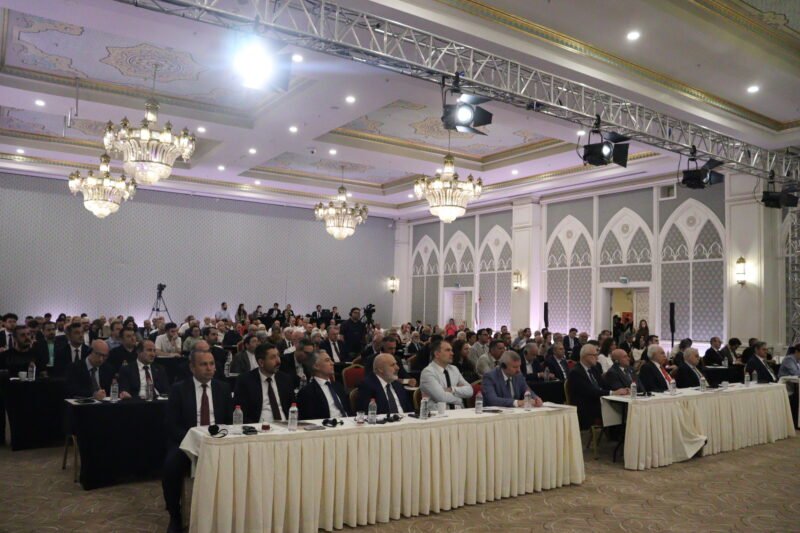
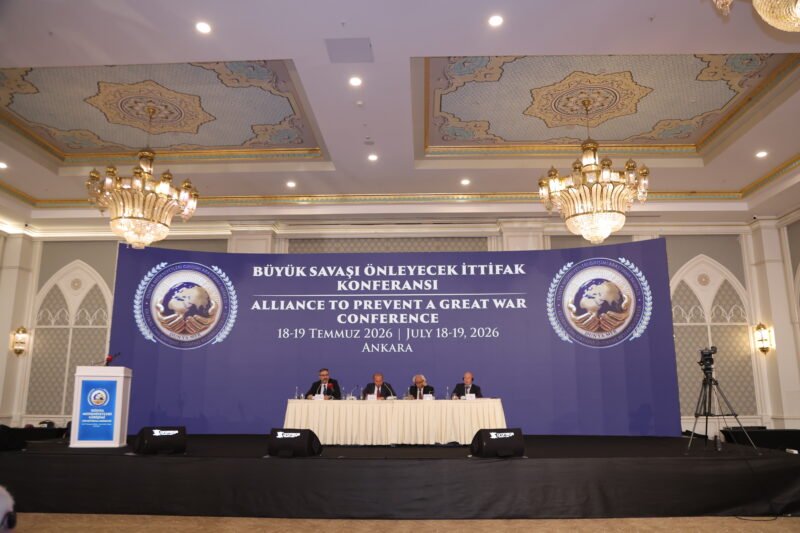
The international conference entitled “The Alliance to Prevent a Great War,” organized by the World Civilizations Initiative Research Center, was held at the Meyra Palace Hotel in Ankara on 18–19 July 2026.Mehmet Perinçek answered İsmet Özçelik’s questions on the conference in a broadcast by Radio Sputnik. Perinçek gave a detailed account of the main issues discussed at the conference.
“Türkiye could be at the center of an alliance to prevent a great war”
Perinçek argued that an alliance between Türkiye, Russia, China, and Iran would create a powerful deterrent against a global war. He said that, through such cooperation, Türkiye could strengthen its national security and economic independence while also helping to prevent a possible world war:
“To prevent a war, you have to frighten those intent on starting one. In other words, they must not dare. For this, the ‘TRCI Alliance’ must be formed.
“The Pentagon conducts war simulations regularly, and they show that the US loses a conventional war if China and Russia join forces. As seen in the last war, Iran has already stood up to them on its own.
“The Eastern Mediterranean, developments in Syria, the threat posed by Israel and the US; these are all immediate dangers to Türkiye. While securing its own national security, Türkiye could also devise a formula capable of preventing a wider war. This is one reason why this conference was important. The main objective was to develop solutions for Türkiye’s national independence, national security, and national economy; to forge international alliances capable of preventing a global war.”
Participants from the West
Perinçek said that the American and European participants at the conference regarded NATO as one of the principal sources of the danger of war and nuclear confrontation. He maintained that, in the event of a conflict between Türkiye and Israel, NATO would protect Israel. In his view, Trump’s remarks also showed that the US places Türkiye on “the other side”:
“The participants included representatives from Russia, Iran, African countries, South America, and Asia. Yet there was also substantial participation from the West.
“There were two figures from the US. One was a former CIA analyst; the other was a former military officer who had also served as one of the United Nations’ weapons inspectors. There was a highly prominent professor from Britain. The former commander of the German Navy, who held the post three years ago, was also present. We also had participants from Switzerland, Greece, France, and Spain.
“The Europeans and US Americans delivered the most forceful speeches. They all concluded that NATO is finished and that NATO itself is the danger. They said that NATO should dissolve itself and that, if it refuses to do so, the major powers must unite against it. They also said that Europe must free itself from US tutelage.
“They see the danger of war. They also see that those responsible for that danger are in the West, in the US. They see that there is a risk of nuclear war as long as the West continues to support the war in Ukraine.
“NATO sees Türkiye not as an ally”
“What is particularly interesting is that participants from the West expressed their support for the TRCI Alliance. The Americans and Europeans also issued warnings about the Turkish government’s policies. The participants from the US said: ‘We come from the most powerful country within NATO, and NATO cannot possibly have even the slightest positive intention toward Türkiye. They are lying to you.’ They are asking the same question we have always asked: If Israel attacks Türkiye, whom will NATO defend, Türkiye or Israel? Of course, Israel?
“Trump said something highly revealing on this matter. He appeared to be criticizing Netanyahu. He said that he had told Netanyahu: ‘If we turn Türkiye against us, they will enter the war on the opposing side.’ So he called a NATO member ‘the opposing side’, and a non-NATO country to be on ‘their side’”.
“All the wars in the world are interconnected”
Perinçek said that escalating tensions in different regions could gradually converge and develop into a broader conflict. He warned that the intensification of wars and the expansion of their geographical reach are increasing the danger of a nuclear war. He stressed that international solutions must be devised:
“In all the contested regions of the world, violence is scaling up. The war in Iran was said to be over, but it didn’t. The war in Ukraine is now in its fifth year. The Eastern Mediterranean has been a source of tension for some time. Every day, the opposing side draws up new plans targeting the sovereignty of the Turkish Republic of Northern Cyprus. When we look at the Aegean and Thrace, we see a large military buildup and the bases.
“We are living through a period in which tensions are rising rapidly, the wars already under way are becoming fiercer with the potential of spreading into new regions. Some disputes that have so far remained at the level of a cold war or prolonged confrontation may now be sliding toward open conflict. Further down the line, all these could begin to feed into one another.
Today’s world bears the risk of new conflicts. The more these conflicts multiply, intensify, and widen geographically, the greater the risk of a world war and of a nuclear war. With that catastrophe and immense suffering now looming before us, we must develop ways to prevent it. That is the main reason we held this conference and why it was under the title ‘The Alliance to Prevent a Great War.’”