


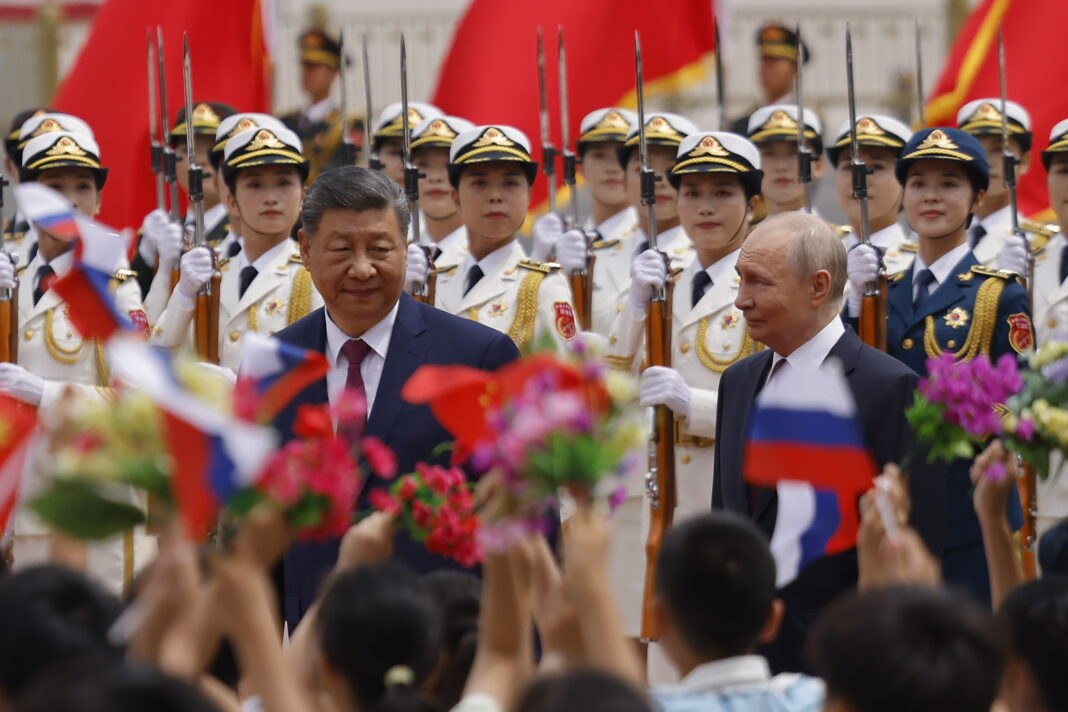
Russian President Vladimir Putin visited China on May 19-20 and held important meetings with Chinese officials, including his Chinese counterpart, Xi Jinping.
UWI writer and political scientist Dr. Onur Sinan Güzaltan evaluated Russian President Putin’s visit.
How would you generally assess the outcomes of Russian President Vladimir Putin’s visit to China and his meeting with Xi Jinping?
They held a historic meeting. Of particular importance is the fact that the two leaders emphasized their commitment to multipolarity in a joint statement. In doing so, they have once again declared that they do not accept the unipolar hegemony of the United States. Of course, we will see the results of this strategy more clearly in the coming period on various fronts, primarily in Ukraine and Iran.
Aside from the emphasis on multipolarity, the outcomes and key points can be summarized under several headings:
The emphasis on energy was significant. In the coming period, we can expect the two countries to develop joint strategies not only on mutual energy exchange but also on issues such as the Strait of Hormuz.
Apart from trade and technology, one notable heading was education. On the subject of education, this is one of the biggest indicators that the two countries are preparing for long-term cooperation. Indeed, the fact that Chinese has recently become almost fashionable in Russia, especially in Moscow, shows that this new trend has a concrete counterpart.
Another important heading is trade in local currencies… In parallel with multipolarity, the message of the dedollarization effort and strategy through local currencies was also given. To summarize briefly, this meeting was a declaration that Russia and China are moving towards a common strategy, at least on fundamental points, on a global scale, beyond their bilateral relations.
How is Putin’s visit being talked about in Russia? Especially coming right after Trump’s visit to China, how is Putin’s visit being perceived?
Well, because Putin is arriving right after Trump’s trip, people are naturally looking at it as some sort of direct response to Trump. But these visits were decided way ahead of time. Moscow actually announced Putin’s visit back in February. Washington announced Trump’s China visit in March. So, these visits weren’t some last-minute calendar shuffle.
Now, when you look at Russia-China relations, we are talking about a massive, deeply strategic partnership that spans many different fields. Recently, with the Western sanctions on Russia and trying to corner China, we’ve seen deepening ties especially in energy feeling. In a way, the US and Europe pursued a wrong strategy, and they ended up pushing these two giant countries to each other.
Because of those sanctions, market and consumer habits in Russia have totally shifted. Western left, and to give you a visible example: in the streets of Moscow today, Chinese cars have almost entirely replaced Western ones. There is also a growing interest in Chinese culture across Russia right now. Chinese language education is becoming widely adopted as a second language in schools.
The emphasis on education made during the meeting also points to this fact.
“Russia and China are increasingly converging with one another in terms of global strategy as well”
To what extent does this deepening Russia-China relationship alter the global balance of power?
As I said, pushing Russia and China into deepening their bilateral ties was a strategic fault by the West. If you look back at old Western strategists, Henry Kissinger for example, they constantly warned that a unified Russia and China would be the ultimate nightmare for the US and the West. Historically, Western policy was always about driving a wedge between Moscow and Beijing. But recently, by launching economic, military, and diplomatic offensives against both countries, they have effectively forced these two giants together.
Remember back in March 2023, when Xi Jinping visited the Kremlin, as he was saying goodbye to Putin at the door, he told him, “Right now there are changes—the likes of which we haven’t seen for 100 years—and we are the ones driving these changes together.” Chinese diplomacy doesn’t usually use such bold statements.
Also, in Trump’s recent visit to Beijing, it was clear that China was implicitly calling on the American side to accept this new multipolar reality. You can see this in the subtext of the statements.
It is now clear that Russia and China are increasingly converging with one another in terms of global strategy as well. At this point, it is worth emphasizing once again the multipolarity declaration jointly issued by the two countries.
This is more than a simple declaration; it is a call for a new global order, and it will certainly have concrete consequences.
In the coming period, the United States may resort to new provocations in order to break this will and maintain its unipolar order.
On the other hand, Russia and China will make moves both to deepen the rift between the United States and Europe and to hold and even advance their positions on the Ukrainian and Iranian fronts. It is clear that Russia, and ultimately China, would pay a heavy price if they were to back away from the claim of multipolarity – that is, from the claim of a new order. Therefore, they will persist in maintaining this course.
We are talking about the transformation of 500 years of Western hegemony… Of course, it will not be an easy process.
Trump’s visit didn’t produce any concrete agreements or concrete results. On the other hand, Russia and China signed more than 40 agreements. Looking at these two meetings from this perspective, what do you see?
Russia and China have strategic cooperation. But when it comes to the US and China, we are talking about two countries on opposite sides of the confrontation and fierce rivalry. So, comparing the US-China relations to the Russia-China relations isn’t really accurate. Russia and China endorse a multipolar world, whereas the US rejects it.
If you look at the delegation travelled to China with Putin, it is mostly economic and energy officials. This shows that the growing trend in their bilateral trade is going to keep accelerating in the coming period. It also tells us that they aren’t just discussing the political side of multipolarity, but also the economical.
Is a new phase in the war possible? In the days before Putin’s visit, there was another important news. Kyiv deployed military reinforcements to the Belarus border, and in response, Russia and Belarus launched joint nuclear exercises…
The Western provocations through Ukraine are continuing. Recently, there were drone strikes targeting Moscow. It’s clear that a certain faction within the West and the US is determined to keep this war alive. Their strategy is to use this war to keep Russia distracted and weakened, and they are using the Kyiv administration as a tool to achieve that.
When it comes to Kyiv military deployment on the Belarusian border, we might see new provocations there. These could be aimed at bringing NATO and Russia into a direct confrontation. In fact, it looks highly likely that Western provocations targeting both Russia and Iran will escalate in the period ahead. There is a possibility that the war could transition into a new phase on both the Iranian and Russian fronts. The developments indicate that the war between Western hegemony and the forces in favor of multipolarity will intensify.
Cuba’s importance
Do you think we might see fronts opening up? Lately, Cuba has been in the news a lot. A recent report by Axios in the US claimed that Cuba has acquired 300 drones, and that Russia and China were behind it…
Cuba is important both strategically and symbolically. Right next to the US, it has survived as a socialist state for decades and has never bowed down to American hegemony. We’ve already seen Washington’s increasing pressure on Latin America in the case of Venezuela. They unlawfully abducted the Venezuelan president and his wife, and they are now overtly intervening in Venezuela’s internal affairs. We also see some back-and-forth and even concessions from the Venezuelan leadership.
Furthermore, US Secretary of State Rubio actually comes from a family that fled the Cuban revolution, a family of revolution fugitives. He holds a personal vendetta against the Cuban government. Right now, the US is trying to squeeze Cuba even harder through embargoes and so.
Russia and China would stand behind the Cuban administration in a certain manner. When you look at the global dynamics as a whole, there is a conflict playing out across multiple fronts. From the center of Eurasia to Western Asia and Africa, there are so many flashpoints, and Latin America is definitely one of them. All these developments will play out in a somewhat interconnected way. Of course, we shouldn’t downplay the resilience and struggle that the Cuban state and its people have maintained to this day, but Cuba’s fate is closely tied to the fate of all these singular fronts of the global confrontation.