


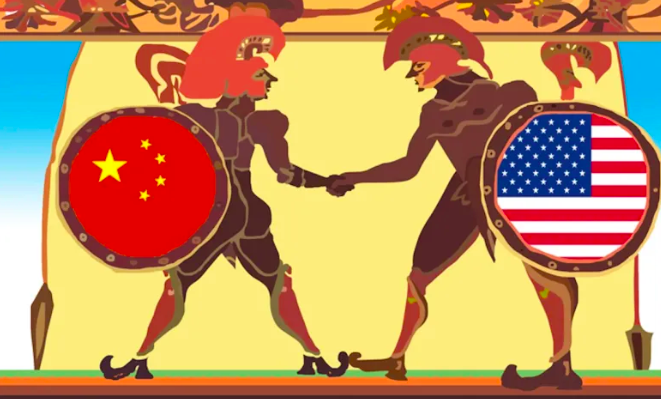
Chinese President Xi Jinping’s reference to the “Thucydides Trap” during US President Donald Trump’s latest visit to China reverberated across the world. The concept quickly attracted wide attention, with a wave of explanations and commentary. Yet this was not the first time Xi had spoken of the “Thucydides Trap”; he had used it many times before in his speeches and writings.
Named after the ancient Greek historian Thucydides (460-400 BC), the concept refers to the challenge posed by a rising power to an established dominant power, often ending in war. Thucydides, who chronicled the wars between Sparta and Athens in the 5th century BC in his History of the Peloponnesian War, is known for his impartial account, reliance on reliable evidence, his cause-and-effect analysis and excluding divine intervention from his explanation of historical events.
Thucydides famously wrote that “the rise of Athens and the fear that this instilled in Sparta made war inevitable.” In modern times, it was political scientist Graham Allison who popularized the “Thucydides Trap”. In his book Destined for War: Can America and China Escape Thucydides’s Trap?, first published in 2012, Allison used the term to describe how rivalry between hegemonic powers and rising powers has often ended in war throughout history.
Xi Jinping uses the concept by stressing that the US should not fear China’s rise, China does not wish to fall into the trap of war. At the same time, Xi warns that if China’s red lines are crossed, Beijing will also be prepared to risk war.
“War is not inevitable”
Xi has referred to this concept regularly since 2013, especially in the context of China-US relations. His central argument is that the rivalry between China’s rise and the US’ existing hegemonic position does not have to automatically lead to war. In other words, the head of state of the rising power, China, rejects the idea that the rising power–established power conflict model popularized by Graham Allison is inevitable.
Xi first used the concept in 2013 during a meeting with then US President Barack Obama. In the same year, in a speech addressed to Western investors, he said: “We must all work together to avoid the Thucydides Trap.” This statement was later frequently repeated in analyses in the Chinese media.
The most visible global reference to the concept came in September 2015, during Xi’s speech in Seattle. “There is no such thing as the so-called Thucydides Trap in the world,” Xi said. “But if major countries again and again make the mistakes of strategic miscalculation, they might create such traps for themselves.” In the same speech, Xi also defended the idea of a “new type of major-country relations.”
2017 speech at the United Nations
And on January 18, 2017, in his speech at the United Nations Office in Geneva, Xi was saying:
“The Swiss writer and Nobel laureate Hermann Hesse stressed the importance of serving “not war and destruction but peace and reconciliation”. Countries should foster partnerships based on dialogue, non-confrontation and non-alliance. Major powers should respect each other’s core interests and major concerns, keep their differences under control and build a new model of relations featuring non-conflict, non-confrontation, mutual respect and win-win cooperation. As long as we maintain communication and treat each other with sincerity, the “Thucydides trap” can be avoided. Big countries should treat smaller ones as equals instead of acting as a hegemon imposing their will on others. No country should open the Pandora’s box by willfully waging wars or undermining the international rule of law. Nuclear weapons, the Sword of Damocles that hangs over mankind, should be completely prohibited and thoroughly destroyed over time to make the world free of nuclear weapons. Guided by the principle of peace, sovereignty, inclusiveness and shared governance, we should turn the deep sea, the polar regions, the outer space and the Internet into new frontiers for cooperation rather than a wrestling ground for competition.”
Firm warning on Taiwan
As can be seen, there is an important nuance in Xi’s use of the concept. Unlike Graham Allison, Xi does not present the “Thucydides Trap” as a theory of structural war risk. Instead, he speaks of it as a historical mistake that must be avoided.
This formulation is repeatedly reflected in the statements of China’s Ministry of Foreign Affairs and the Communist Party of China as the message that “the US should not fear China’s rise and should avoid war.”
Xi Jinping’s reference to the concept during Trump’s latest visit to China isn’t new, it has been a diplomatic line for more than a decade.
When it comes to Taiwan, however, Xi uses the same concept as a sharper warning. He makes clear that a Taiwan crisis mismanaged by the US could drag the two powers into direct confrontation.
Cover image: Li Shigong / Beijing Review